About Argemone polyanthemos (Fedde) G.B.Ownbey
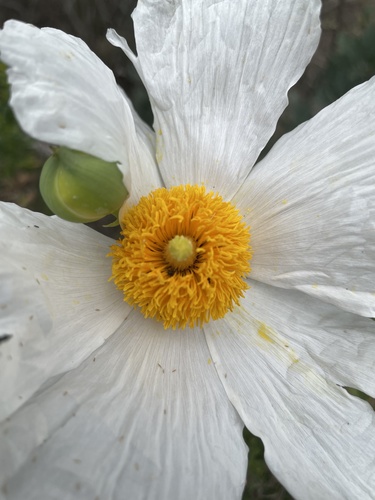
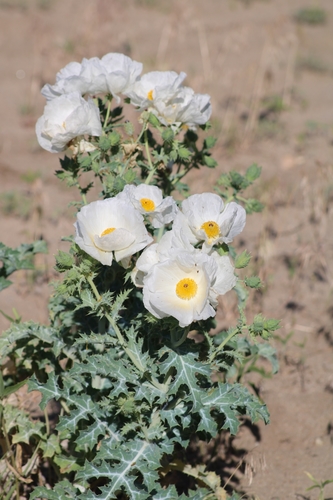
A key distinguishing feature of Argemone polyanthemos is that it lacks prickles on its upper leaf surfaces; like all species in the Argemone genus, it does have many prickles on its stems and leaf margins. Individual plants vary in height: they most often grow up to 1 meter, though exceptional specimens can reach 1.2 meters tall. Its deeply lobed leaves grow up to 20 centimeters long, and both leaves and stems are pale blue-green in color. Its flowers, which measure 7 to 10 centimeters across, bloom from late spring through summer. Each flower has 4 to 6 very thin, translucent white petals that flutter in wind, and a dense central cluster of yellow stamens. By late summer, the plant produces sparsely prickly seed capsules that hold small black seeds. When stems are broken or nicked, they release thick orange-yellow sap. It grows a large taproot to access water in freely draining soils. All parts of this plant are poisonous. Thanks to its prickly defenses and the acrid taste caused by its toxins, grazing animals generally avoid eating it. This causes it to become more abundant relative to other plant species in grazed areas. Argemone polyanthemos is not a long-lived species. Some individuals bloom during their first year of growth, but most bloom heavily in their second year, then die. Occasionally, when sufficient moisture is available, a plant will produce new underground buds and sprout again. This species grows in areas with dry soil, ranging from Texas northward to North Dakota and as far west as Washington State. Its natural range is primarily east of the Rocky Mountains, in shortgrass and mixed grass prairies, and it has spread or been introduced into areas adjacent to this native range.