About Argemone albiflora Hornem.
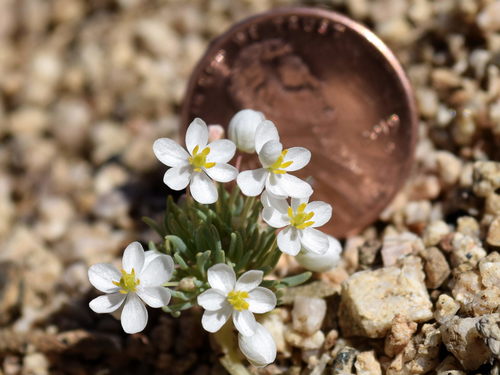
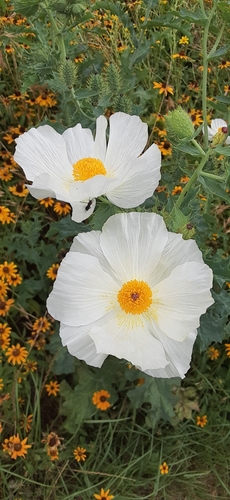
Argemone albiflora Hornem. is an erect, prickly, deep-rooted plant that produces white flowers containing many yellow and red stamens. Its flowers grow either singly or in loose clusters (cymes) at the top of the plant. This species has grayish-green, lanceolate to ovate leaves that measure 2 to 10 inches long. Lower leaves are lobed all the way to the midrib, while upper leaves have shallower lobing. The upper leaf surface is smooth with a few prickles along the midrib, and the lower leaf surface is spiny along the midrib and main vein. The distribution of Argemone albiflora ranges from east Texas to northern Arkansas and southern Missouri. It is also native to the High Desert of Southern California, including areas like Twentynine Palms. White prickly poppy, the common name for this species, grows as an annual or biennial plant that often forms colonies in sandy or gravelly soils. It is commonly found along fences, roadsides, and railroad tracks, on hills and slopes, and in overgrazed pastures. Cattle and many other animals in the southern Midwest usually avoid this plant, because it is very prickly and has limited nutritional value. The seeds are the most nutritious part of the plant, and they have a high oil content that makes them a food source for quails and doves. Each flower produces a large number of seeds, so the seeds are a reliable food source for these birds. White prickly poppy exudes a yellow latex that was used by Native Americans to treat many different ailments. Aztec priests used the plant in sacrificial rituals, and the Comanche people held the plant in high regard, making offerings to it during harvesting. The Comanche used the latex to remove warts, treat cold sores, and address other skin problems. A concoction made from the flower can be used to treat congestion caused by colds or flu. The seeds can be used as an emetic to induce vomiting, as a laxative, or as a mild sedative. The whole plant can be used to treat bladder infections, prostate pain, and the throbbing pain of migraines. A wash made from the plant’s tea can be used to help heal sunburns or scraped skin. The plant is also smoked during some important ceremonies to produce a euphoric and mild sedating effect. If not used properly, this plant can be very toxic.