About Arctotheca populifolia (P.J.Bergius) Norl.
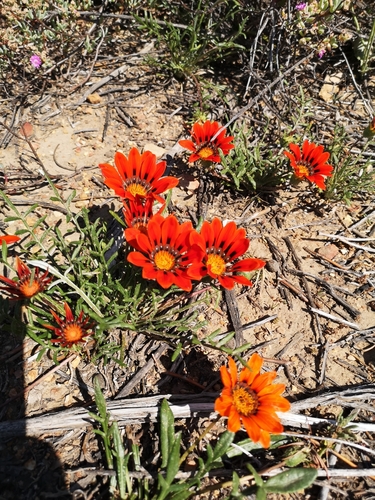
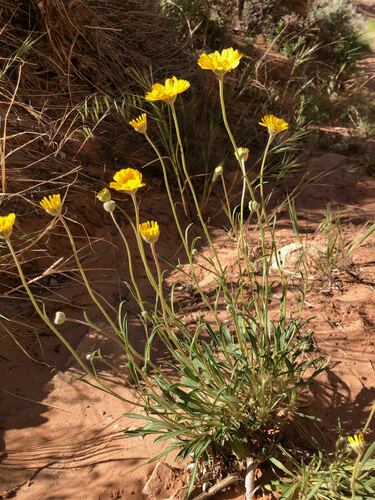
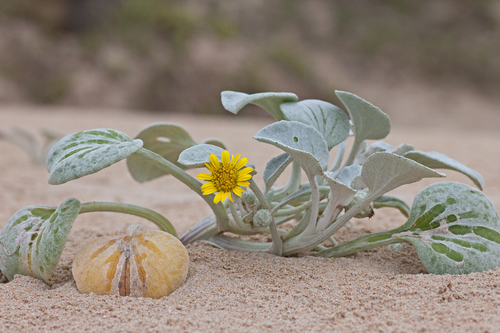
Arctotheca populifolia (P.J.Bergius) Norl. is a perennial herb that grows in clumps up to 30 centimeters tall, with thick, ribbed, decumbent stems. Its foliage is woolly, gray, and fleshy. Its white-haired leaves have oval blades that can reach 6 centimeters long and 5 centimeters wide, with smooth or toothed edges. The inflorescence grows on a woolly, erect stalk (peduncle) up to 11 centimeters tall. The flower head measures around 2 centimeters wide, with yellow ray florets 5 to 7 millimeters long and yellow disc florets at its center. The fruit is a white-woolly cypsela roughly half a centimeter long. In ecology, this species is a pioneer plant of sandy coastal habitats like dunes. In its native South Africa, it is a key contributor to the formation of dune hummocks, which form when wind deposits sand around this and other newly established beach plants. A small type of dune hummock is called a nabkha; Arctotheca populifolia and its associate Gazania rigens form nabkhas that are inhabited by a range of small animals including nematodes and the sand flea Talorchestia capensis. The species can colonize bare sand, which allowed it to establish on the Australian coastline. It was planted for beach stabilization in Western Australia until it was identified as invasive, and native Spinifex grasses are now used for this purpose instead. Now classified as a coastal weed across much of temperate Australia, it can also grow on basaltic soils, letting it spread inland from beaches to grasslands. The plant's seeds are dispersed by wind, but they also commonly disperse via water because they remain viable in both fresh and salt water; as a coastal species, its seeds are carried by ocean currents. Seeds can also be transported in soil and plant waste. As an invasive species, it competes with native plants including the hairy spinifex Spinifex sericeus. It binds sand more effectively, holding more sand in place and altering the topography of dune systems. This alteration can disrupt the flow of seawater into and out of coastal lakes. Even seedlings only one centimeter tall can accumulate sand and build tiny individual dunes. Many shorebirds nest on bare sand beaches to better spot predators, so the buildup of vegetation and uneven hilly dunes from this plant disrupts their nesting activity. The flowers are pollinated by bees and flies. The plant acts as a host for the arbuscular mycorrhizal fungus Septoglomus fuscum. Its seeds are a preferred food of the African hairy-footed gerbil Gerbillurus paeba, which also eats the sand flea T. capensis that lives in dunes surrounding the plant.