About Arctotheca calendula (L.) Levyns
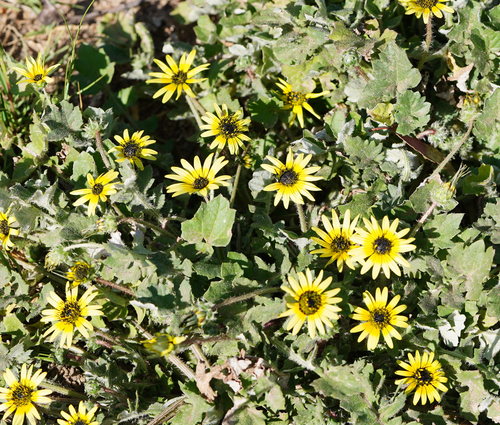
Arctotheca calendula (L.) Levyns is a low-growing perennial or annual herb that forms rosettes, produces stolons, and can spread rapidly across the ground. Its leaves are covered in white woolly hairs, particularly on the undersides; they are lobed or deeply toothed, arranged in a basal rosette and also distributed along stems, and are divided into a petiole and leaf blade. Leaf blades measure 5 to 25 centimeters long and 2 to 5 centimeters wide: the uppermost leaves are nearly simple and obovate, while lower leaves are pinnately lobed to lyre-shaped. The upper leaf surface is finely covered in cobweb-like hairs, and the lower surface is densely covered in white, tomentose or woolly hairs. The generic name Arctotheca comes from the Greek words arktos, meaning 'a bear', and theke, translated as 'a capsule' or 'a case'; this name refers to the heavily fuzzy fruits of the plant. The specific epithet calendula refers to the species' resemblance to the European genus Calendula. The name Calendula means 'little calendar', derived from the Greek word kalendae meaning 'the first day of the month', and this may refer to Arctotheca calendula's long flowering span. Arctotheca calendula is native to southern Africa, occurring in Lesotho and the South African provinces of KwaZulu-Natal, Eastern Cape, Northern Cape and Western Cape. It grows well in Namaqualand, the Karoo, and as far south as the Cape Peninsula, where it is found in coastal areas on ruderal sandy soils, along roadsides, on old farmland, and at disturbed sites. It has become naturalized in California, Spain, Portugal, Italy, Australia, New Zealand, and Chile, and is classified as a noxious weed in some of these regions. It is cultivated as an attractive ornamental groundcover, but has invasive potential when introduced to new areas. It grows best in full sun, is hardy to moderate frost, and can reproduce either vegetatively or from seed. Seed-producing populations are most likely to become weedy, and establish most easily in bare, sparsely vegetated, or disturbed soil.