About Arctostaphylos uva-ursi (L.) Spreng.
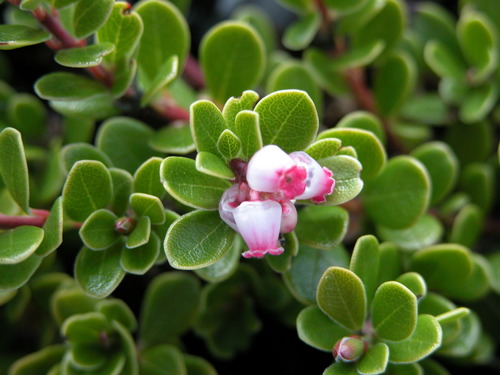
Arctostaphylos uva-ursi is a small, low-lying woody groundcover shrub that reaches 5–30 centimetres (2–12 inches) in height. Dense wild stands of this species rarely grow taller than 15 cm (6 in). Erect branching twigs grow from long flexible prostrate stems, which develop from single roots. The trailing stems layer naturally, producing small roots at regular intervals. Young finely textured velvety branches are white to pale green, and become smooth and red-brown as they mature. The small, solitary, three-scaled buds are dark brown.
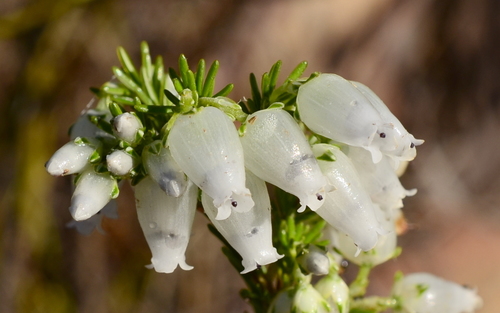
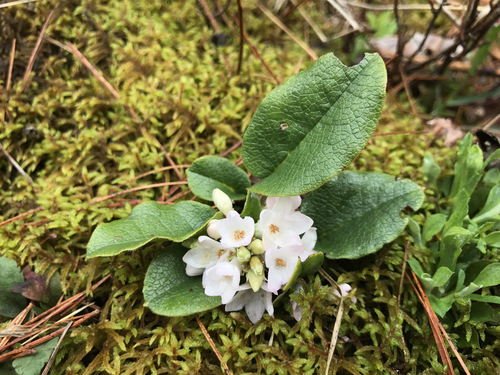
The leaves are small, shiny, thick, and stiff, measuring approximately 4 cm (1+1⁄2 in) long and 1 cm (1⁄2 in) wide. The upper surface of the leaf is darker green than the underside. Leaves have rounded tips that taper toward the base, arranged alternately on stems and held vertically by a twisted leaf stalk. Leaves stay green on the plant for 1–3 years, then turn reddish-green or purple (pale on the underside) and fall in autumn. Terminal clusters of small urn-shaped flowers bloom from May to June, and the flowers range from white to pink.
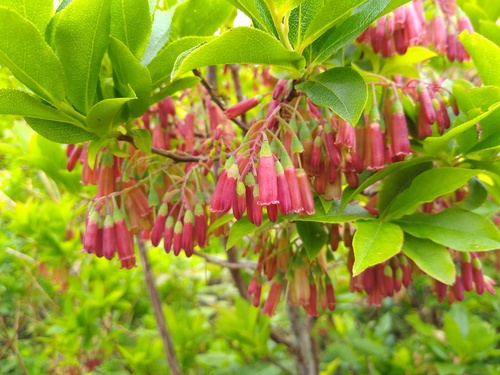
After flowering, the plant produces round, fleshy or mealy drupes (fruits) that are bright red to pink. The smooth, glossy-skinned fruits are 6 to 13 mm (1⁄4 to 1⁄2 inch) in diameter. Red fruits stay on the plant into early winter. Raw fruits have a bittersweet flavor, which becomes sweeter after boiling and drying. Each drupe holds 1 to 5 hard seeds. Seeds require scarification and stratification before germination to reduce the seed coat and break embryo dormancy, with an average of 40,900 cleaned seeds per pound.
Arctostaphylos uva-ursi has a circumpolar distribution, and is widespread across northern latitudes. Further south, it is only found at high altitudes. In Europe, it ranges from Iceland and the North Cape of Norway, south to Sierra Nevada in southern Spain, the Apennines in central Italy, and the Pindus mountains in northern Greece. In Asia, it grows from arctic Siberia south to Turkey, the Caucasus, the Levant, and the Himalaya. In North America, it occurs from arctic Alaska, Canada, and Greenland, south to California (the north coast, central High Sierra Nevada above Convict Lake in Mono County, the Central Coast, and the San Francisco Bay Area), New Mexico in the Rocky Mountains, and the Appalachian Mountains in the northeastern United States. It is common across all regions of British Columbia and Alberta.
This species is fire-tolerant, and may act as a seedbanking species. It serves as an alternate host for spruce broom rust, and bears and other animals eat its berries.
One review has found that ingesting large doses of this plant can cause allergic reactions, alongside nausea and seizures that can present a potential emergency. Preliminary research suggests arbutin may be toxic when consumed in high doses. Uva ursi may cause adverse effects for people with liver or kidney disease, and for pregnant or breastfeeding women. The leaves of this plant contain arbutin, which metabolizes into hydroquinone, a potential liver toxin.
Members of the Blackfeet Nation use both the fruits and leaves of this plant as food. While the fruits are edible raw, they are fairly bland in this state, but can be made into jelly. Historically, the berries were used as seasoning and cooked with meat. Young leaves can be brewed into tea. For centuries, First Nations traditional medicine has used leaf teas and extracts of this plant as urinary tract antiseptics, diuretics, and laxatives. In modern herbalism, leaf tea is used to treat urinary tract inflammation. Though it has been considered an astringent and a potential cure for sexually transmitted diseases, as of 2017 there was no high-quality clinical research evidence that these treatments are effective or safe.
Dried bearberry leaves are the main ingredient in many traditional North American Indigenous smoking mixtures, collectively called kinnikinnick (Algonquin for "smoking mixture"), which are commonly used by western First Nations groups, and often blended with other herbs and sometimes tobacco. Indigenous peoples also used this plant to produce yellow dye. Several cultivars of Arctostaphylos uva-ursi are propagated to use as ornamental plants. It is an attractive evergreen groundcover that stays green year-round for gardens, and helps control erosion on hillsides and slopes thanks to its deep roots. It tolerates sun and dry soils, so it is a common groundcover choice for urban areas, naturalized areas, native plant gardens, and rock gardens. Because seeds are difficult to germinate, the plant is most often propagated using rooted stems.