About Arctostaphylos rubra (Rehder & E.H.Wilson) Fernald
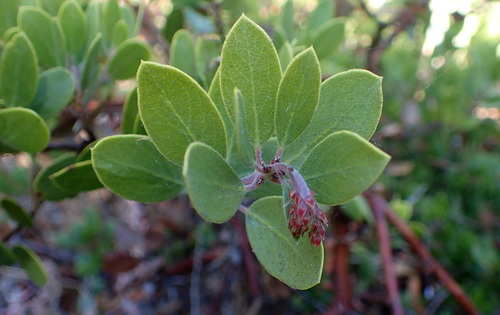
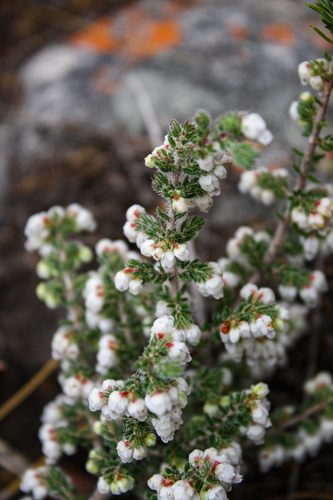
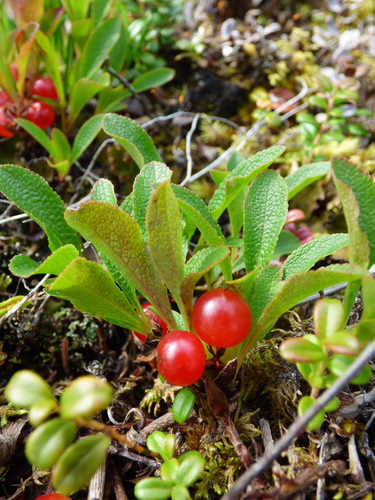
Arctostaphylos rubra (Rehder & E.H.Wilson) Fernald is a low, spreading shrub that reaches up to 15 centimetres (5.9 inches) in height. Its leaves are 2 to 6 centimetres (0.79 to 2.36 inches) long and marcescent, meaning they stay attached to the shrub after they die. The inflorescence is a hairy, glandular raceme that holds up to 6 flowers, each measuring about half a centimeter long. It produces a drupe as fruit. The plant reproduces both by seed and by sprouting from stolons and underground rhizomes. This shrub occurs within many plant communities in Arctic and alpine climates, growing in subalpine forests and tundra. It is a common component of forest ecosystems dominated by spruces, including white spruce and black spruce. It may act as a dominant species in several habitat types, such as balsam poplar (Populus balsamifera ssp. balsamifera) floodplains and tundra shrublands in Alaska. In Jasper National Park, it is dominant or co-dominant alongside Engelmann spruce (Picea engelmannii) and cup lichen (Cladonia cariosa and C. pyxidata); in the Mackenzie Delta it is dominant or co-dominant with white spruce and mountain alder (Alnus viridis ssp. crispa); and along the Alaska Highway in Yukon it is dominant or co-dominant with white spruce. At lower latitudes, the plant grows at higher elevations, especially near the timberline. Research indicates its maximum latitude and elevation is increasing due to climate change. It has one disjunct population in Wyoming, which is its only known population in the contiguous Lower 48 United States. This shrub grows on low-nutrient soils in cold regions, most often soils that overlie permafrost. It is most commonly found in moist areas, including the shores of lakes and bays, riverbanks, bogs, and wet forest floors. It often acts as a pioneer species during the primary phase of ecological succession, colonizing areas cleared of vegetation such as floodplains, bare tundra, cleared openings in taiga, and newly formed dunes. It also grows along the scoured edges of receding glaciers and in old bulldozer tracks. Clearing disturbances including floods, oil spills, and wildfire can increase the species' local abundance. Many animals feed on its fruits: mammals such as polar bears and other bears, red-backed voles, western heather voles, Dall's sheep, and sometimes caribou and hoary marmots eat the fruit, and it is also a food source for birds such as ravens. This species works well for revegetation projects on wet, disturbed habitat in subalpine and boreal regions. Its fruit is edible for humans, though it is not a popular food. It has been used by the Gwich'in people and the Inuit.