About Arctostaphylos glauca Lindl.
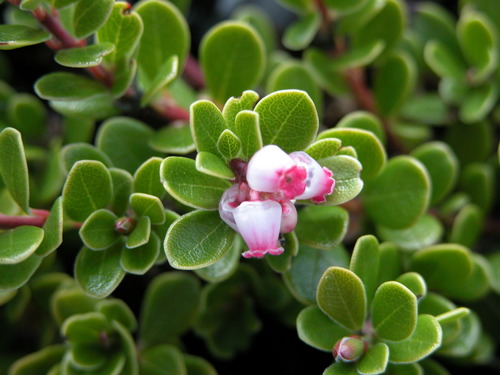
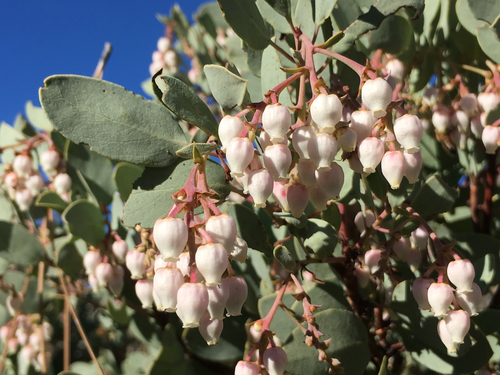
Arctostaphylos glauca is a large shrub that ranges in height from 1 meter to well over 6 meters. Shrubs growing in desert regions are typically shorter than those growing along the coast. Its leaves are light gray-green, with a somewhat waxy texture; they range in shape from oval to nearly round, and have smooth or toothed edges. Leaves reach up to 5 centimeters long and 4 centimeters wide, growing on short petioles that are about 1 centimeter long. Its inflorescence produces hanging clusters of narrow, urn-shaped white flowers. The edible fruit is a round or egg-shaped drupe 12 to 15 millimeters wide. This fruit is light red, with thick pulp covered by a tough, sticky outer coat, and it holds three to six nutlets fused into one single mass. This shrub can reproduce both by seed and by layering. Its seeds require exposure to fire before they are able to germinate. It is a long-lived species, and can reach 100 years of age or older; however, it does not start producing fruit until it is approximately 20 years old. This shrub is allelopathic: when rain leaches toxic arbutin and phenolic acids from its foliage, it inhibits the growth of other plants in its understory. The aphid Tamalia glaucensis induces leaf galls on this species, which is also called big-berry manzanita. Despite their constipating effects, Native Americans of California ate the fruits of this shrub, and also made ripe fruits into cider.