About Arctostaphylos bicolor (Nutt.) A.Gray
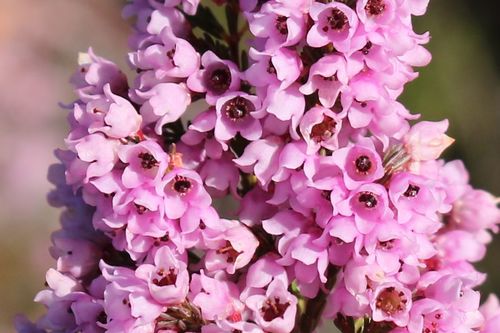
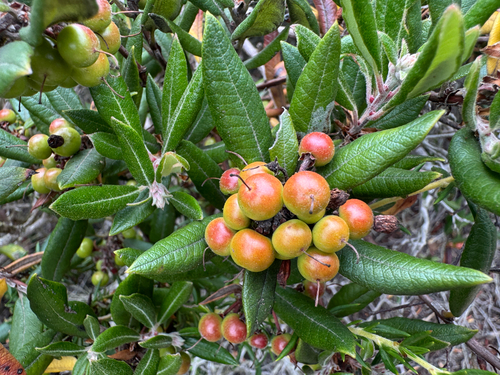
This evergreen shrub or tree (Arctostaphylos bicolor) grows from an underground lignotuber storage organ called a burl, which is topped by a smooth trunk with peeling red bark. Like other Arctostaphylos species in the Arbutoideae subfamily native to the region, this species has a smooth red trunk, though its bark carries a darker tint. While it rarely reaches 6 metres (20 ft) in height, erect stems are typically less than 2.5 m (8.2 ft) long, with canescent twigs. Alternately arranged, leathery leaves grow on these twigs; their lower surfaces are densely covered in white to gray hairs, leaf margins have no teeth and are rolled under, and leaves can grow up to 4.5 cm long. The species produces a dense, downward-hanging, bracted panicle inflorescence. Each flower has a non-jointed pedicel with 2 bractlets, 5 sepals, and 5 fused petals that form an urn-shaped, hairy white to pink corolla. Inside the flower, there are 10 stamens with filaments that are wooly on their lower half. The ovary is superior, hairy, and typically has 5 chambers. Mature flowers develop into a dark-brown drupe fruit around 9 mm (0.35 in) wide, which contains 5 stones fused into a single smooth unit. The native range of Arctostaphylos bicolor is very limited: it grows naturally in the Peninsular Ranges of Southern California (U.S.) and the Baja California Peninsula (México), Southern California's South Coast and Santa Catalina Island, and the northwestern Baja California coast and Cedros Island, with most populations concentrated in San Diego County, California and the Mexican state of Baja California. It is a member of the chaparral plant community in the California chaparral and woodlands and California coastal sage and chaparral ecoregions, growing at elevations below 3,500 feet (1,100 m) on dry, sunny slopes. In Baja California, it can also grow outside the chaparral community, specifically in sky islands of the central desert and in the xeric scrub community of the Sierra de la Giganta mountain ranges in Baja California Sur. Ecologically, birds including the California thrasher and California scrub jay eat its seeds; Anna's hummingbirds, the local resident species, drink nectar from its flowers; and many bird species use the plant for nesting and cover. Unlike some other chaparral species that require fire to germinate seeds and reproduce, Arctostaphylos bicolor does not need fire or fire-created open areas to reproduce. It survives wildfires by resprouting from its base after the upper portion of the plant burns away. This survival mechanism works well unless a second wildfire occurs soon after the first, when the plant will likely die if it has not had enough time to regenerate sufficiently. The Luiseño Native American people bruised ripe berries of this species and soaked them overnight in cold water to make a cider-like drink. Delfina Cuero, a Kumeyaay person, noted a similar use, with ripe berries soaked to make a cool drink; the Kumeyaay call the plant Haasill. Arctostaphylos bicolor is cultivated as an ornamental plant by specialty nurseries for use in California native plant gardens and wildlife gardens. It forms a distinct attractive shrub with flowers that attract hummingbirds. It prefers full sun for its leaves, but shade for its roots. While tolerant of most soil types, it requires excellent drainage; it grows best in fast-draining soil with a pH of 6–7, and is suited to USDA hardiness zones 7–10. It grows best on north-facing, dry rocky slopes, with a moderate growth rate forming a rounded shape that is typically around 8 feet (2.4 m) high by 6 ft (1.8 m) wide. It requires regular light watering over the first summer after planting. Once established, it is drought-tolerant and can survive dry months without supplemental water, though it can tolerate infrequent summer watering. It produces white and pink blooms over winter and spring, and is hardy to 20 °F during these months.