About Arctostaphylos alpinus (L.) Spreng.
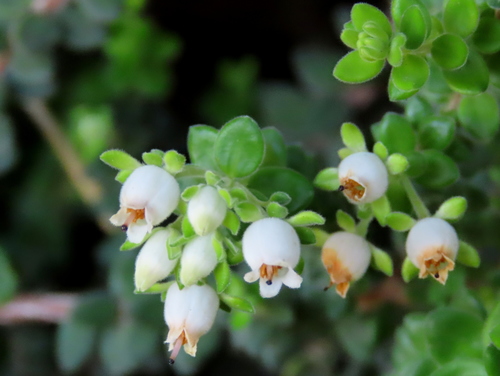
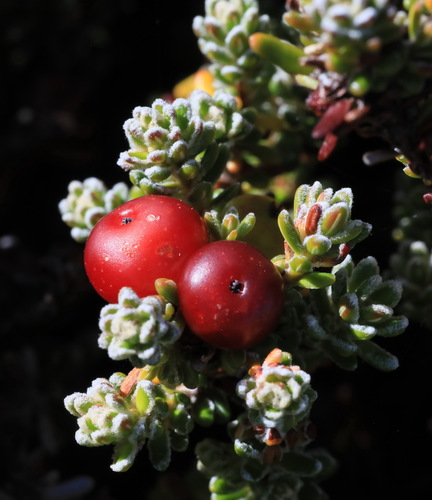
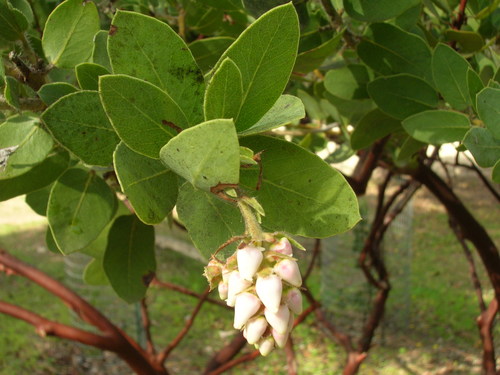
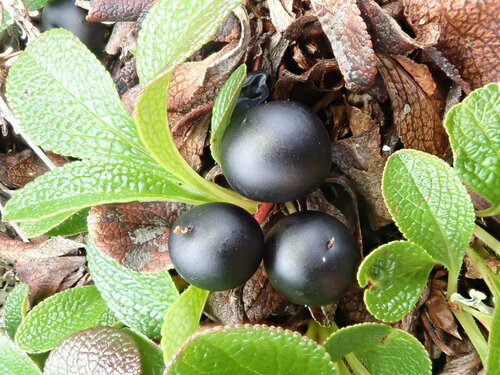
This species, currently classified as Arctostaphylos alpinus (L.) Spreng., was historically called Arctous alpina. It is a procumbent shrub that typically grows no taller than 15 centimeters (6 inches), with a woody stem and straggling branches. Its leaves are arranged alternately, stalked, oval in shape, with serrated margins and a network of veins. The leaves wither in autumn but remain attached to the plant for an additional year, and they often turn red to scarlet in autumn. Flowers grow in clusters of two to five; they are white or pink, urn-shaped, and measure 3 to 5 millimeters (0.12 to 0.20 inches) in length. Each flower has five sepals, five fused petals with five small projecting lobes, ten stamens, and a single carpel. The species flowers in June. The fruits are spherical, 9 to 12 millimeters (0.35 to 0.47 inches) long, and change color as they mature: starting green, turning red, and becoming glossy black and succulent when fully ripe. Arctostaphylos alpinus has a circumpolar distribution, occurring at high latitudes from Scotland east across Scandinavia, Russia, Alaska, northern Canada, and Greenland. Its southern range limits are the Pyrenees and the Alps in Europe, the Altay Mountains and Mongolia in Asia, and in North America, British Columbia in the west and Maine and New Hampshire in the east. Its natural habitat includes moorland, dry forests composed of birch and pine, and moss-covered hummocks at bog edges. This plant forms a symbiotic relationship with fungi that provide it with nutrients such as phosphorus. Birds appreciate its berries.