About Arctoparmelia incurva (Pers.) Hale
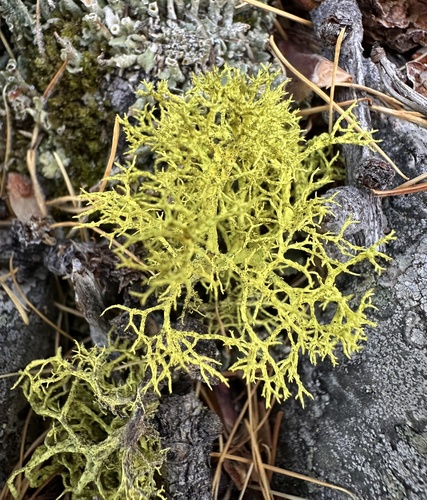
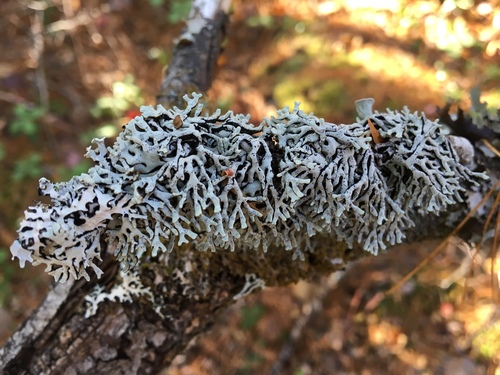
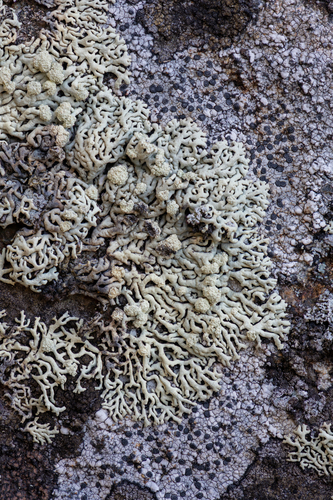
Arctoparmelia incurva is a lichen with a yellowish-green thallus 0.5 to 2 cm in diameter. Individual thalli often merge with one another to form much larger growths that can reach up to 20 cm wide. The thallus attaches very closely to its growing substrate, and its inner regions frequently show signs of degeneration. The lobes that make up the thallus are narrow, reaching up to 3 mm wide, and occasionally 4 mm wide. They radiate outward in an intricate pattern, do not overlap, and are convex in shape. The upper surface of the thallus is a dull yellow-grey, darkening in color toward the center. Soralia, structures that produce the reproductive granules called soredia, are 2 to 4 mm in diameter, located at the tips of smaller inner lobes within the thallus. These soralia are globular and scattered across the thallus. The lower surface of the thallus is pale and finely pubescent, meaning it is covered with soft, fine hairs. Rhizines, the root-like structures that anchor the lichen to its substrate, are sparse, dark, short, and do not have septa, or dividing walls. Apothecia, the lichen’s fruiting bodies, are rare and bear a brown disc. The medulla, or inner layer of the thallus, and the soralia test negative with C and K spot tests, but give a positive KC reaction that turns red. They react to para-phenylenediamine with either a positive rust-red Pd+ reaction or a negative Pd− reaction. Under ultraviolet light, these structures display a vivid glaucous blue fluorescence, which indicates the presence of alectoronic acid; sometimes the species also contains α-collatolic acid and/or protocetraric acid. The cortex, or outer layer of the thallus, tests K+ yellow and KC+ yellow because it contains usnic acid. There is notable variation in protocetraric acid content between different populations of Arctoparmelia incurva: the compound is absent in some populations, and predominant in others. Arctoparmelia incurva grows on sun-exposed siliceous rocks, and only very rarely grows on wood. It is tolerant of acid pollution. It is widely distributed across Europe, where it has been recorded in 19 countries. In North America, its range is primarily arctic, with documented records extending as far south as southern British Columbia and the Cascade Range. It has also been reported in the Appalachians and the Great Lakes region of North America. Arctoparmelia incurva has additionally been recorded in Greenland, Japan, Russia, and Ukraine.