About Arctocephalus tropicalis (J.E.Gray, 1872)
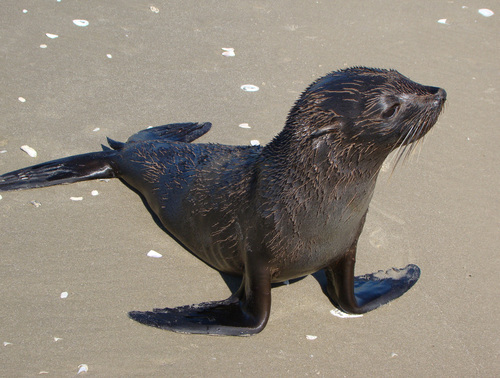
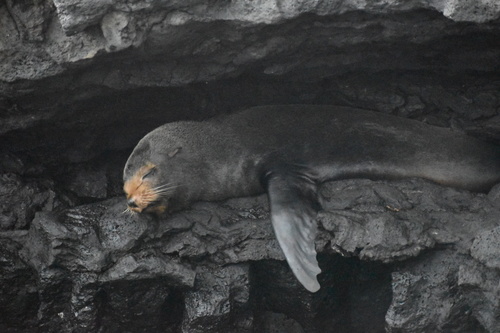
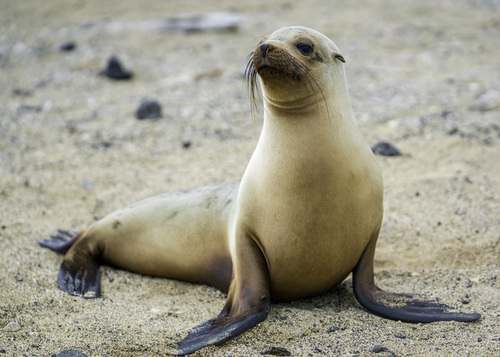
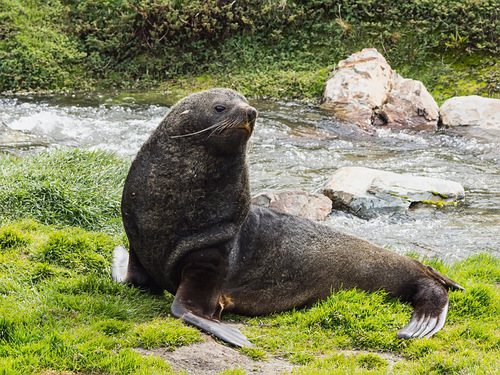
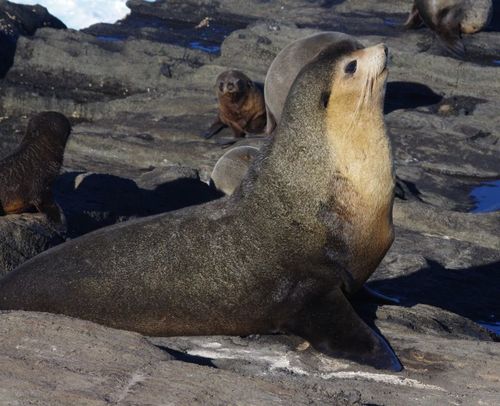
The subantarctic fur seal, scientifically named Arctocephalus tropicalis (J.E.Gray, 1872), is medium-sized compared to other fur seals, and exhibits strong sexual dimorphism. Adult males reach 2 meters (6 feet 7 inches) in length and 160 kilograms (350 pounds) in weight, while adult females are significantly smaller, reaching 1.4 meters (4 feet 7 inches) in length and 50 kilograms (110 pounds) in weight. This species has creamy-orange chests and faces, with more brownish bellies. Males have dark grey to black backs, while females have lighter grey backs. Males have a characteristic dark tuft of hair on the top of the head that stands erect when they are excited. Pups are black at birth, and molt their first coat at around 3 months old. Subantarctic fur seals have short, flat snouts and short, broad flippers, and have a typical lifespan of 20 to 25 years. Arctocephalus tropicalis has a wide geographic range. As both its scientific and common names suggest, it generally breeds and inhabits more northerly (subantarctic, or "tropical") locations than the Antarctic fur seal (Arctocephalus gazella). The largest known breeding colonies are located on Gough Island in the South Atlantic, and Île Amsterdam in the southern Indian Ocean. Additional breeding grounds include Marion Island (part of the Prince Edward Islands, which it shares with the Antarctic fur seal), the Crozet Islands, and Macquarie Island. In areas where the two species occur together, A. tropicalis can be visually identified by its lighter orange chest colouring. Occasional hybridization between the two species has been recorded in these overlapping areas. Today, there are approximately 300,000 subantarctic fur seals remaining. This number is substantially lower than the population size when the species was first discovered in 1810, as the species was heavily hunted for its pelts throughout the 19th century. Pre-human population sizes were likely even larger than the 1810 population. However, the species recovers rapidly in areas protected by the Convention for the Conservation of Antarctic Seals (CCAS). A small population on Heard Island is classified as endangered. Antarctic fur seals were also heavily hunted, leaving only one breeding colony by 1900 and resulting in very low species-wide genetic variability. In contrast, subantarctic fur seals have retained high genetic diversity. There are three distinct genetic lineages within the species, but none of these lineages are restricted to a specific geographical area. After birth, subantarctic fur seal pups spend around 11 months feeding on their mother's milk, which contains approximately 39% fat. This lactation period length is typical for otariid seals, and differs greatly from the much shorter 4-month lactation period of the Antarctic fur seal. Pups remain at the rookery throughout the lactation period. Weaning occurs shortly before the mother's next offspring is born. Pups molt their black natal coat at around 3 months of age, and adult subantarctic fur seals molt their coat annually between March and May.