About Arctium lappa L.
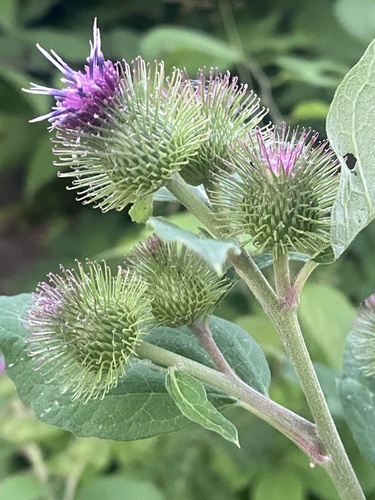
Greater burdock (Arctium lappa L.) is a tall biennial plant that can reach up to 3 meters (10 feet) in height. Its fleshy taproot grows up to 1 meter (3 1⁄2 feet) long and 2 centimeters (3⁄4 inch) across. It produces large, alternating leaves with wavy edges and a heart-shaped form; these leaves have long petioles and are covered in fine hairs on their underside. The purple flowers form individual rounded flower heads (capitula), which are grouped together in larger clusters. Flowers bloom in mid-summer, between July and September. Each capitulum is surrounded by an involucre of many bracts, each of which curves into a hook shape. These hooked bracts allow mature fruits to cling to passing animals and be carried long distances. The fruits are long, compressed achenes with short pappus hairs. This species is native to temperate regions of the Old World, ranging from Scandinavia to the Mediterranean, and from the British Isles through Russia and the Middle East to India, China, Taiwan and Japan. It has become widely naturalized in other temperate climate regions. It typically grows in disturbed areas, and grows best in humus- and nitrogen-rich soil, with a preference for full sunlight. Greater burdock leaves serve as a food source for the caterpillars of some Lepidoptera species, including the thistle ermine (Myelois circumvoluta). Dried greater burdock roots (called Bardanae radix) are used in traditional medicine. In traditional Chinese medicine, greater burdock seeds are used under the name niubangzi (Chinese: 牛蒡子; pinyin: niúbàngzǐ).