About Arctia caja (Linnaeus, 1758)
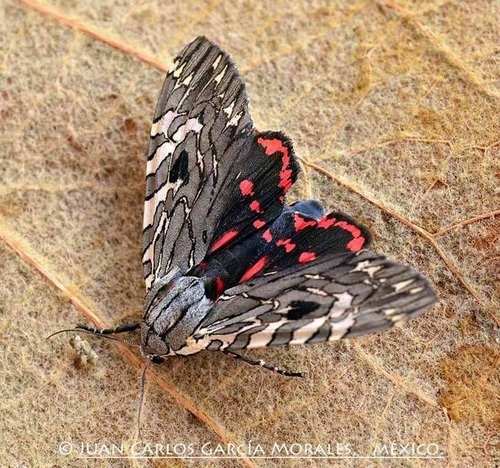
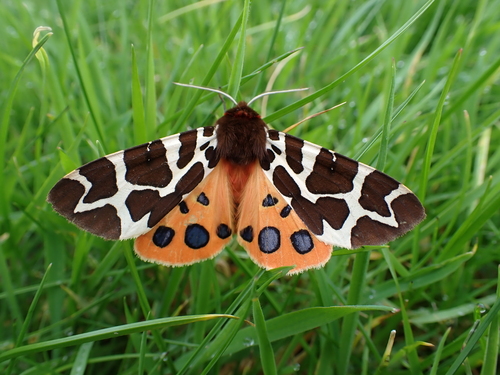
Arctia caja, commonly known as the garden tiger moth, has a wingspan ranging from 45 to 65 millimeters, which equals 1.8 to 2.6 inches. Wing patterns vary between individuals: the front wings are brown with a white pattern that is sometimes absent, while the back wings are orange with a pattern of black dots. There are many aberrations, which are pattern and colour variants, that arise either artificially or by chance. French entomologist Oberthür documented around 500 different variants across 36 figures, and Seitz provided descriptions of several named aberrations.
The garden tiger moth is distributed across the northern United States, Canada, and Europe, and it favors cold, temperate climates. It occurs throughout most of the Palearctic realm: in Europe it ranges as far north as Lapland, and it is also found in Northern Asia, Central Asia, and North America. In the Tien Shan mountains, this species can be found at elevations up to 3,000 metres, or 9,800 feet.
This species occupies a wide variety of wild habitats, from grasslands to forests. Thanks to its generalist diet, it is not limited by factors such as the location of specific host plants. The only consistent requirements for its habitat are that it is seasonal and cool; like many other species in the genus Arctia, tropical climates are unsuitable for both garden tiger moth larvae and adults.
For the life cycle of A. caja, caterpillars hatch at the end of summer, between August and September. They overwinter once, reemerge in spring, and finish growing by June. Adults are active from July to August, or September in warmer climates, and are primarily active at night. Females lay eggs on leaf surfaces, and the new larvae hatch and begin feeding shortly after the previous generation dies. After feeding for a few months, larvae enter dormancy while covered in ground debris. In spring, larvae resume feeding before pupating. Adults emerge by June or July, all from the same generation that was laid the previous fall. There is no overlap between generations at any life stage, for either adults or larvae.
Declines in the garden tiger moth population are a concern both for laboratory research and in natural populations. Using synthetic food is a potential solution for maintaining this species in laboratory settings. While not ideal, it addresses many problems that come with raising captive Lepidoptera. It quickly resolves concerns such as food sterility, as well as issues related to collecting or cultivating hard-to-source host plant material. Many larvae, including those of A. caja, are able to consume synthetic food, which is primarily composed of agar, powdered cellulose, cabbage, sucrose, salts, and wheat germ. Synthetic food sources appear to be a promising option for raising laboratory populations of this species for conservation purposes or research.