About Arcte coerula (Guenée, 1852)
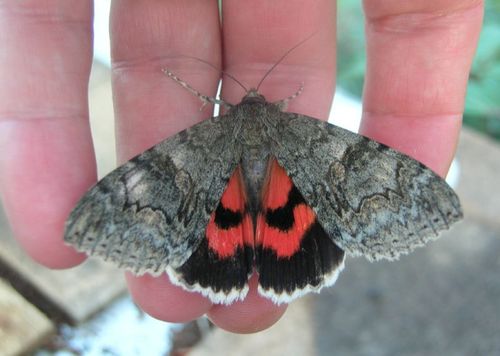
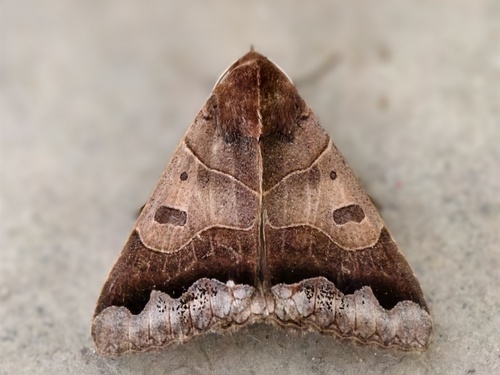
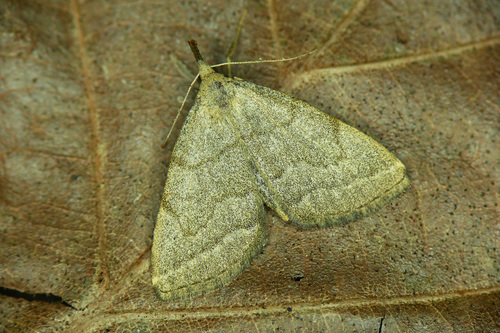
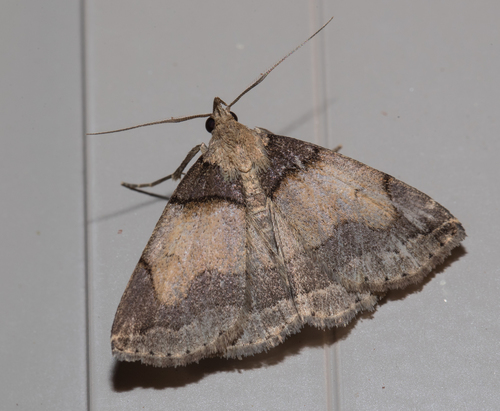
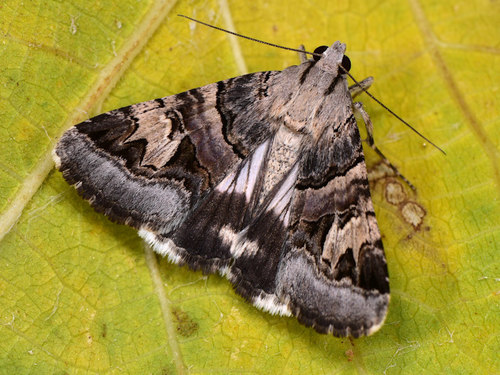
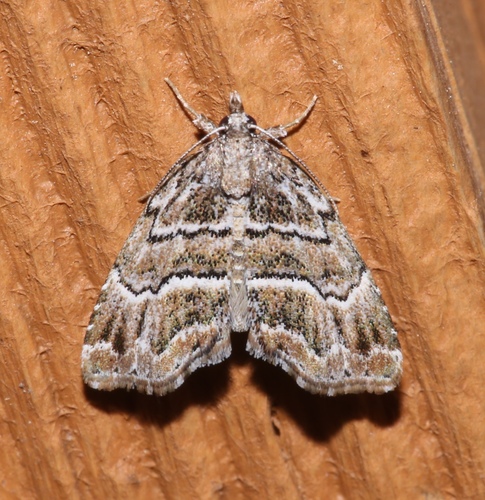
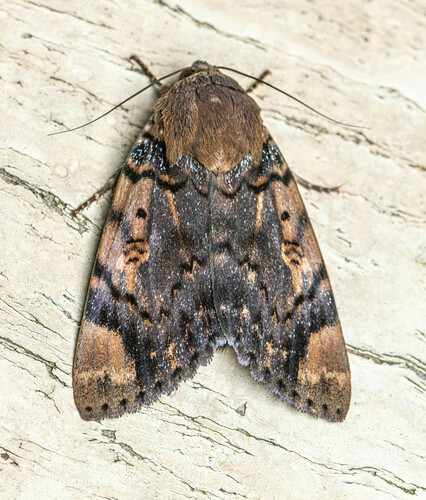
Arcte coerula (Guenée, 1852) has a wingspan of approximately 84 mm. The mid and hind tibiae are spiny. Male individuals have hindwings with a long, hairy inner margin. The head is black, and the thorax is vinous reddish brown. The pectus is white. The abdomen is bluish fuscous, with a white tuft below the claspers in males. Forewings are brown suffused with black, except for the costal area extending to the postmedial line and the apical area, and are sprinkled with a small number of bluish-white scales. A short, almost basal line, two black sub-basal patches, and an oblique waved antemedial line are present. There is a black spot in the cell and two lunules at the end of the cell. Traces of a pale waved sub-marginal line are visible. Hindwings are black, with a bright blue patch on the disk, a maculate post-medial band, and a patch near the anal angle. Mature larvae are black. Each somite has a transverse dorsal white bar that encloses a black line. The stigmata are ochreous, have black ridges, are surrounded by some red color, and sit on white patches; near the top of each white patch grows a white hair. There is a disconnected inter-spiracular white line, and a broader spiracular line that has a black spot below each spiracle, from which a white hair grows. A broad ventral white band is present. The 11th somite is humped and black on its upper surface. The posterior extremity is orange on top, spotted with black. The head and all somites are covered in long white hairs. The larvae feed on Boehmeria nipononivea (ramie) and Boehmeria australis. In Hawaii, larvae have been observed feeding on native Urticaceae, including Pipturus albidus (māmaki) and Boehmeria grandis ('akolea) — these are also food sources for the native Kamehameha butterfly.