About Arctagrostis latifolia (R.Br.) Griseb.
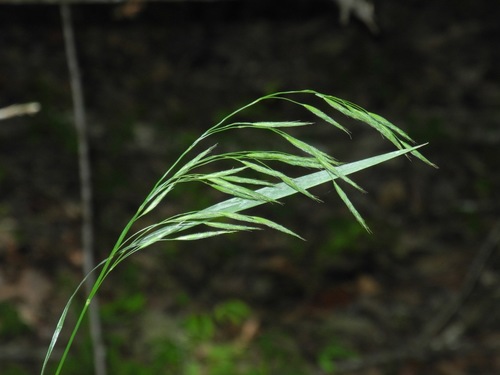
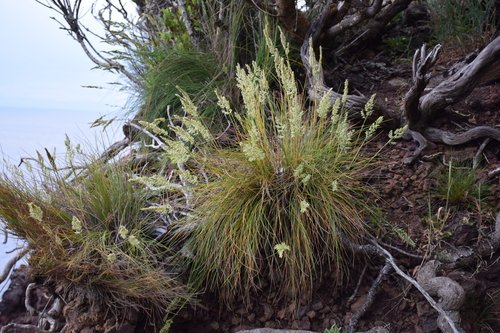
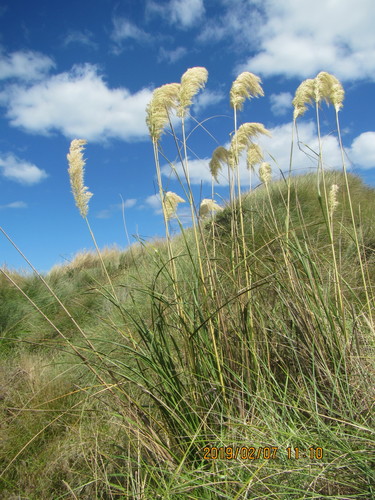
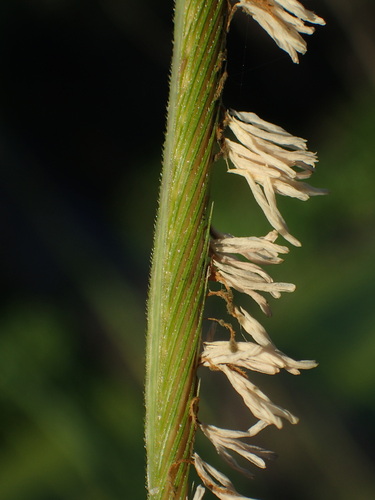
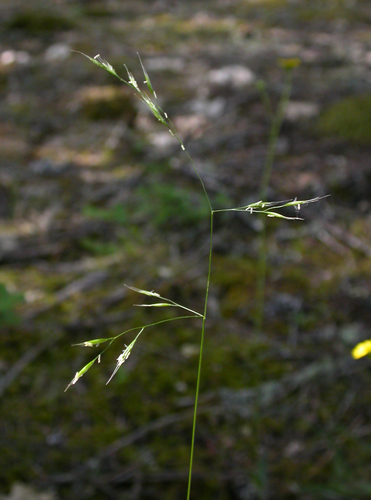
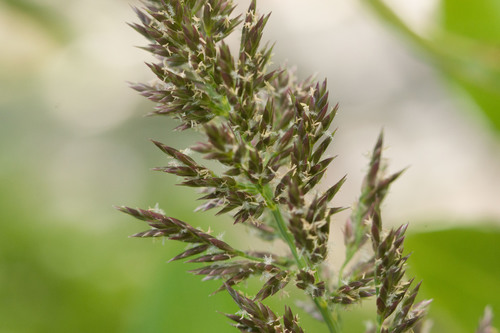
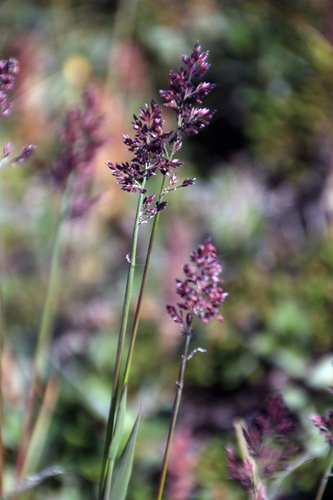
Arctagrostis latifolia (R.Br.) Griseb. is a long-lived, mat-forming perennial grass. It grows from a horizontal, highly branched rhizome; aerial shoots up to 6 cm (2 in) long emerge from the rhizome at intervals, and each shoot is surrounded by a tuft of leaves, some of which are reduced in size. Most of these shoots are leafy, bearing broad, flat leaves, and only a small number produce flowering stems. The inflorescence is a dark violet, narrowly elongated panicle that measures 5–7 cm (2–3 in) long and has short branches; this inflorescence grows on a stout stalk that is 10–20 cm (4–8 in) long.
Arctagrostis latifolia has a global circumpolar distribution. Its native range in North America includes Alaska, British Columbia, Yukon, Northwest Territories, Nunavut, Québec, Ontario, Newfoundland, Manitoba, Labrador and Greenland. In Europe, its range includes Finland, Norway, Svalbard, North European Russia and East European Russia. In Asia, its range includes West Siberia, Irkutsk, Khabarovsk, Kazakhstan, Kamchatka, Yakutsk and Mongolia.
This species is a constituent of Arctic tundra, alongside other subarctic grasses. Along with other cold-resistant species from the related genera Alopecurus, Beckmannia, Holcus and Deschampsia, these grasses are highly important because of their long lifespan, good forage quality, and the stable habitat they provide. As a polyploid species with polymorphic forms, Arctagrostis latifolia is highly tolerant to environmental stress. In Svalbard, this species flowers in August, but few if any of its flowers produce mature seed, and flowers are often damaged by frost. Dispersal is mainly vegetative and clonal; when seeds are produced, they are contained within achenes and dispersed by wind.