About Archilestes grandis (Rambur, 1842)
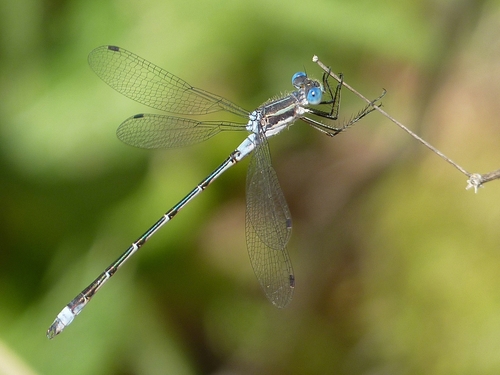
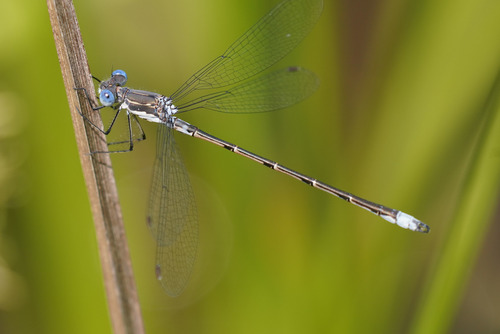
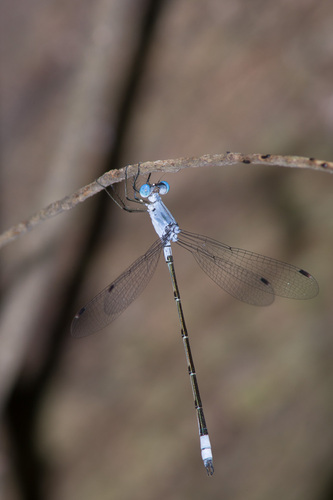
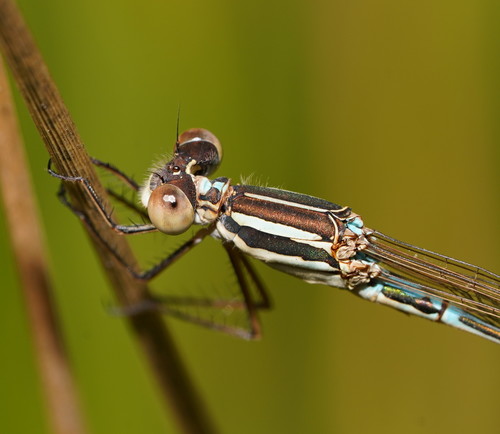
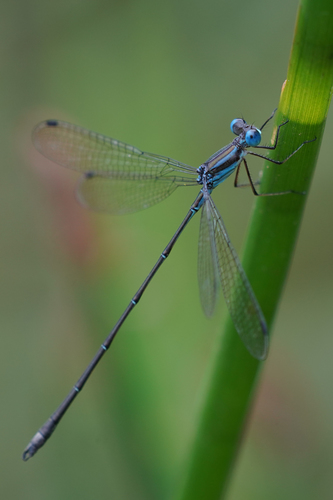
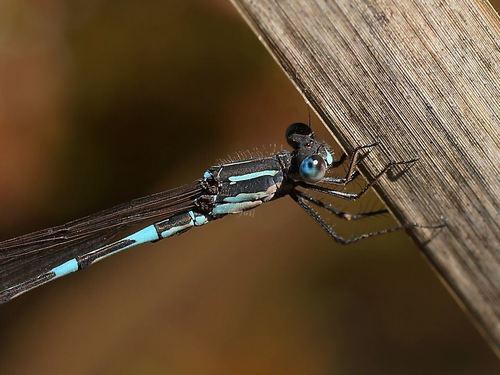
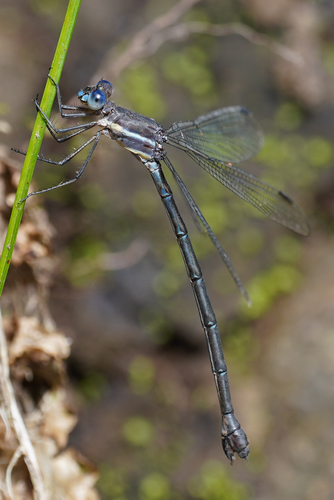
The great spreadwing, Archilestes grandis, is one of the largest North American spreadwings, reaching 2 to 2.4 inches in length with a 3-inch wingspan. Males have a dull greenish bronze thorax on the upper surface, with a broad diagonal yellow stripe along the sides of the thorax. This species is the only spreadwing that has this broad yellow thorax stripe. The abdomen is dark, with a blue-gray tip, and the eyes and face are blue. Females are similar in general form to males, but their bodies are more brown, their eyes are a paler blue than males, and they also have the characteristic yellow thorax stripe. When laying eggs, females may take on a putty color that matches the withered leaves where they deposit their eggs. The great spreadwing is distributed across western and southern North America, and it is more common in the western United States than in the eastern part of the region. It also occurs in Central America and northern South America. Starting in the 1920s and continuing to the present, Archilestes grandis has expanded its range in North America eastward and northward. This species prefers habitats including small slow streams (often with alder or willows), wetlands, ponds, and temporary pools. It breeds successfully in both natural unpolluted water and heavily vegetated unpolluted water gardens. Females oviposit in vegetation such as water iris while being clasped by males. Males typically hang from vegetation less than 2 feet above or near water. Occasionally, nymphs can be seen in winter, basking in sun-warmed shallow water alongside tadpoles. Nymphs can be recognized by their Y-shaped tails, which are actually their gills. During mating, after the female collects sperm, she cuts a slit into emergent vegetation and lays her eggs inside the slit. Nymphs then develop underwater until they climb out of the water to emerge as adult great spreadwings. Like other odonates, emergence to adulthood usually takes place under the cover of darkness.