About Arbutus unedo L.
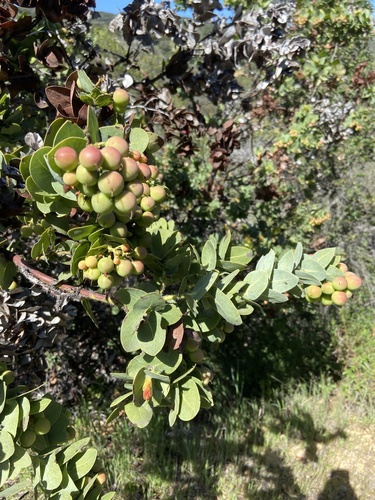
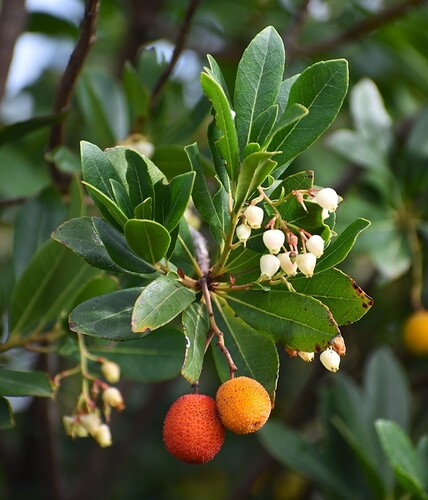
Arbutus unedo L. typically grows 4–7 m (13–23 ft) tall, rarely reaching 15 m (50 ft), with a trunk diameter up to 80 cm (31 in), and thrives in hardiness zones 7–10. Its leaves are green and glossy on the upper surface, dull on the underside, 8–10 cm (3–4 in) long, 3–4 cm (1–1+1⁄2 in) broad, laurel-like, and have a serrated or serrulated margin. The hermaphrodite flowers are white (yellow when dried out), bell-shaped, 7–8 mm (1⁄4–5⁄16 in) in diameter, grow from reddish hanging panicles, bloom in autumn, are pollinated by bees, and carry a mild sweet scent. Twigs are reddish-brown, heavily leafed, and often covered in small hairs. The fruit is a spherical red berry 7–20 mm (1⁄4–13⁄16 in) in diameter with a rough surface. It takes around 12 months to mature, ripening in autumn at the same time the next year’s flowering occurs. The fruit is edible, and is sweet when ripe (red). Small, brown, angular seeds are most often dispersed by frugivorous birds. The specific epithet unedo is attributed to Pliny the Elder, who is said to have stated "unum tantum edo", which translates to "I eat only one". It remains unclear whether Pliny meant the fruit was so pleasant he could only eat one, or that it was uninteresting so he only ate one. Arbutus unedo is widespread across the Mediterranean region: it grows in Portugal, Spain, and southeastern France; extends south into Algeria, Morocco, Libya, and Tunisia; and stretches east into Italy, Malta, Slovenia, Croatia, Montenegro, Greece, Turkey, Israel, Palestine, Jordan, Lebanon, and Syria. It is also found in western France, Albania, Bulgaria, and southwestern Ireland. This species is known for its disjunct distribution, with isolated relict populations in southern and western Ireland separate from its core Mediterranean range. It is commonly cited as an example of Lusitanian flora, a small group of plants native to Iberia and southwestern Ireland that are generally absent from Britain. Recent genetic studies suggest A. unedo may not be truly native to Ireland, and instead was introduced during the Chalcolithic period. A red-flowered variant, named A. unedo rubra by William Aiton in 1785, was discovered growing wild in Ireland in 1835. Arbutus unedo is relatively easy to cultivate and adaptable to many climates. Once established, it is fairly drought resistant, frost resistant, shade tolerant, and salt tolerant. However, lower fruit mass production has been recorded during summer droughts, and frosts during flowering reduce fruit count. A. unedo is naturally adapted to dry summer Mediterranean climates, and has become a very popular ornamental plant in California and the rest of the west coast of North America. It grows easily in USDA hardiness zone 7 or warmer, and also grows well in the cool, wet summers of western Ireland and England, as well as temperate regions of Europe and Asia. Known pests include scales and thrips; known diseases include anthracnose, Phytophthora, root rot, and rust. Unlike most members of the Ericaceae family, A. unedo grows well in basic (limy) pH soils, though it performs better in more acidic soils. Fruit production is not very high and varies heavily based on weather, which may be why this plant is not frequently cultivated for fruit. Over two years of study, the average yield was around 46 kg per hectare, and 180 grams per cubic metre of crown. Very little research has been done on genotype selection for this species. Arbutus unedo forms a mycorrhizal relationship; inoculation with Pisolithus tinctorius has been shown to greatly improve the plant’s root mass, size, drought tolerance, and nutritional status. In UK cultivation, the form A. unedo f. rubra and the cultivar 'Atlantic' have earned the Royal Horticultural Society's Award of Garden Merit. Arbutus berries have a high sugar content (40%), plus antioxidant vitamins including vitamin C, beta-carotene, niacin, and tocopherols, and organic acids that are precursors to omega-3 and omega-6 fatty acids (nearly 9% total). They are edible fresh, but are rarely eaten raw, in large part because mature fruit bruises very easily, making transportation difficult. Most often, they are used to make jam, marmalades, yogurt, and alcoholic beverages, such as medronho, a type of strong Portuguese brandy. Many regions of Albania prepare the traditional drink rakia from the plant's fruits (called mare or kocimare in Albanian), which gives the drink its name raki kocimarje. Bees pollinate the flowers, and the resulting honey is bitter-tasting but still considered a delicacy. In traditional and folk medicine, a decoction made from Arbutus unedo leaves is said to have astringent, diuretic, urinary anti-septic, antiseptic, intoxicant, and tonic properties, and is used to treat rheumatism; more recently, it has been used in therapy for hypertension and diabetes. The leaves are reported to have a high concentration of flavonol antioxidants, especially quercetin, which is best extracted via decoction. Both leaves and fruits are a source of antioxidants. The plant's nectar contains the biologically active isoprenoid unedone (2-(1,2-dihydroxypropyl)-4,4,8-trimethyl-1-oxaspiro[2.5]oct-7-en-6-one), which acts against Crithidia bombi, a common, debilitating parasite of bumble bees. This means unedone could offer a naturally occurring way for bees to resist disease burden that contributes to pollinator declines. Once consumed by a bee, the compound is glycosylated into an inactive form called unedone-8-O-glycoside, which may reduce toxic effects on the bee. The bee's gut microbiome then transforms it back to the active aglycone in the hindgut, where the parasite is most common and damaging, indicating the microbiome supports this anti-parasitic process. The wood of Arbutus unedo is quite hard, making it well suited for uses like firewood and pipe making. Since the tree does not usually grow straight, it is not well suited for construction or similar uses. The tree is also grown as an ornamental plant, valued for its attractive, sweet-smelling flowers and fruit that are present on the plant at the same time, and for being an evergreen. It is used as a single or multi-trunked ornamental tree, and as a specimen or hedge shrub in gardens and public landscapes.