About Arbutus menziesii Pursh
Arbutus menziesii Pursh, commonly known as Pacific madrone, is an evergreen tree that typically reaches 10 to 25 metres (33 to 82 feet) in height, and can grow up to 30 m (98 ft) under ideal conditions. Its trunk is usually around 60 centimetres (24 inches) thick. The tree has thin, rich orange-red bark that naturally peels away in thin sheets when mature, leaving a greenish, silvery surface with a smooth satin sheen; older trunks turn gray-brown near the base. Individual trees can live for more than 300 years.
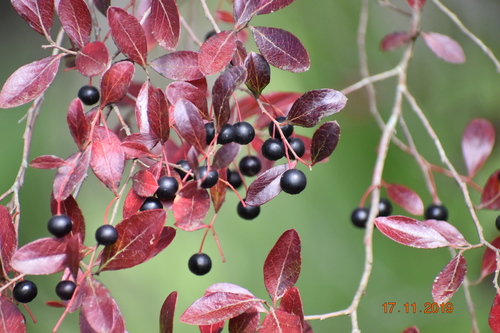
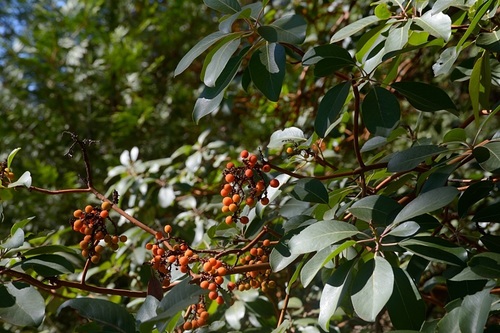
Its leaves are thick, waxy in texture, elliptical in shape, and measure 7 to 15 cm (2+3⁄4 to 6 in) long by 4 to 8 cm (1+1⁄2 to 3+1⁄4 in) broad, arranged in a spiral pattern on branches. They are glossy dark green on the upper surface and a lighter, more grayish green underneath, with smooth entire margins. As an evergreen species, its leaves persist for a few years before falling. Some second-year leaves turn orange to red and drop in autumn. In the northern part of the tree's range, wet winters often cause brown to black leaf discoloration from fungal infections; this staining remains until the leaves naturally fall at the end of their lifespan. In spring, the tree produces clusters of small, white to pink, bell-shaped flowers, and it bears red berries in autumn.
Madrones are native to the western coast of North America, ranging from British Columbia (mainly Vancouver Island and the Gulf Islands) south to California. They occur most commonly in Puget Sound, the Oregon Coast Range, and the California Coast Ranges, but are also scattered across the west slope of the Sierra Nevada and Cascade mountain ranges. A few small relict stands of Arbutus menziesii exist in southern California, thought to be survivors from the last glacial period. These populations are found on Santa Cruz Island, in the San Gabriel Mountains, and extend south to the Santa Ana Mountains, Agua Tibia Mountains, and Palomar Mountain. The southernmost confirmed population grows on Roderick Mountain overlooking the San Luis Rey River canyon in San Diego County, where several hundred trees are present. George Bishop Sudworth documented a small number of shrubby Pacific madrone individuals in Los Tuñas Canyon, Santa Monica Mountains, but this population may no longer survive. One source records the species' southern range extending into Baja California, Mexico, but other researchers note no confirmed collected specimens from that far south, and the species is not recorded in modern surveys of native trees there, though other Arbutus species are endemic to the region. Pacific madrone grows well on dry, rocky sites, is tolerant of salt water, and is fairly intolerant of shade.
In the wild, Arbutus menziesii often grows alongside Douglas-fir. Its thin bark is susceptible to damage from fire, but new saplings readily sprout after fire disturbances. Mature trees survive fires, and can regenerate more quickly after fire than Douglas-firs. Pacific madrone also produces very large numbers of seeds that germinate after fire, and the tree can sprout from cut stems.
Many species of mammals and birds feed on its berries, including juncos, American robins, cedar waxwings, band-tailed pigeons, varied thrushes, quail, mule deer, raccoons, ring-tailed cats, and bears. Since berries are produced in great quantity and may remain on the tree through winter, they are a very valuable food source. Mule deer also eat young shoots when the trees are regenerating after fire. The flowers produce nectar that can be used to make honey. Mature leaves are almost never eaten by browsing animals, but young leafy sprouts are consumed by ungulates and the dusky-footed woodrat. The species is considered a high-importance winter forage for many ungulates. It is an important nest site for many bird species, and is disproportionately chosen for nest building in mixed woodland relative to its abundance. This may be because the tree is susceptible to heart rot, which makes it ideal for cavity-nesting birds. Pacific madrone also provides cover for big game and small mammals, and perching sites for a variety of bird species, and serves as important habitat for woodpecker and sapsucker species.
For cultivation, Pacific madrone trees are difficult to transplant, so seedlings should be placed in their permanent location while they are still small. Transplant mortality becomes significant once a madrone grows taller than 30 cm (1 ft). Cultivation sites should be sunny (south- or west-facing slopes are preferred), well drained, and lime-free, though occasional seedlings will establish on shell middens. Within its native range, established trees require no extra water or fertilizer.
The berries are considered unpalatable and may be harmful if consumed by people or pets. According to legend, Native Americans ate the berries both raw and cooked, but due to the berries' high tannin content and resulting astringency, they more often chewed them or processed them into cider. Overeating the berries causes cramps. Native Americans also used the berries to make necklaces and other decorations, and as fishing bait — for example, the Karuk people used the berries to catch steelhead. The bark was often made into a tea consumed for supposed medicinal benefits. Early Californian settlers may have used charcoal from this species to make gunpowder.
The wood is durable and develops a warm color after finishing, so it has become more popular as a flooring material, especially in the Pacific Northwest. An attractive veneer can also be produced from the wood. However, because large pieces of madrone lumber warp severely and unpredictably during drying, it is not widely used for large lumber applications. Madrone is used for firewood, since it is a very hard and dense wood that burns long and hot, even surpassing oak in this quality. The W̱SÁNEĆ people of British Columbia prohibit burning arbutus due to its salvific role in their creation myths, where an arbutus anchored their canoes to the world during a deluge.