About Araujia sericifera Brot.
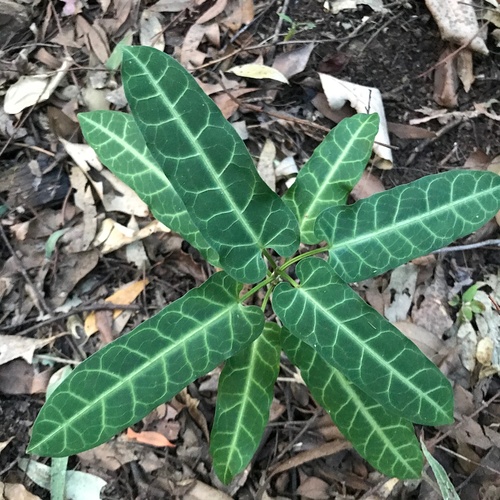
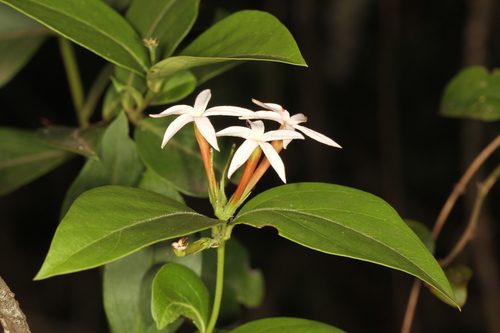
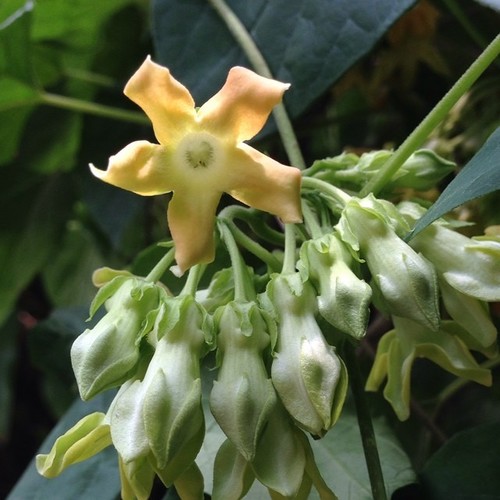
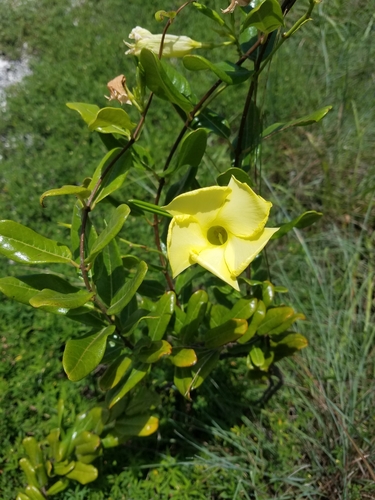
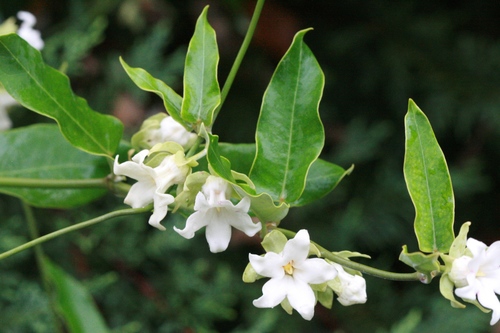
Araujia sericifera Brot. is a creeping climbing vine that can reach heights of 5–10 metres (16–33 ft). When any part of the plant—stem, leaf, or unripe fruit—is broken, it releases a milky, smelly exudate at the break site. Its leaves are opposite, dark green, glossy, and quite fleshy, shaped almost triangular with full, unbroken margins. Leaves measure about 10–12 centimetres (3.9–4.7 in) long and 1–6 centimetres (0.39–2.36 in) wide. The upper leaf surface is dark green, hairless, and shiny, while the underside is grey-green and covered in felt-like hairs. Stems are thin, right-winding, and heavily branched, and may become woody (lignify) at the base. This vine typically twines around other plants, posts, or fence bars for climbing support. Its root system consists of a short taproot with superficial lateral roots. Stems and leaves may senesce in late summer or early autumn, but new shoots will grow from old stems to use as climbing support.
This species is native to South America, primarily Peru, and is also native to Argentina, Brazil, and Uruguay. It was introduced to Europe and other regions as an ornamental plant, and is now considered a noxious weed. As of 2024, it is widely distributed across southern Europe, South Africa, North America (California, Georgia, North Carolina), expanded South America (Argentina, Brazil, Paraguay, Uruguay), Australia, and New Zealand. Within France, it is spread by horticultural networks to be grown as a climbing scented plant. It grows best in rich soil in sunny locations, though it can also tolerate partial shade, and acts as a perennial when protected from frost.
Its natural habitat includes wastelands with trees and hedges, forests, and rocky areas or cliffs. It prefers sunny or partially shady sites, growing at altitudes from 0 to 1,800 metres (0–5,906 ft) above sea level. It is a fast-growing vine that can completely cover a tree canopy in two to three years. It competes with host trees for light, water, and nutrients, and also damages trees by twining tightly around branches to girdle them.
This plant is slightly toxic. It is toxic to some people, and skin contact with its milky sap can cause allergic reactions including rashes; contact with the eyes, in particular, can cause severe discomfort.