About Araucaria angustifolia (Bertol.) Kuntze
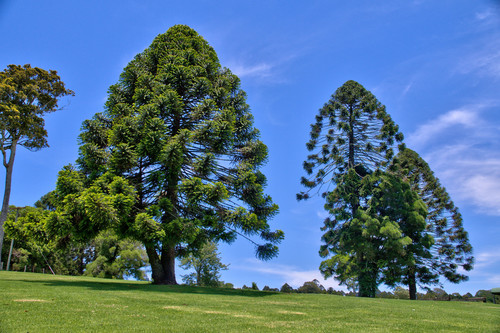
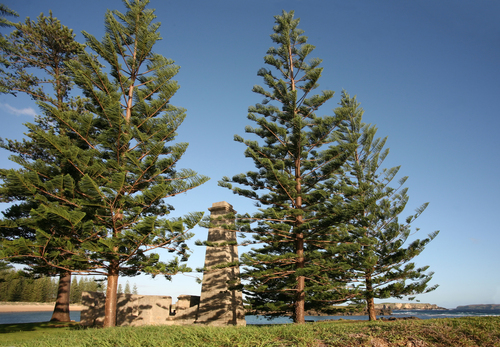
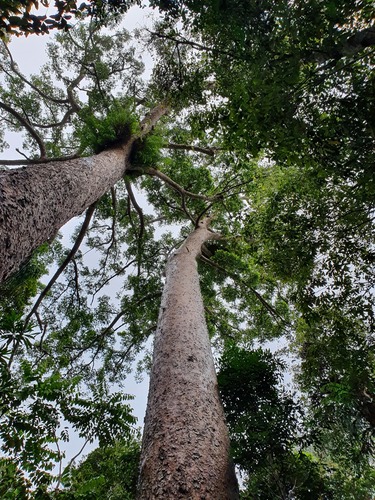
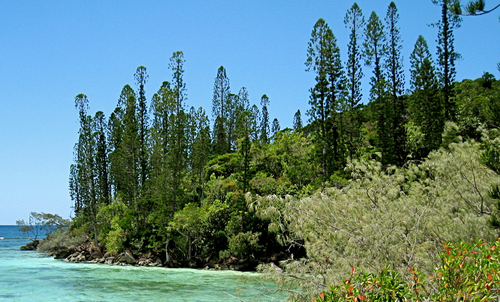
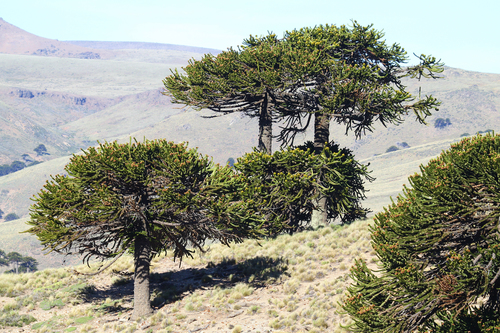
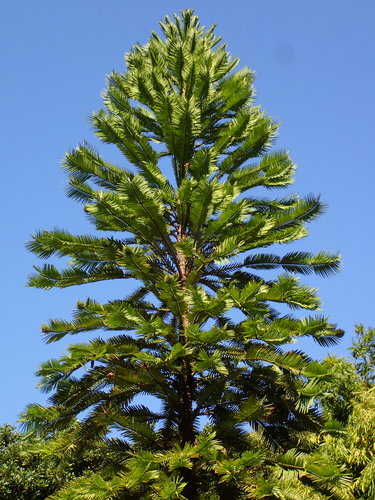
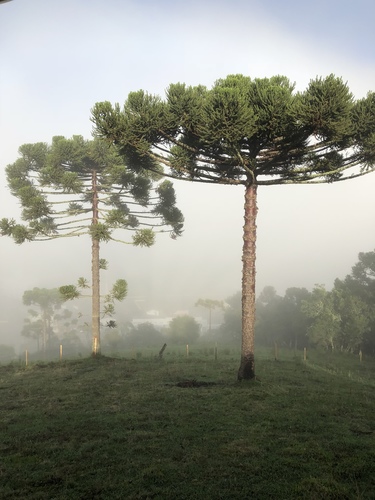
Araucaria angustifolia (Bertol.) Kuntze is an evergreen tree that typically reaches 40 metres (130 ft) in height, with a diameter at breast height of 1 m (3 ft 3 in). It grows quickly; in a plantation at Puerto Piray, Misiones Province, Argentina, individuals can reach as much as 16 m (52 ft) tall in 14 years. Its leaves are thick, tough, scale-like, and triangular, measuring 3–6 cm (1+1⁄8–2+3⁄8 in) long and 5–10 millimetres (25⁄128–25⁄64 in) wide at the base, with razor-sharp edges and a sharp tip. Leaves persist on the tree for 10 to 15 years, so they cover most of the tree's surface, leaving only the trunk and older branches bare. The bark is unusually thick, reaching up to 15 cm (6 in) deep, and the inner bark and resin from the trunk are reddish. It is usually dioecious, meaning male and female cones grow on separate individual trees. Male pollen cones are oblong; they start at 6 cm (2+1⁄2 in) long, and expand to 10–18 cm (4–7 in) long by 15–25 mm (9⁄16–1 in) wide when they release pollen. Like all conifers, this species is wind pollinated. Female seed cones mature in autumn around 18 months after pollination. They are globose and large, 18–25 cm (7–10 in) in diameter, and contain roughly 100–150 seeds. At maturity, the cones disintegrate to release their nut-like seeds, which are approximately 5 cm (2 in) long. These seeds are dispersed by animals, most notably the azure jay, Cyanocorax caeruleus.
The prehistoric distribution of A. angustifolia in earlier geologic periods differs greatly from its current range; fossils of the species have been found in northeastern Brazil. This species shifted into its present-day range in southern Brazil during the late Pleistocene and early Holocene. This geographic shift may be caused by climate change and the migration of mountain flora along river courses. The species originally covered 233,000 square kilometres (90,000 sq mi), but has lost an estimated 97% of its habitat to logging, agriculture, and silviculture. In addition to southern Brazil, it also occurs in high-altitude areas of southern Minas Gerais, central Rio de Janeiro, and the east and south of São Paulo. It is most common in the Brazilian states of Paraná, Santa Catarina and Rio Grande do Sul. According to a study by Brazilian researcher Reinhard Maack, the species' original range made up 36.67% of Paraná state (73,088 km² or 28,219 sq mi), 60.13% of Santa Catarina state (57,332 km² or 22,136 sq mi), 21.6% of São Paulo state (53,613 km² or 20,700 sq mi), and 17.38% of Rio Grande do Sul state (48,968 km² or 18,907 sq mi). It also grows in northeast Argentina (Misiones and Corrientes provinces), in local populations in Alto Paraná, Paraguay, and in northern Uruguay, where it was thought to be extinct until recent discoveries. It grows on low mountains at altitudes between 500–1,800 metres (1,600–5,900 ft). It prefers well drained, slightly acidic soil, but will tolerate almost any soil type as long as drainage is good. It requires a subtropical or temperate climate with abundant rainfall, and can tolerate occasional frosts down to approximately −5 to −20 °C (23 to −4 °F).
The seeds of this tree are very important food for native animals. Multiple species of mammals and birds eat the seeds, called pinhão, and the species plays an important ecological role in Araucaria moist forests, a subtype of the Brazilian Atlantic Forest. A long-term study of year-round feeding behavior of the squirrel Guerlinguetus brasiliensis ingrami in a secondary A. angustifolia forest in Parque Recreativo Primavera near Curitiba, Paraná found that among the ten plant species whose seeds or nuts the squirrels ate, A. angustifolia seeds were the most important fall food source, and made up a significant percentage of the squirrels' winter diet as well. The squirrels cache these seeds, but it remains unclear how this caching affects tree recruitment.
Araucaria angustifolia is a popular garden tree in subtropical regions, planted for its distinctive appearance: thick, 'reptilian' branches arranged in a very symmetrical form. Its seeds are similar to large pine nuts and are edible, and are harvested extensively in southern Brazil's Paraná, Santa Catarina, and Rio Grande do Sul states. This harvest is particularly important for the region's small native population, including the Kaingáng and other Southern Jê peoples. The seeds, called pinhão (pronounced [piˈɲɐ̃w]), are a popular winter snack. The city of Lages, Santa Catarina, holds a popular annual pinhão fair, where attendees consume mulled wine and boiled Araucaria seeds. Around 3,400 tonnes (7,500,000 lb) of seeds are collected annually in Brazil. The species is also harvested for softwood timber, used for stair treads and joinery. It is also widely used in folk medicine. While A. angustifolia is a main, dominant tree species across southern Brazil, it is also grown as an ornamental plant in parks in towns and cities of Chile, from Santiago to Valdivia. It grows better at low altitudes than the native Chilean species Araucaria araucana, so it is used as a substitute in Chile's Central Valley and coastal regions. In some locations such as the town of Melipeuco, A. angustifolia can be found growing alongside A. araucana. The hybrid Araucaria angustifolia × araucana is thought to have first developed in a plantation forestry setting in Argentina sometime in the late 19th or early 20th century. It is not a natural hybrid, as the natural ranges of the two parent species are more than 1000 km apart.