About Araneus cavaticus (Keyserling, 1881)
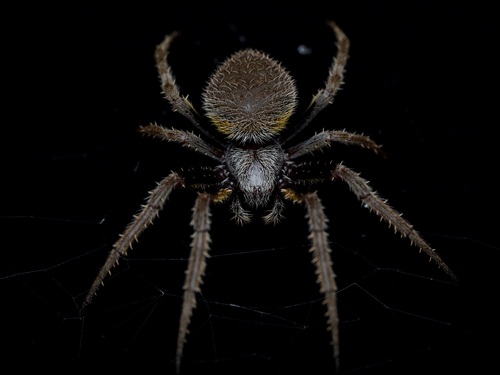
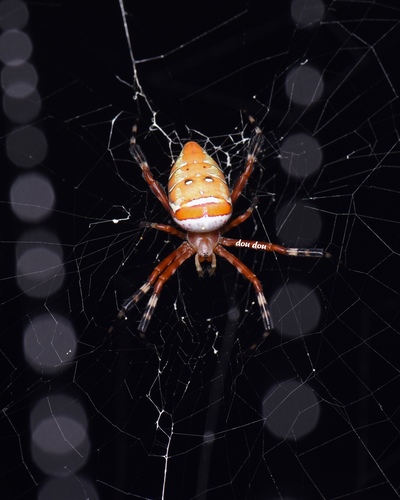
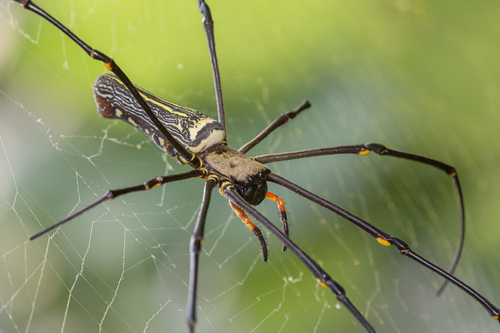
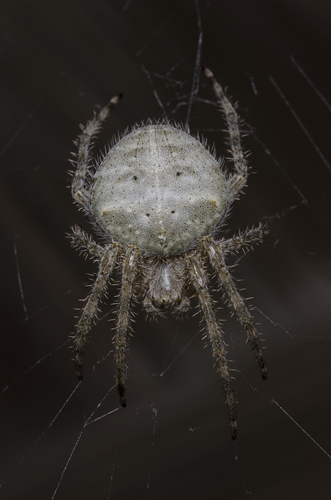
Araneus cavaticus, commonly called the barn spider, is predominantly yellow and brown with striped legs. Its underside is typically black with white markings, though overall coloration can vary quite widely. Adults are around three-quarters of an inch (20 mm) long, and can grow to an inch (25 mm) or longer, with large, round abdomens. This species shows sexual dimorphism: like most orb-weaver spiders, females are significantly larger than males. Araneus cavaticus is native to Canada and the United States. Barn spiders are nocturnal, and they build their orb webs under the cover of darkness. Their webs have symmetrical spokes connected by sticky spirals. After completing a web, the spider usually retreats to a nearby silk-lined hiding spot to wait for insects to become trapped. Typically, only female barn spiders build webs. The bite of a barn spider may or may not deliver venom. Their venom is considered non-toxic to most humans, comparable to any other non-toxic insect bite. Barn spiders are aggressive toward each other; they will attack one another if they are in close proximity, even though many can share the same structure or general area at the same time. They are most often found in rafters and wooden structures in suburban and rural areas, as well as on boats near lakes, which is how they got their common name "barn spider". When agitated, for example by a puff of air, these spiders sometimes bounce up and down in the center of their webs, likely to appear larger and more threatening. This reaction may be tied to their response to web vibrations when prey is trapped. Barn spiders shake or sway their webs either to trigger further movement from prey already caught in the web, or to confirm if the disturbance came from debris or other environmental causes like fallen leaves or sticks. They can also gather information about the object or insect disturbing the web through how the web moves as it shakes. If the spider detects that a potential meal has been caught, it will move to the prey and immediately wrap it in silk.