About Aramides axillaris Lawrence, 1863
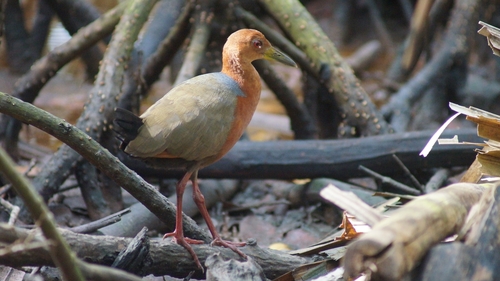
The rufous-necked wood rail (scientific name Aramides axillaris Lawrence, 1863) measures 29 to 33 cm (11 to 13 in) long and weighs approximately 300 to 325 g (11 to 11 oz). Males and females have identical plumage and features. Individuals have long, stout yellow-green bills, and red legs and feet. For adults, the head, neck, and breast are rufous brown. The nape and upper back are gray, while the remainder of the back is olive brown to greenish olive. The wings are a mix of greenish olive and chestnut. The rump, tail, flanks, and undertail coverts are black. The throat is white, and the belly is grayish brown. Juveniles are much duller in overall coloration than adults. Their upperparts share the same color pattern as adults, but are duller in tone. Their face, chin, and upper neck are buffy brown to dirty white, with a cinnamon tint. Their lower flanks and undertail coverts are deep brownish olive, and the rest of their underparts are buffy brown with an ochre cinnamon wash. The rufous-necked wood rail occurs in Mexico along the Pacific coast and the coast of the Yucatán Peninsula, and generally (though discontinuously) along both the Pacific and Caribbean coasts of Central America. In South America, it is found along the Pacific coast discontinuously from Colombia through Ecuador to northern Peru, along the Caribbean coast from Colombia through Venezuela and the Guianas, and on the island of Trinidad. Additionally, a vagrant individual stayed at Bosque del Apache National Wildlife Refuge in New Mexico for most of July 2013, and many birdwatchers traveled to the state to see it. For a long time, the rufous-necked wood rail was considered primarily a coastal species, and in parts of its range it is only known to occur in mangrove forest. However, a growing number of inland sightings in deciduous, humid, and montane forest at elevations up to 1,400 m (4,600 ft) suggest the species performs elevational migration, with mangroves used only as winter habitat.