About Aramides albiventris Lawrence, 1868
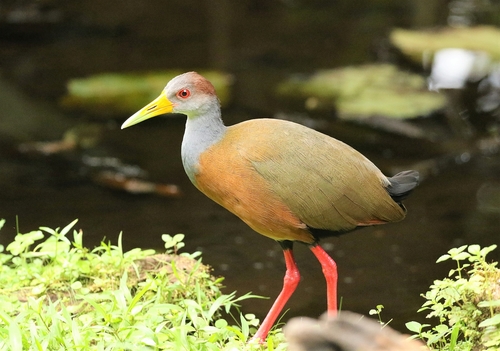
The russet-naped wood rail, Aramides albiventris Lawrence, 1868, is 33 to 40 cm (13 to 16 in) long and weighs approximately 450 to 600 g (16 to 21 oz). Both sexes have identical plumage, and the species' subspecies are practically indistinguishable from one another. Adult russet-naped wood rails have a thick dark yellow bill with a light green tip, a deep red eye, and red to pink legs and feet. Their forehead, crown, and hindneck are slate gray, with a chestnut patch on the back of the head. Their back is grayish olive, and their tail is black. Their chin and upper throat are white, while the sides of the neck, lower throat, and upper breast are gray. The remainder of the breast, upper belly, and flanks are pale tawny cinnamon, which blends into a pale band that separates these areas from the black lower belly, vent, and undertail coverts. Juveniles have no white on the belly; instead of the adult's black underparts, juvenile underparts are dark gray with tawny flecks.
Per the International Ornithological Congress, the subspecies of russet-naped wood rail have the following distributions: A. a. mexicanus is found in eastern Mexico, from southern Tamaulipas south onto the Yucatán Peninsula; A. a. vanrossemi occurs along the Pacific slope from Oaxaca in southern Mexico to southern Guatemala and El Salvador; A. a. albiventris ranges from the Yucatán Peninsula through Belize into northern Guatemala; A. a. pacificus is found on the Caribbean slope of Honduras and Nicaragua; A. a. plumbeicollis lives in northeastern Costa Rica.
The russet-naped wood rail inhabits a wide variety of both wet and dry landscapes. It can be found in fresh and salt marshes, swamp forest, river and stream corridors, thorn forest, semi-evergreen forest, and mangrove forest, as long as the landscape provides dense cover.