About Aralia californica S.Watson
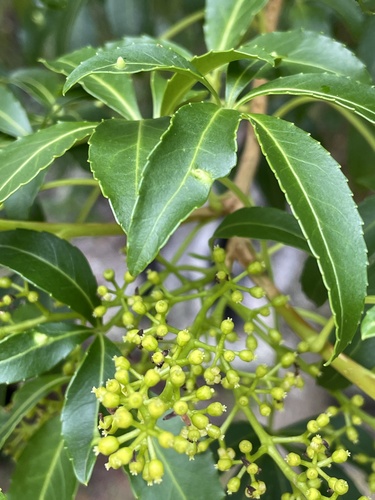
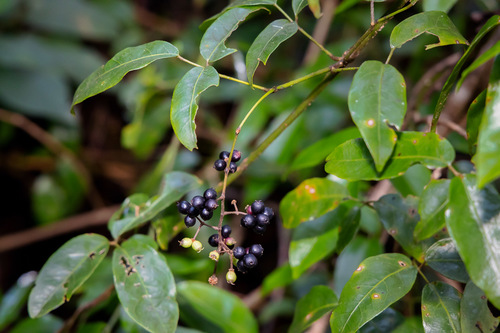
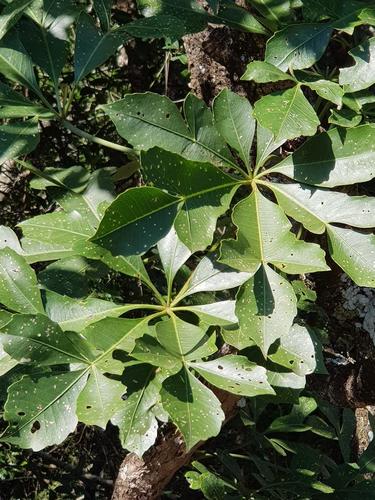
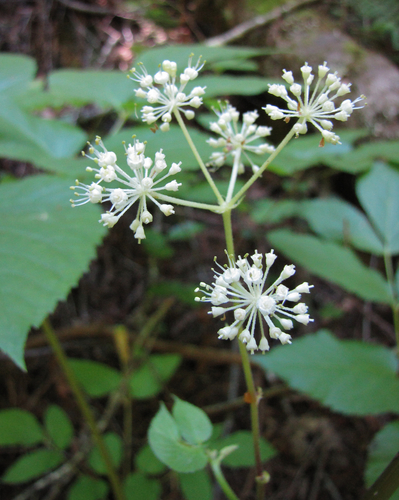
Aralia californica S.Watson is a deciduous, herbaceous perennial plant. It grows 2–3 meters tall on thick, non-woody stems. Its stems bear large green pinnately or tripinnately compound leaves that measure 1–2 meters long and 1 meter wide. Individual leaflets are 15–30 cm long and 7–15 cm broad, arranged oppositely along the leaf structure, with an odd terminal leaflet at the end. Greenish-white flowers form in large compound racemes of umbels at the stem apex, with the whole cluster measuring 30–45 cm across; each individual flower is 2–3 mm in diameter. After flowering, the plant produces small dark purple or black berries that are 3–5 mm wide, each containing 3–5 seeds.
Aralia californica is distributed across western and central California, and extends north into Oregon. It is most common in cooler, moister regions of northern California, particularly in the San Francisco Bay Area. Birds feed on the berries of this plant. This species is sometimes substituted for other Aralia species used in herbal remedies, such as American spikenard and Japanese spikenard. A preparation made from the root of Aralia californica has been traditionally used as an anti-inflammatory, a cough suppressant, and to treat arthritis. In the Konkow language, the Concow tribe calls this plant mâl-ē-mē'.