About Arachis hypogaea L.
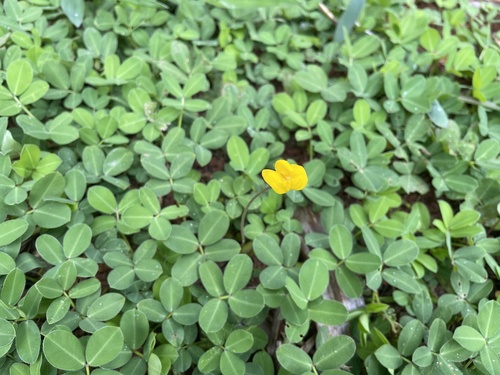
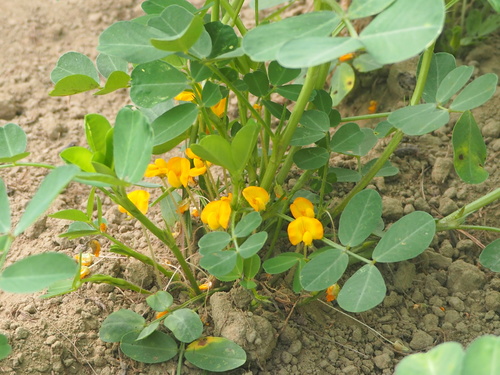
Arachis hypogaea L. was first formally described by Carl Linnaeus in his 1753 work Species Plantarum. This species is an annual herbaceous plant that reaches a height of 30 to 50 centimetres, or 12 to 20 inches. It is classified in the botanical family Fabaceae, which is also called Leguminosae, and is commonly known as the legume, bean, or pea family. As with other legumes, peanuts host symbiotic nitrogen-fixing bacteria in their root nodules. Its leaves are opposite and pinnate, with four leaflets arranged in two opposite pairs with no terminal leaflet. Each individual leaflet measures 1 to 7 centimetres (1⁄2 to 2+3⁄4 inches) in length, and 1 to 3 centimetres (1⁄2 to 1+1⁄4 inches) across. Like the leaves of many other legumes, peanut leaves are nyctinastic, meaning they perform "sleep" movements and close at night. The flowers are 1 to 1.5 centimetres (3⁄8 to 5⁄8 inches) across, yellowish orange in color with reddish veining, and grow in axillary clusters on the plant's stems. A defining unusual feature of peanuts is that their fruits develop underground, a trait called geocarpy. After fertilization, a short stalk at the base of the ovary—often called a gynophore, which appears to be part of the ovary—elongates to form a thread-like structure called a "peg". This peg grows down into the soil, allowing the fruit to develop underground. The peanut pods, which are technically legumes, are 3 to 7 centimetres (1 to 3 inches) long, and normally contain between one and four seeds. The outer shell of the peanut fruit is made primarily of mesocarp, with several large veins running lengthwise through it. Botanically, peanuts are not true nuts, which are defined as fruits where the ovary wall hardens at maturity. Peanuts contain polyphenols, polyunsaturated and monounsaturated fats, phytosterols, and dietary fiber in quantities that are similar to the levels found in many tree nuts. Resveratrol is found in peanut skins.