About Arabis aculeolata Greene
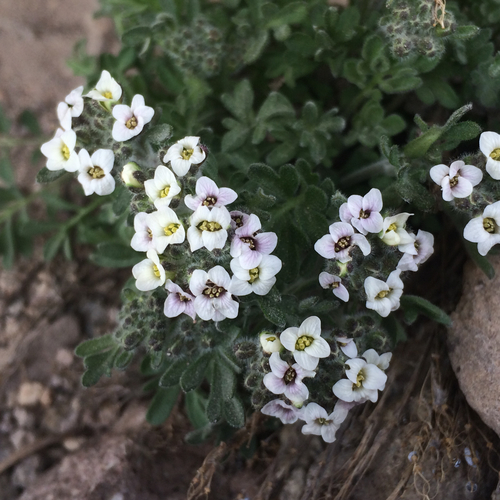
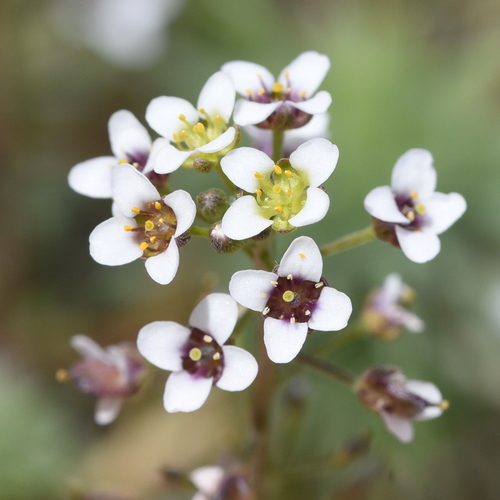
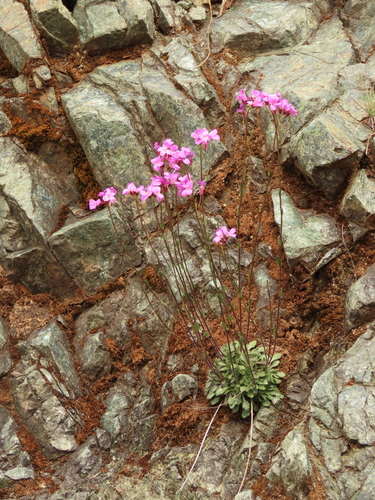
Arabis aculeolata Greene is a perennial herb that grows from a tough caudex covered in large hairs and the leaf bases left from previous growing seasons. It produces one or more upright stems that reach 20 to 35 centimeters in height. The stems are dark, often reddish or purplish, and covered in stiff white hairs. Leaves form a basal rosette around the caudex; they are oval-shaped, green, sparsely covered in coarse white hairs, up to 4 centimeters long, with smooth or wavy edges. Leaves growing higher on the stem are smaller. Leaf shapes can also be elliptic, oblanceolate, or obovate, with entire leaf margins. The inflorescence is a raceme. Flowers have dark purple sepals and lighter purple petals; overall bloom color can be pink or purple. The fruit is a long, thin, upright silique that grows up to 6.5 centimeters long. This species blooms from April through June. In the 1940s, some plants were observed that appeared to be intermediate between Arabis aculeolata and Arabis modesta, but this intermediate status has not been confirmed. This species is native to a small range in the mountains of southern Oregon and northern California, where it is an uncommon member of serpentine soils flora. It occurs in Del Norte and Siskiyou counties in California, and in Curry, Josephine, Jackson, and Douglas counties in Oregon. It grows at elevations between 200 and 1800 meters, in rocky hillsides and serpentine soils within yellow pine forest, red fir forest, lodgepole pine forest, and mixed evergreen forest communities. Its global conservation rank is G4 (apparently secure), with a S3 (vulnerable) rank in Oregon and S2 (endangered) rank in California. The global status of this species was last reviewed in 1989.