About Arabidopsis thaliana (L.) Heynh.
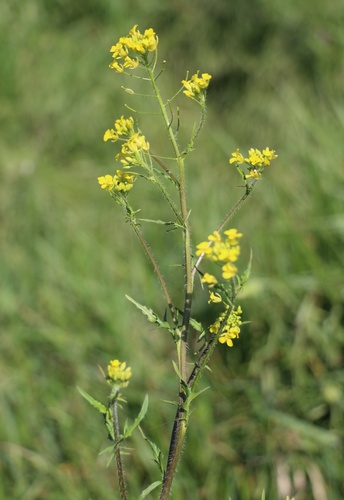
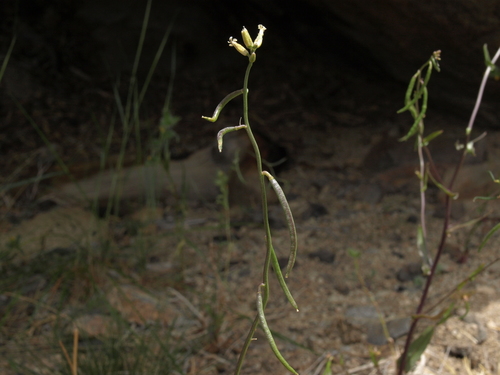
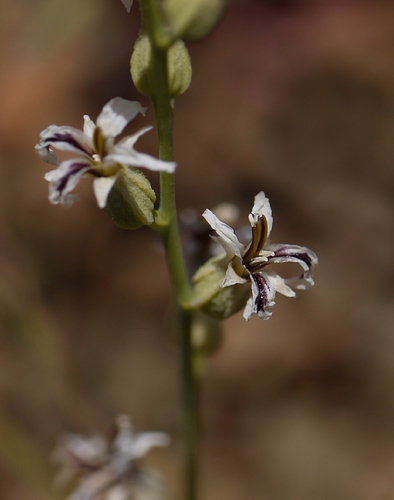
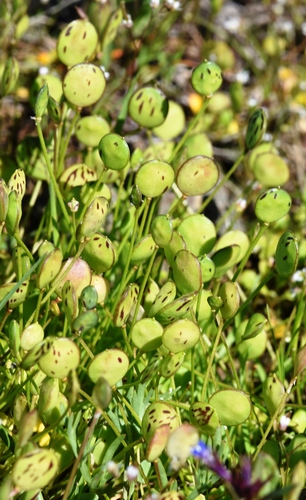
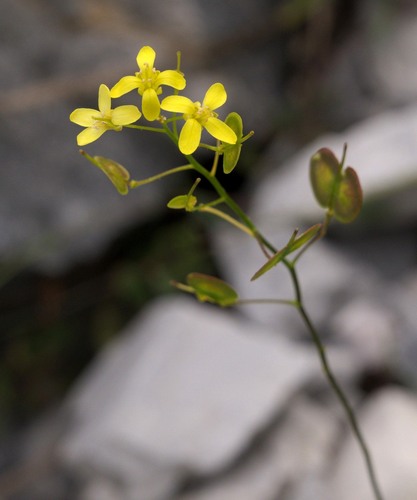
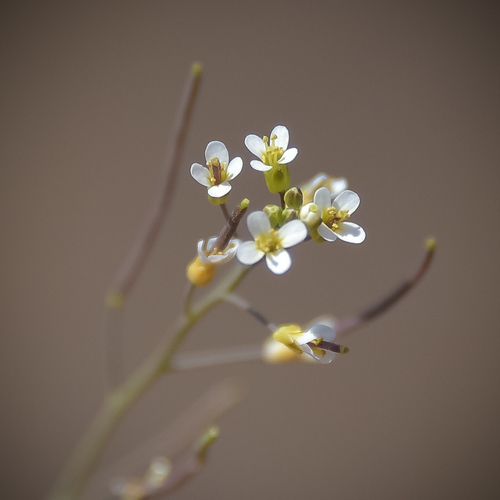
Arabidopsis thaliana (L.) Heynh. is most commonly an annual plant, and rarely biennial, that usually reaches 20–25 cm in height. Its leaves form a rosette at the plant's base, with a smaller number of leaves also growing along the flowering stem. Basal leaves range from green to slightly purplish, measuring 1.5–5 cm long and 2–10 mm broad, with margins that are anywhere from smooth to coarsely serrated. Stem leaves are smaller, stalkless, and typically have smooth margins. All leaves are covered in small, single-celled hairs called trichomes. Flowers of A. thaliana are 3 mm in diameter, arranged in a corymb, and have the standard flower structure of the Brassicaceae family. The fruit it produces is a silique 5–20 mm long, holding 20–30 seeds. Its root system is simple: a single primary root grows vertically downward, and later develops smaller lateral roots. These roots form ecological interactions with rhizosphere bacteria such as Bacillus megaterium. A. thaliana can complete its full life cycle in just six weeks. The central flowering stem develops after approximately three weeks of growth, and flowers naturally self-pollinate. In laboratory settings, A. thaliana can be grown in Petri plates, pots, or hydroponic systems, under fluorescent lighting or in a greenhouse. A. thaliana is native to Europe, Asia, and Africa, with a largely continuous native range stretching from the Mediterranean to Scandinavia, and from Spain to Greece. It also appears to be native to tropical alpine ecosystems in Africa, and possibly to South Africa. It has been introduced to and naturalized across the rest of the world, including North America where it was introduced around the 17th century. It grows easily and often acts as a pioneer species on rocky, sandy, and calcareous soils. It is generally classified as a weed because it is widespread across agricultural fields, roadsides, railway lines, waste ground, and other disturbed habitats, but it is not categorized as a noxious weed due to its small size and limited competitive ability. Like most species in the Brassicaceae family, A. thaliana is edible by humans when eaten raw in salads or cooked, but it is not widely used as a spring vegetable. A. thaliana is a predominantly self-pollinating species, with an estimated outcrossing rate of less than 0.3%. Analysis of genome-wide linkage disequilibrium patterns suggests self-pollination in this species evolved roughly a million years ago or earlier. Meioses leading to self-pollination are unlikely to generate large amounts of beneficial genetic variation, but they do provide the adaptive benefit of recombinational repair of DNA damages during germ cell formation each generation. This benefit may have been enough to allow the long-term persistence of meiosis even when it is followed by self-fertilization. The physical mechanism of self-pollination in A. thaliana is pre-anthesis autogamy, meaning fertilization largely occurs before the flower opens. Botanists and biologists began researching A. thaliana in the early 1900s, and the first systematic description of its mutants was completed around 1945. Today, A. thaliana is widely used to study plant sciences including genetics, evolution, population genetics, and plant development. While the plant itself has little direct agricultural importance, A. thaliana as a model organism has revolutionized scientific understanding of the genetic, cellular, and molecular biology of flowering plants. The first documented A. thaliana mutant was recorded in 1873 by Alexander Braun, who described a double flower phenotype; the mutated gene was likely Agamous, which was cloned and characterized in 1990. Friedrich Laibach, who first published A. thaliana's chromosome number in 1907, did not propose it as a model organism until 1943. His student Erna Reinholz published her thesis on A. thaliana in 1945, which described the first collection of A. thaliana mutants generated using X-ray mutagenesis. Laibach made further key contributions to A. thaliana research by collecting a large number of accessions, often questionably referred to as "ecotypes". With assistance from Albert Kranz, these were organized into a large collection of 750 natural A. thaliana accessions collected from around the world. In the 1950s and 1960s, John Langridge and George Rédei played important roles in establishing A. thaliana as a useful organism for biological laboratory experiments. Rédei wrote several scholarly reviews that helped introduce this model organism to the broader scientific community. The A. thaliana research community traces its origins to the newsletter Arabidopsis Information Service, established in 1964. The first International Arabidopsis Conference was held in 1965 in Göttingen, Germany. In the 1980s, A. thaliana became widely used in plant research laboratories around the world. It was one of several candidate model organisms alongside maize, petunia, and tobacco. Petunia and tobacco were attractive candidates at the time because they were easily transformable with the technologies available then, while maize was already a well-established genetic model for plant biology. 1986 was the breakthrough year for A. thaliana as a model plant: that year, researchers described both T-DNA-mediated transformation of A. thaliana and the first cloned A. thaliana gene.