About Aquilegia scopulorum Tidestr.
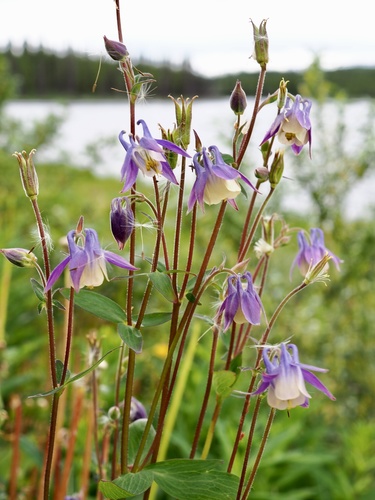
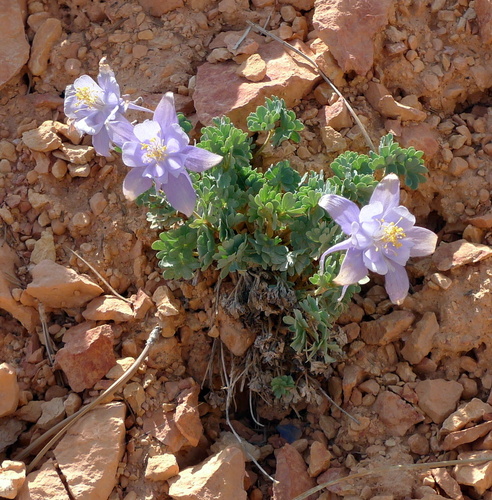
Rock columbine, scientifically known as Aquilegia scopulorum Tidestr., is a herbaceous plant that typically reaches 5–30 centimeters in height at maturity, and occasionally grows as tall as 40 cm. Stems and leaves emerge from a thick, branched caudex covered in old leaf stems. Its basal leaves, which grow directly from the plant base, are doubly compound (bipinnate). They are always shorter than the plant's flowering stems, spreading out to form a dense half-globe shape. Basal leaves are usually 2–11 cm long, and occasionally reach up to 22 cm in length. Individual leaflets are crowded together and overlap. Compared to the green leaves of Aquilegia coerulea (Rocky Mountain columbine), the leaves of rock columbine are somewhat blue-tinted. The leaflets are not sticky and hairless on both surfaces, but the primary petioles (main leaf stems) may be either smooth or covered in fine hairs. Plants may have one or multiple flowering stems, which may be branched or unbranched. Stems are topped with one or more large, attractive flowers that can range in color from vivid flax-blue to white or reddish purple. The spreading sepals are ovate-oblong (intermediate between egg-shaped and rounded rectangle), measuring 13–22 millimeters long and 4–10 mm wide. The five petals are 8–14 mm long and 4–7 mm wide, with slender spurs that measure 2.5 to 4 centimeters long. In addition to matching the colors of the sepals and spurs, the face of the petals can also be yellow. The fruits are clusters of multiple follicles, most often four or five, and sometimes as many as ten. They are upright and spread outward at their tips, and measure 1.5 to 2.2 cm long. The seeds inside the follicles are shiny, black, three-angled, and 1.9–2.3 mm long. Rock columbine is confirmed to grow in the U.S. states of Nevada and Utah. The Natural Resources Conservation Service (NRCS) also lists it as growing in Wyoming and Colorado, but the Flora of North America (FNA) considers the Wyoming record doubtful. According to the NRCS, it grows in seven counties in central and western Utah. In Nevada, it has been recorded in Clark, Nye, Lander, and White Pine counties. It grows at elevations between 2,000 and 3,500 meters (6,600 and 11,500 ft). Its native habitats include alpine slopes, scree (broken rock at the base of cliffs), and subalpine areas growing amid ponderosa pines and bristlecone pines on broken shale. Rock gardening expert and author Robert Nold praised rock columbine, writing, "In its time, in full flower, this is possibly the most beautiful plant in the rock garden." Like other alpine species grown in gardens, it is typically planted in deep scree, a mixture of equal parts small gravel, sand, and garden loam. However, it is adaptable to a wide range of soil textures as long as the soil is well-drained; it can even grow in clay soils if the soil is occasionally dry. Rock columbine cannot tolerate hot and humid summer conditions. In cultivation, it produces a main bloom in spring, then reblooms with a smaller number of flowers in summer. It is hardy in USDA plant hardiness zones 3–8. It was first cultivated by Carleton Worth in the 1950s, but only available as hybrids with other Aquilegia species by the 1960s. It was reintroduced to the commercial plant trade by Panayoti Kelaidis and Gwen Kelaidis in 1989.