About Aquilegia longissima A.Gray ex S.Watson
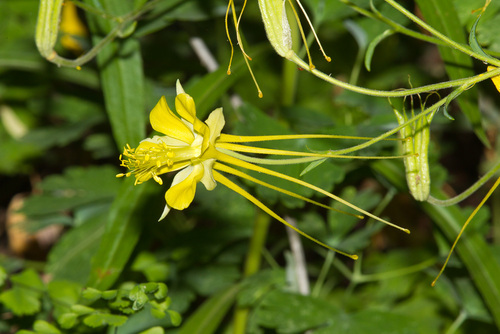
Aquilegia longissima grows between 25–90 cm (9.8–35.4 in) tall. Its biternate basal leaves measure 20–45 cm (7.9–17.7 in) across, and are usually shorter than the plant's stems. The flowers are erect, with pale yellow lanceolate sepals 25–40 mm (0.98–1.57 in) long that spread at right angles to the petals. The petals themselves are yellow, spoon-shaped, and 15–30 mm (0.59–1.18 in) long. The species' most notable feature is its extremely long nectar spurs, which measure 72–180 mm (2.8–7.1 in). These spurs are straight, evenly tapered, very slender, and usually hang straight down; they are the longest spurs of any eudicot. Aquilegia longissima is native to Trans-Pecos Texas and southern Arizona in the United States, and to Chihuahua, Coahuila, Nuevo León, and Sonora in northern Mexico. It grows at altitudes of 1,370–1,520 m (4,490–4,990 ft) in gravelly limestone or igneous soils. It can be found on canyon walls, and along streams, drainages, springs, or waterfalls, within shady, mesic canyons of pine-oak or pine-oak-juniper woodlands. Aquilegia longissima flowers from July to September. In 1883, William Trelease hypothesized that the most likely pollinator of A. longissima would be the giant sphinx moth, Cocytius antaeus. The giant sphinx moth is a rare stray in west Texas, and has been collected in Big Bend National Park near populations of long-spur columbine. However, the common pollinators are likely large hawkmoths in the genera Manduca and Agrius, which have tongue lengths from 9–14 cm (3.5–5.5 in) long. Hybridization is common among columbines, and populations with intermediate spur lengths of 7–9 cm (2.8–3.5 in) are found near some long-spur columbine populations. One such population is located at Cattail Falls in Big Bend National Park, a site that is significantly impacted by human visitation.