About Aquilegia chrysantha A.Gray
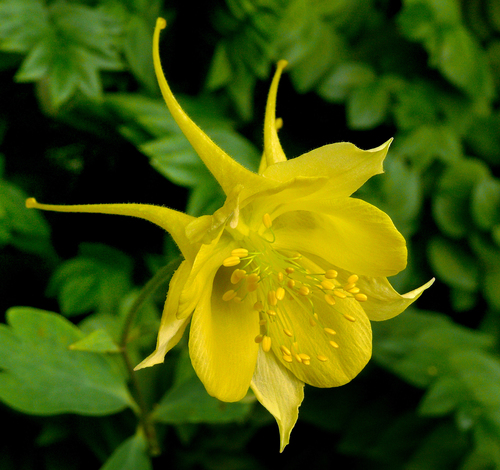
Aquilegia chrysantha A.Gray has ferny foliage, with each leaf made up of three three-lobed leaflets. Leaves grow both from the plant’s base and along its flowering stems. Flowers are borne on a long stem that sits above the foliage, and all floral parts are golden yellow. Each flower has five pointed yellow sepals, five yellow petals with long backward-projecting spurs that measure around 6.7 cm (2.6 in) between the sepals. The sepals themselves range from 20 millimetres (0.79 in) to 35 millimetres (1.4 in) in length, and can be spreading, lanceolate, or somewhat oval in shape. Many yellow stamens sit at the center of the flower. Flowering stems of this species grow between 40 centimetres (16 in) to 120 centimetres (47 in) tall. When cultivated, this species reaches maturity in at minimum two years. It is polycarpic, meaning it drops seeds multiple times over its lifespan, which is longer than the lifespan of other Aquilegia species. This species is monoecious, with unisexual flowers: each individual flower holds exclusively either stamens or carpels. Aquilegia chrysantha resembles the yellow-flowered Aquilegia flavescens, but A. chrysantha is more drought resistant and has a longer blooming period. Primary pollinators include moths, butterflies, and bees; one ecological account notes it is chiefly pollinated by the Achemon sphinx moth (Eumorpha achemon) and other Sphinx genus moths, and is occasionally visited by large bees and hummingbirds. Its general blooming period falls between April and September, with the peak bloom occurring anywhere from late spring to late summer; one ecological source notes blooming occurs in May and early June. This plant requires moist, well-drained growing conditions to thrive; poor drainage leads to root crown rot, excessive heat raises the risk of infestation by aphids and spider mites, and extended warm periods can trigger the plant to go dormant. Wild specimens observed in southern Arizona in May and June 1980 generally had a faint scent; during this survey, one individual was found with pink sepals and spurs and yellow petals, a pattern also seen in some Aquilegia micrantha populations from Colorado and Utah. There are two described varieties that are not universally accepted. Aquilegia chrysantha var. hinckleyana has leaves that are divided into two parts, with petal blades that measure only 2 centimetres (0.79 in) long by 16 millimetres (0.63 in) wide. An unusually disjunct population of A. chrysantha grows in south-central Colorado, separated from the rest of the species’ range. Plants in this population typically have smaller flowers: sepals measure only 10 millimetres (0.39 in) to 18 millimetres (0.71 in) long, and spurs measure 35 millimetres (1.4 in) to 40 millimetres (1.6 in) long. This population is sometimes classified as the separate variety A. chrysantha var. rydbergii, but this distinction is not recognized in the Flora of North America. In 1881, botanist Thomas Meehan recorded that A. chrysantha had apparently proliferated in the Colorado Springs area, particularly around Cheyenne Cañon and Glen Eyrie, since the area was last surveyed by botanists in 1871 and 1873. Meehan theorized that increased human habitation in the area, which altered local environmental conditions, was partially responsible for this rapid spread. The columbine population native to the Baboquivari Mountains of southern Arizona has been the subject of taxonomic debate; it is sometimes described as a variety of A. chrysantha, and sometimes classified as part of the species Aquilegia longissima. This species is native to the southwestern United States, ranging from extreme southern Utah to Texas, and includes populations in Arizona, Colorado, and New Mexico. It also grows in northwestern Mexico, in the states of Sonora, Chihuahua, Coahuila, and Nuevo Leon. In its native range, it grows in moist mountainous habitats, at elevations between 910 metres (2,990 ft) and 3,350 metres (10,990 ft) above sea level. In cultivation, Aquilegia chrysantha grows well in a range of soil types as long as it receives adequate moisture, good drainage, and shade. It is valued for its large flowers and is a parent of many popular garden hybrids. Some cultivated selections, such as the white-flowered 'Alba', were given pseudo-botanical names in the 19th century. Seeds have been collected from the Baboquivari Mountains population for private cultivation. The cultivar 'Yellow Queen' has earned the Royal Horticultural Society's Award of Garden Merit; it is often sold under the species name A. chrysantha, and is known for its very large yellow flowers, longer lifespan, and greater flower production than the wild-type A. chrysantha. 'Yellow Queen' flowers have darker yellow central petals, and bloom in May and June in the northern hemisphere. This cultivar prefers moist, well-drained soil that can be clay, sand, or loam. The most valued garden hybrids come from crosses between A. coerulea and A. chrysantha, sometimes with A. formosa added to introduce red coloring. These hybrids show traits from both parent species and have relatively short lifespans; seed of these hybrids is widely available in North America. Aquilegia x jaeschkanii, thought to be a cross between A. chrysantha and Aquilegia skinneri, is a less popular, less valued hybrid. In 1916, botanist Theodore D. A. Cockerell described an F1 hybrid created by his wife Wilmatte P. Cockerell from a cross between A. chrysantha and Aquilegia desertorum. Cockerell observed that flower color and flowering time were both indeterminate in this hybrid. While the flower form of F1 A. desertorum × chrysantha is less similar to either parent and more characteristic of species in the Aquilegia vulgaris group, the flower width matches the typical width seen in A. chrysantha. Cockerell also noted that A. chrysantha × A. coerulea hybrids had long been common in cultivation; this hybrid produces paler flowers than A. coerulea, with yellow coloring.