About Aquila verreauxii Lesson, 1831
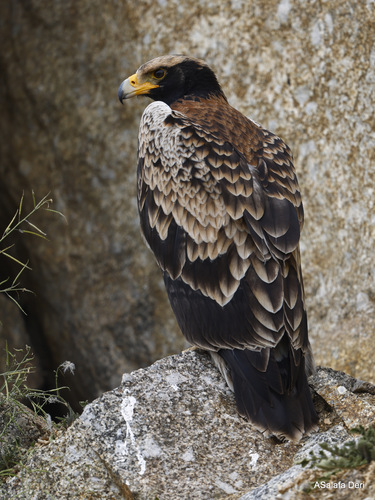
Verreaux's eagle (Aquila verreauxii Lesson, 1831) is a very large eagle. It measures 75 to 96 cm (30 to 38 in) from bill to tail tip, making it the sixth longest eagle in the world. Males weigh 3 to 4.2 kg (6.6 to 9.3 lb), while the larger females weigh 3.1 to 7 kg (6.8 to 15.4 lb). Across 21 individuals of both sexes, the average weight is approximately 4.19 kg (9.2 lb). Other studies have recorded lower average body masses: 3.32 kg (7.3 lb) from seven unsexed birds, and 3.72 kg (8.2 lb) from four unsexed birds in an additional study. Another study found seven males averaged 3.76 kg (8.3 lb) and seven females averaged 4.31 kg (9.5 lb), while a different group of four weighed females averaged 4.6 kg (10 lb). Overall, it is the seventh or eighth heaviest living eagle in the world. In average mass and total weight range (if not linear measurements), Verreaux's eagle is very similar in size to its occasional competitor, the martial eagle, which is commonly called the largest eagle in Africa. It also rivals both the martial eagle and golden eagle as the largest living member of the booted eagle group. It has a wingspan of 1.81 to 2.3 m (5 ft 11 in to 7 ft 7 in). Male wing chord measures 56.5 to 59.5 cm (22.2 to 23.4 in), while female wing chord measures 59 to 64 cm (23 to 25 in). For other standard body measurements, both sexes have a tail length of 27.2 to 36 cm (10.7 to 14.2 in) and a tarsus length of 9.5 to 11 cm (3.7 to 4.3 in). Other than the female's slight size advantage, adult males and females cannot be told apart physically. Adult Verreaux's eagles are mostly jet-black. The yellow color of the cere (the bill itself is gun-metal grey), eye-ring and "eye-brows" stand out sharply against the black plumage. A more prominent feature visible on flying birds from above is white marking on the back, rump, upper-tail coverts and part of the scapulars, which forms a V-shaped patch. This patch is partially hidden when the bird is perched. Adults also have noticeable white patches on the wing quills at the carpal joint (at the base of the primaries) that can be seen when flying from both above and below. The species has a stout bill, a prominent head on a relatively long neck, and fully feathered legs. Juvenile and immature Verreaux's eagles have plumage that differs greatly from adult plumage. They are overall dark brown. Immatures have a strongly contrasting golden crown, and a rufous or ginger nape and mantle. They have small white streaks on the forehead and black coloring on their cheeks. The throat is dark streaked, the lower throat is pale brown, and the upper-chest is brown. The rest of the underside is brown, apart from a blackish-blotched rufous to cream-colored abdomen and lightly marked creamy thighs and legs. The feathers of the upper-tail and upper-wing coverts of young birds are brown with white streaks, while the other tail and wing quills are nearly black. When seen from below in flight, the wing quills show considerable whitish mottling, with more extensive white than is typically seen in adult plumages. Immatures have a dark brown iris and yellowish feet. Black feathers gradually increase between 2 and 5 years of age, mixed in with scattered brown-tipped feathers. The contrasting creamy trousers are maintained through the third year. By the fourth year, individuals look dark grey-brown with a buff patch on the nape and mottling from remaining brownish feathers. At the end of the subadult phase, around 5 years of age, the plumage is almost indistinguishable from that of an adult. Full adult plumage is likely attained between 5 and 6 years of age. Verreaux's eagle is essentially unmistakeable, especially as an adult. No other black-colored raptor in its native range reaches this species' large size, or has its distinctive white patterning. The golden eagle is similar in size or marginally larger; the two species are the heaviest living Aquila species, and are only marginally smaller in total wing length and bill-to-tail length than the slightly lighter-weight Australasian wedge-tailed eagle. While juvenile Verreaux's eagles are quite different from adults, their plumage is no less distinctive. No other accipitrid has the combination of a mottled brownish body, blackish wings with large white patches, and contrasting whitish, rufous and golden color around the head and neck. The flight profile of Verreaux's eagle is also distinctive: it is the only Aquila species other than the golden eagle that soars in a pronounced dihedral, with wings held slightly above the back and primaries upturned at the tip to form a V shape. In the Bale Mountains of Ethiopia, and possibly parts of the Arabian Peninsula and the southwestern edge of the Middle East, the ranges of the golden eagle and Verreaux's eagle overlap. Golden eagles are mostly brown and do not share Verreaux's eagle's black plumage. Immature golden eagles have white underwing patches like Verreaux's eagles, but these patches are less extensive than those of Verreaux's eagles. Wing shape also differs between the two species: Verreaux's eagle has very broad outer secondaries and a relatively narrow pinch at the base of the primaries, while a golden eagle's wing tapers more gradually. Verreaux's eagle wings have been variously described as paddle-shaped, spoon-shaped or leaf-shaped. Imperial eagles also have white markings on their wing coverts, but differ in flight profile (they have flatter wings) and overall coloration (they are dark brown). Verreaux's eagle has specific habitat requirements and is rare outside of its preferred habitat type. It lives in kopjes, which are dry, rocky environments ranging from rocky hills to high mountains, including cliffs, gorges and inselbergs, often surrounded by savanna, thornbush and sub-desert. It is most often found in dry areas with less than 60 cm (24 in) of average annual rainfall. It reaches its highest elevations in Ethiopia and East Africa, where it occurs up to 4,000 m (13,000 ft) above sea level. Verreaux's eagle is found from the Marra Mountains of Sudan southward through Sudan to 16°N in Eritrea, along the northern mountains of Somalia, across most of Ethiopia (mostly the central, mountainous spine), and possibly occurs in some mountains in northeastern Uganda, Kenya, easternmost Democratic Republic of the Congo and Tanzania. Southeastern Africa forms the core of Verreaux's eagle's range: they are found in most mountain ranges in Malawi except the Nyika Plateau, the Mafinga Hills and the Lulwe Hills; in Zambia (especially the escarpments bordering Lake Kariba to the gorges below Victoria Falls); in Zimbabwe (especially east of the central plateau); Mozambique, Eswatini, Lesotho, and south into South Africa, where they mostly inhabit the Karoo, the cliffs of the Great Escarpment, the Cape Fold Mountains and Cape Peninsula. A sparser distribution occurs in Botswana, western Namibia and southwestern Angola (in the Serra da Chela). Elsewhere in Africa, Verreaux's eagle may occur but is rare and only seen occasionally: examples include eastern Mali, northeastern Chad, the Aïr Mountains of Niger and southwestern Cameroon, where it is only known as a vagrant. In 1968, only a single record of Verreaux's eagle (from Jordan) was known from outside of Africa, but it is now known to be a rare breeder in the Middle East: based on a handful of immature records and territorial adult behavior, breeding has been inferred in Lebanon, Israel, Oman, Saudi Arabia and Yemen. Two species make up considerably more than half (often more than 90%) of Verreaux's eagle's diet: the Cape hyrax (Procavia capensis) and the yellow-spotted rock hyrax (Heterohyrax brucei). Few other accipitrids are as uniquely specialized to hunt a single prey family as Verreaux's eagles, with the possible exceptions of the snail kite (Rostrhamus sociabilis) and the slender-billed kite (Helicolestes hamatus), which are specialized to hunt Pomacea snails. Even accipitrids named for their staple food are not as specialized: examples include the bat hawk (Macheiramphus alcinus), palm-nut vulture (Gypohierax angolensis), lizard buzzard (Kaupifalco monogrammicus) and possibly the rufous crab hawk (Buteogallus aequinoctialis). Verreaux's eagle certainly has the most conservative diet of any Aquila species, though its diet is more diverse in South Africa than in Zimbabwe. In the Matobo Hills of Zimbabwe, the two hyrax species made up 1,448 out of 1,550 recorded prey items at eagle eyries counted just after the breeding season from 1995 to 2003. In the same area, from 1957 to 1990, 98.1% of the diet was made up of rock hyrax. In a sample of 224 prey remains from 102 nests in Serengeti National Park in Tanzania, 99.1% of the remains were hyrax. Elsewhere in Tanzania, the diet is more mixed, with 53.7% of remains from 24 nests being hyrax. In a nest in South Africa, 89.1% of remains from a sample of 55 were hyrax. No detailed statistics are available, but hyraxes are likely the main prey in every population, and have been recorded as the dominant part of the diet in Mozambique, Malawi and Botswana. A pair with young may take around 400 hyraxes per year. The entire distribution of Verreaux's eagle aligns closely with the distribution of the two species of rock hyrax. To date, there are no known records of Verreaux's eagle hunting the two species of tree hyraxes. In the first 10 years of constant observation of the Matobo Hills population, only two kills were witnessed. Enough hunting behavior has ultimately been observed to give a clear understanding of how Verreaux's eagle captures prey. This species most often forages in low-level quartering flight, and rock hyraxes are chiefly caught after a rapid, somewhat twisting dive within seconds of the eagle surprising the hyrax. Like the golden eagle, Verreaux's eagle uses the natural contours of the ground in rocky and mountainous habitats to increase the element of surprise, since hyraxes are highly wary of their many predators. Verreaux's eagle has been recorded hunting from a perch, though this rarely happens. Cooperative hunting of hyrax has been recorded, where one eagle from a pair flies past and distracts prey while the other strikes from behind. Verreaux's eagle may knock hyraxes off cliffs and take arboreal prey from treetops, but it usually kills on the ground. The estimated daily food requirement for this species is around 350 g (12 oz), nearly a third more than that of a golden eagle, despite the golden eagle's slightly heavier body weight. Rock hyraxes are often hard for humans to observe beyond a quick glimpse, but a Verreaux's eagle can fly out, catch prey, and return to the nest in just a few minutes. Of the two regularly taken hyrax species, the yellow-spotted rock hyrax can weigh from 1 to 3.63 kg (2.2 to 8.0 lb), with an average of 2.4 kg (5.3 lb). Specimens from Zimbabwe are noticeably heavier and larger than specimens from Serengeti National Park. Cape hyraxes weigh from 1.8 to 5.5 kg (4.0 to 12.1 lb), with an average of around 3.14 kg (6.9 lb), and can be even larger than Verreaux's eagles themselves, making them harder to kill. Yellow-spotted rock hyraxes are more often taken in the Matobo Hills, possibly because of their smaller size or more strictly diurnal habits. Adult rock hyraxes are disproportionately selected, likely because they spend more time out in the open. For Cape hyraxes, 1- to 2-year-old males are particularly vulnerable, since they are forced to disperse when they reach sexual maturity. Juvenile hyraxes made up 11–33% of prey remains in the Western Cape, while 18% of hyraxes killed in the Matobo Hills were juveniles. Because of their greater weight, Cape hyraxes are often either consumed at the kill site (which leaves the eagle at risk of losing prey to competing predators or being attacked by large mammalian carnivores) or decapitated before being brought to the nest or perch. Fewer skulls or jaws of Cape hyraxes than of yellow-spotted rock hyraxes have been found at nest sites. However, the Cape hyrax has a wider distribution than the yellow-spotted rock hyrax, and Verreaux's eagle may hunt almost exclusively Cape hyrax outside the long band of eastern Africa where the smaller yellow-spotted species is found. Compared to the golden eagle, Verreaux's eagle has a foot pad that is about 20% wider, which may be an adaptation to capturing bulky, broad-backed rock hyrax. The foot of a Verreaux's eagle is reported to be larger than a human hand. The enlarged rear hallux claw of Verreaux's eagle averages 52.3 mm (2.06 in) in 4 females and 49.1 mm (1.93 in) in 5 males, which is quite similar in size to that of a golden eagle. In South Africa, where the Cape hyrax is the main prey species, the estimated mean size of prey brought to the nest is around 2.6 kg (5.7 lb), perhaps twice as heavy as prey taken by some nesting golden eagles. However, the mean size of prey taken by Verreaux's eagle in the Matobo Hills, where more yellow-spotted rock hyrax are taken, was around 1.82 kg (4.0 lb), around the same estimated weight as prey taken by golden eagles in Europe, and smaller than the average estimated mass of prey brought to golden eagle nests in regions like Scotland or Mongolia.