About Aquila spilogaster (Bonaparte, 1850)
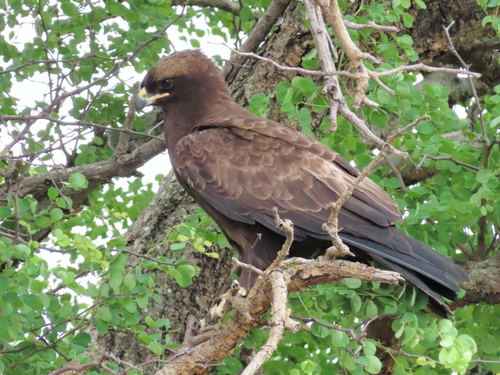
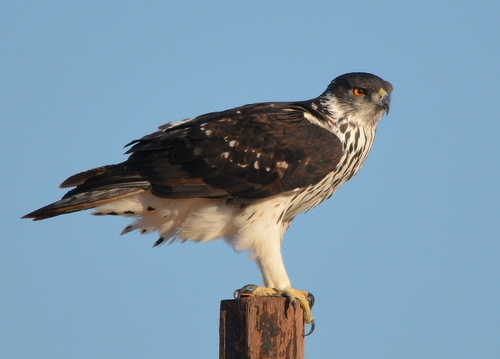
The African hawk-eagle (Aquila spilogaster, Bonaparte 1850) has a small head that protrudes prominently due to its long neck, a relatively large beak, a longish tail, long and fairly slender feathered legs, and large, robust feet. Its wing tips usually end slightly short of the tail tip. While this species sometimes perches in open areas, it most often stays hidden in foliage for most of the day, and typically perches relatively low in tall trees. Adult African hawk-eagles have a distinctly pied plumage: slate black-grey upperparts and whitish underparts. From a distance, they can appear purely black and white, but at close range, sparse but extensive white flecks are visible on the mantle and wing coverts. A greyer patch may occasionally be visible on the folded secondaries of perched birds. The adult’s tail is grey with thin dark bars, a broad subterminal band, and a white tail tip. The underside is white with bold but small, sparse drop-shaped blackish streaks. As noted in a 2010 study, this species follows the typical plumage sexual dimorphism of Aquilinae eagles: adult males have sparser underside markings, while adult females have denser markings. This difference is pronounced enough that experienced observers can usually sex individuals, even though the two sexes are similar in size. Adult thighs and crissum are whitish. Juvenile African hawk-eagles are very different from mature individuals. Juveniles have moderately dark brown upperparts with pale edging, a slightly black-streaked head, and a more clearly barred tail than adults. Their underside has a tawny-rufous base color. When black shaft streaks are present on the underside of juveniles, they are usually only visible on the flanks, and may be nearly absent. By the immature stage, at two to four years old, the upperside becomes progressively darker, the underside becomes paler and more streaked, and a subterminal tail band forms. Like related species, the African hawk-eagle reaches full maturity at four years old. Adult eyes are rich yellow, while juvenile eyes are hazel-brown; the cere and feet are dull to moderately bright yellow at all ages. In flight, the African hawk-eagle is a mid-sized raptor with a small but well-protruding head, a longish tail, and wings that are neither particularly long nor broad. It flies with powerful, shallow wing beats. When gliding or soaring, it holds its wings well spread, and only slightly presses its carpal points forward when gliding. In flight, adult African hawk-eagles show a prominent pale whitish-grey window on the upper side of the wing at the base of the primaries, which extends into dark grey panels across the black-tipped secondaries. From a distance, only the broad subterminal band and faint obscure bars are visible on the grey tail. From below, the black trailing edges contrast with greyish white flight feathers, and the prominent subterminal band is both bordered by paler grey feathering. Solid black diagonal markings on the greater coverts merge, creating a characteristic underwing pattern for flying adults. For flying juveniles viewed from above, the most distinct features are a contrasting creamy window on the upper wing (similar to adults) and a barred tail. From below, juvenile African hawk-eagles have rufous wing linings that match the forebody, with variable dusky edges that often form carpal arcs, and sometimes extend as wing diagonals. The rest of the juvenile’s wings are fairly nondescript, with greyish buff secondaries, thinly barred tail, and white-based primaries. The African hawk-eagle is mostly allopatric with its closest extant relative and sister species, the Bonelli's eagle, though identification may be required in the Red Sea area where there is minimal range overlap. Bonelli's eagles are larger, with a relatively broader head, shorter neck, proportionately longer wings, and a shorter tail. Adult Bonelli's eagles are much lighter and browner on the dorsum, usually have a white mantle patch, and lack pale upper wing panels. Bonelli's eagles have less contrasting underpart markings, being generally creamy with no strong markings. Juvenile Bonelli's eagles are somewhat similar to juvenile African hawk-eagles, but can be distinguished by different body proportions, a paler back, and the absence of the clear wing windows seen in juvenile African hawk-eagles. There are a few other largish raptors in sub-Saharan Africa that are mostly black dorsally and white ventrally, but the African hawk-eagle is the largest and has the most typical aquiline build and posture. Adult Ayres's hawk-eagle (Hieraaetus ayresii) is sometimes considered similar, but it is smaller, more compact, rounder-headed, and may have a nuchal crest. It also lacks the wing upper side windows seen in the African hawk-eagle, and has more even blotching or streaking across the entire underbody, wing linings, and legs. Additionally, Ayres's hawk-eagle has less heavy dark markings on the wings, with more black spotting and splotching, and lacks the black wing trailing edges and subterminal tail band of the African hawk-eagle. Juvenile Ayres's hawk-eagles can be similar to juvenile African hawk-eagles when viewed from below in flight, but they are usually paler rufous with darker quills, generally much paler on the upperparts with whitish scaling, and have a rufous crown and mantle. Furthermore, all plumages of Ayres's hawk-eagle have white 'landing lights', similar to those of the booted eagle (Hieraaetus pennatus). Other pied raptors in Africa that vaguely resemble the African hawk-eagle, including black sparrowhawk (Accipiter melanoleucus), augur buzzard (Buteo augur), and Cassin's hawk eagle (Aquila africana), are clearly distinct in appearance, proportions, and habitat. Of these three, adult Cassin's hawk-eagle is the most similar in structure and appearance to the African hawk-eagle, but the two are mostly allopatric. Cassin's hawk-eagle typically lives in mature forests, while the African hawk-eagle inhabits sparser, drier wooded savanna habitats. Compared to Cassin's hawk-eagle, the African hawk-eagle is larger, has a shorter tail and much longer wings, has much heavier underbody markings, more dense black markings on the mid-wings, and barely barred quills. From a distance, the flight profile of the African hawk-eagle can resemble that of the European honey-buzzard (Pernis apivorus), but that species has an even smaller head, and very different wing movement and patterning, so confusion is quite unlikely. Confusion with the far larger and bulkier crowned eagle (Stephanoaetus coronatus), even at distance, is even more unlikely, as it is very distinct in color and has relatively shorter but much broader wings. Another species that may need to be distinguished from juvenile African hawk-eagles in distant flight is the juvenile booted eagle. That species is smaller, but has proportionately much longer wings and a shorter tail than the juvenile African hawk-eagle. It also has a barred tail and a completely different underwing pattern. The African hawk-eagle occurs across much of sub-Saharan Africa. Its northernmost range extends to eastern Eritrea and adjacent parts of Ethiopia; after a large gap, the range continues through almost all of southern Ethiopia. It is rare in West Africa, so it has been little studied there. In West Africa, it can be found in southern Senegal, The Gambia, Guinea-Bissau, eastern Guinea, the northernmost part of Sierra Leone, Côte d'Ivoire, Burkina Faso, the northern portions of Ghana, Togo and Benin, and north-central Nigeria. In central and East Africa, its range includes southern Chad, southern Sudan (where it is fairly rare), South Sudan, western Somalia, central and southern Democratic Republic of the Congo, and almost all of Uganda, Kenya, and Tanzania. In southern Africa, the species occurs in suitable habitats across northern countries including Angola, Zambia, Mozambique, Malawi, Zimbabwe, north-central Namibia, northern and eastern Botswana, and northeastern South Africa north of the Orange River. The species is extirpated or nearly extirpated from Eswatini, with the last confirmed breeding recorded in 2002. While there have been claims of the species occurring as far south as Cape Province in South Africa, these are almost certainly records of vagrants, and no persistent population likely exists in southern South Africa. This is a bird of well-wooded countryside. It favors tropical broadleaf woodland and woodland edge within savanna, but does not typically occur in true deep forest. It can also adapt to thornbush areas such as the veld, but occurs more often in riparian zones, which support strips of taller trees. Miombo, and especially Mopane, woodland can be central to the species’ persistence in southern Africa. A study from Zimbabwe confirmed that the species avoids more enclosed woodlands, preferring lower density woodlands. Overall, it prefers fairly dry areas, but data from West Africa, Kenya, and Botswana shows it prefers areas with moderate rainfall; it avoids very wet areas such as the Kenyan highlands, and also avoids very arid locations. It is not uncommon for the species to be found near waterways, including ephemeral rivers, and watering holes, especially since these areas support tall trees in otherwise dry regions of Africa and often hold concentrated prey populations. Secondarily, the African hawk-eagle may be seen in fairly open, sparse savanna and various semi-desert areas, while it generally avoids evergreen forests and mountainous areas. However, there are rare records of this species nesting on cliff faces in Kenya, which is an uncommon occurrence unlike the typical behavior of Bonelli's eagles. There are records of the African hawk-eagle visiting (if not nesting in) cultivated areas such as arable land and pastureland, and occasionally nesting in well-treed, low-disturbance plantations. However, the species typically appears to require protected areas to successfully breed. It has been recorded from sea level up to around 3,000 m (9,800 ft), but mainly occurs below 1,500 m (4,900 ft).