About Aquila pomarina C.L.Brehm, 1831
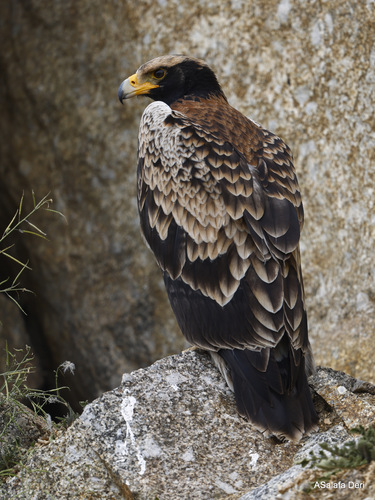
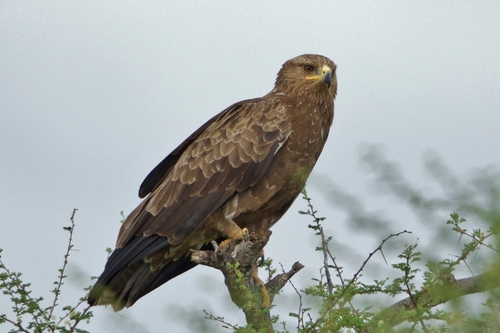
This is a medium-sized eagle, measuring approximately 60 cm (24 in) in length with a 150 cm (59 in) wingspan. Its pale brown head and wing coverts contrast against its otherwise generally dark plumage. Compared to other eagles, it has a small head and bill. A white patch usually appears on the upper wings, and even adult individuals keep a clearly marked white "V" marking on the rump; these wing markings are absent and the white "V" is not well-defined in the greater spotted eagle. Juvenile lesser spotted eagles have less contrast in their wings, but their remiges bear prominent white spots. They differ from juvenile greater spotted eagles by having no spotting on their wing coverts and possessing a cream-colored neck patch. The call of this species is a dog-like yip. The lesser spotted eagle breeds in Central and Eastern Europe, extending southeastward to Turkey and Armenia, and winters in Africa. It is a very wary species that lives in open or lightly wooded country, where it hunts small mammals (especially voles, ground squirrels, rats, and mice) and other similar terrestrial prey, including small birds, amphibians, and reptiles. It occasionally eats insects, including termites, and is known to sometimes feed on carrion. In the north-western part of its distribution, the lesser spotted eagle occupies regularly spaced territories that it uses consistently year after year. The distances between territories vary across this region, and this variation was not found to be linked to breeding success. Synchronous changes in breeding success across the region show that the eagles are instead affected by large-scale factors such as fluctuations in climate or prey availability. The lesser spotted eagle lays one to three white eggs with buff spots in a tree nest. As is typical for eagles, more than one young fledges only in breeding seasons with very abundant prey. The female starts incubating as soon as the first egg is laid, so the first young to hatch usually outgrows its clutch mate(s) and will eventually kill and even eat them.