About Aquila nipalensis Hodgson, 1833
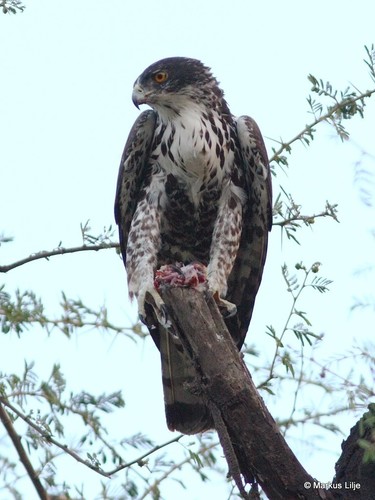
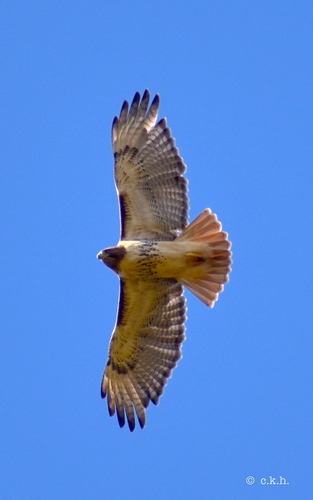
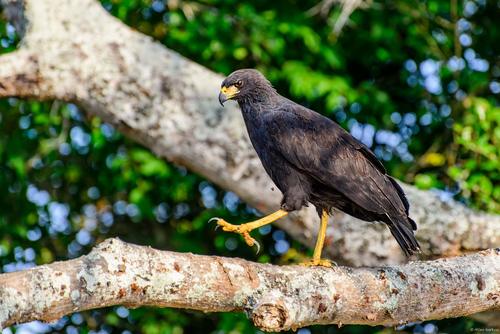
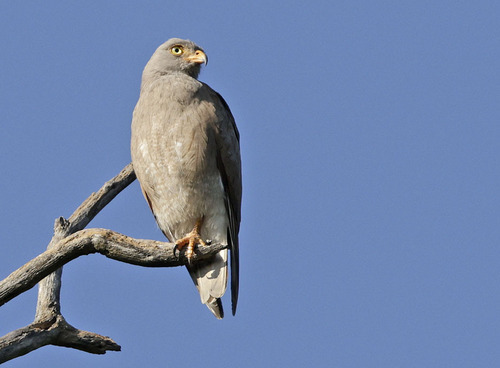
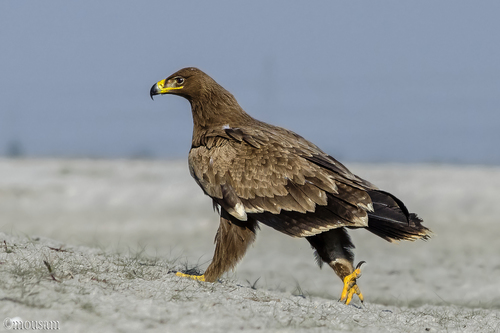
The steppe eagle (Aquila nipalensis Hodgson, 1833) is a large, bulky, robust eagle. It is mainly dark brown, with a long, very thick neck, a relatively small head that has a strong bill and a long gape-line. It has long wings, a long, rather rounded tail, and markedly well-feathered legs, whose feathers often look disheveled. Steppe eagles typically perch somewhat upright in open areas, and often use isolated trees, posts, rocks, mounds or straw-piles as low lookouts. They are often seen on the ground, where they may stand for hours at a time, walk with a horizontal posture, and have wingtips that just extend past the tip of the tail. Like tawny eagles, steppe eagles can be relatively tame and approachable, especially compared to most other Aquila eagles. Adult steppe eagles are variable brown, with darker centers on the greater coverts. More noticeably in the eastern part of the species’ range, adults usually have prominent pale rufous to dull orange-yellow to yellow-brown patches on the nape and hindcrown. Any other paler areas, such as feather tips on the back and uppertail coverts, are hidden on perched adults. The massive gape-line extends to the level of the back of the eye, and is highlighted by a dark border against a paler chin. This gape-line is longer than that of any other Aquila eagle, including the tawny eagle. Combined with deep-set eyes, it gives steppe eagles a rather fierce facial expression. Juvenile steppe eagles are almost always paler than adults, with overall color ranging from umber-brown to tawny-buff, though some juveniles are darker and more deeply brown. Juveniles are usually brown to grey-brown on the upperparts, apart from a generally rufous-buff nape patch that is more prominent in eastern populations. Juveniles have conspicuously broadly white-tipped black feathers on the greater coverts, wings and tail, and a bold narrow cream band on the brown medians. The white uppertail coverts of juvenile steppe eagles are usually hidden when the bird is perched; underparts are usually the same color as upperparts, but may be a slightly paler tawny-buff. In their second year, plumage remains mostly similar to first-year plumage, but the pale tips on secondaries, median coverts and tail are often worn and narrower. By the start of the second winter, the tips of retained juvenile flight feathers and coverts are heavily abraded and very thin. By the end of the second winter, immature eagles often look very worn and have nearly lost all pale tips. From the third year onward, they show a variable mix of old and new feathers. Immatures generally have a scruffy appearance until they reach adult plumage at five years old, after which their feathers appear more compact. Adults have brown to hazel eyes, while juveniles have distinctly dark brown eyes; the cere and feet are yellow at all ages. In flight, the steppe eagle is a large, impressive, visibly heavy raptor, with a well-projecting large head and bill, a rather broad neck, and long, broad wings. They have proportionately long arms, especially in larger eastern birds. Wings are usually held almost parallel-edged and square-ended, with 7 very elongated emarginations. Juveniles often appear to have narrower wings. The broad body of the species often looks suspended below the wings, and the tail appears rounded or even wedge-shaped, measuring about three-quarters of the length of the wing base. The wingspan is about 2.6 times greater than the total body length. On the upperwings, steppe eagles have a pale greyish primary patch that is often quite large and obvious, especially on non-adults. The patch is pale at the base on the greater primary coverts, but is much less marked on adults, especially dark individuals. On the underwing, a very small carpal crescent may be present, but can range from invisible to slightly noticeable. The flight feathers are greyish, and all have 7–8 well-spaced blackish bars that are less conspicuous than those on spotted eagles; the flight fingers are plain blackish. Adults are basically fairly uniformly dark brown, though wings can be slightly greyer or, rarely, yellowish brown. Adults may show whitish patches on the back and tail coverts in flight, ranging from insignificant to fairly prominent. Adult eagles that have a dark-barred greyish primary patch usually have it confined to a wedge shape on the inner primaries, though it can sometimes be more prominent. Below, adults have dark-barred grey flight feathers and tail, with broad blackish trailing edges and wing ends that are quite distinctive. Wing linings are often slightly paler or darker than the remiges, and often have an obscure remnant of a broken paler central band. Juveniles are quite distinctive in flight when seen clearly. From above, juveniles have pale greyish-brown to yellow-brown body and forewing-coverts, and a broad whitish U above the tail. They have broad white tips to the blackish greater coverts, flight feathers and tail, creating obvious whitish bars on the wings and trailing edges, along with a large prominent whitish patch that covers most of the inner primaries, making the barring stand out more and offsetting the plain black wing end. On the underside, the juvenile is mid-brown to brownish-yellow with a paler throat and creamy crissum. Below, the creamy central wing band is even broader than it is from above, while the greater coverts are all white with some dark centers on the primaries. Rare extremely pale individuals have almost uniform pale color across the entire wing lining, with buffish-white to pale sandy lesser and median coverts, and often a whitish pale primary wedge. Despite reports that some first-year juveniles have subtle or no central wing bands, this is thought to occur when the feathers are hidden by long median coverts. At the end of the first year, the pale tips on the wings, tail and upperwing coverts of young steppe eagles become quite abraded. After this, development varies widely between individuals. Usually, by the end of the second winter, the wing looks even more worn and unevenly patterned, with any newly grown narrowly white-tipped quills clearly longer than the old worn juvenile quills that have lost their pale tips. From the third winter onward, the pale parts are clearly reduced, flight feathers and tail often look quite ragged, and by the fourth year they start to resemble adults more closely. From the end of the third year until they gain adult plumage, eagles have adult-like broad blackish trailing edges and tail, often paired with dark-barred grey bases to black fingers and traces of a pale band along the greater underwing-coverts. Maturity is reached between the fourth and fifth years, not at 6–7 years as previously reported, though some five-year-old eagles still have pale flecks on the wing coverts and throat, and more subtle nape patches than they will have as fully mature adults. The breeding range of the steppe eagle is quite extensive, but the species essentially nests only in four large countries: Russia, Kazakhstan, Mongolia and China. However, the steppe eagle once bred in Europe. It bred into the 20th century in at least southeasternmost Ukraine, and possibly elsewhere in eastern Europe. It still rarely breeds in southwestern Russia from Stavropol to Astrakhan. It is recorded breeding down to Makhachkala and Maykop, as far west as Leningradskaya, north as far as the lower Volga, and south to the Caspian Sea nearly as far as Makhachkala and south of Fort-Shevchenko. The breeding range extends through suitable habitat across most of Kazakhstan, from north of Nur-Sultan south (spottily) to Kyzylorda, and around the former Aral Sea. From their main northern breeding areas, steppe eagles also breed marginally in northeastern Kyrgyzstan and possibly northern Uzbekistan. The breeding distribution is continuous as it extends far east in Russia to Transbaikal and Altai. The steppe eagle also breeds across large areas of western and northern China, including Tian Shan, Xinjiang, the Gobi area, Gansu, Ningxia, northern Tibet (its southernmost breeding area by far), and Inner Mongolia, and reaches its eastern breeding limit in Manchuria and other parts of northeastern China. The species’ breeding range also covers most of Mongolia, excluding the northern portion. The steppe eagle is fully migratory, and winters in eastern Africa, and to a lesser extent southern Africa. Its African range extends west to southern Sudan, across almost all of eastern Africa, to the easternmost part of the Democratic Republic of the Congo. The southern African wintering range extends to central Angola, northern and eastern Namibia, south to Botswana, Zambia, Zimbabwe, Eswatini and northern South Africa, including the former Transvaal and northern Natal, and rarely occurs south of the Orange River. In South Africa, steppe eagles are reported to be common only in the lowveld of the Kruger National Park area. The steppe eagle’s wintering range also extends into the Middle East. It occurs widely across central and southern parts of the Arabian Peninsula in winter, and is also found regularly in eastern Iraq and western Iran, with occasional individuals as far north as Turkey and Georgia. While sometimes described as occurring only somewhat commonly in Arabia, more extensive surveys have shown that many steppe eagles winter on the peninsula rather than in Africa. The largest wintering numbers ever recorded were in Saudi Arabia, where around 7200 individuals (around 9% of the current world population) were recorded near Riyadh. As many as 3000 individuals have also been recorded in Oman. Other countries that host wintering steppe eagles include Yemen, Azerbaijan and Syria, as well as (rarely) the United Arab Emirates, Lebanon and Kuwait. Unusually, a few steppe eagles now have been recorded overwintering in Kazakhstan, near Shymkent, in the Aksu-Zhabagly Nature Reserve, the Syr Darya valley, the Shardara Dam, and towns in the East Kazakhstan Region. In South Asia, the species occurs in winter from Afghanistan (it rarely still winters in Nuristan Province) across much of the Indian subcontinent. Pakistan’s Poonch and Jhelum valleys of Azad Kashmir host an average of 154 steppe eagles per study area. In India, steppe eagles occur mainly south to Madhya Pradesh, the Indo-Gangetic Plain, the Deccan Peninsula, the Himalayan zone, Mizoram, Assam and southern Orissa. Vagrants have been recorded in India at Periyar National Park, Mahendragiri, Kanyakumari Wildlife Sanctuary and Mudumalai National Park. The wintering range extends east to Tibet (though the species is said to have disappeared from Lhasa in recent years), Nepal, Burma, and across eastern China from southeastern Guizhou to Hainan and southwestern Guangdong. Recent winter records show the species lingers seasonally during the non-breeding season, though very rarely, in central and southern Myanmar, western Thailand, peninsular Malaysia and northern Vietnam. The species may have been able to expand its eastward wintering range due to deforestation. The steppe eagle occurs widely across many countries between its central Eurasian breeding areas and its generally tropical South Asian and African wintering grounds. In fact, the largest concentrations of the species tend to occur during migration passage. Steppe eagles also not infrequently wander far from traditional migration routes, and have been found in many areas from western Europe to as far east as Japan. Vagrant steppe eagles have been recorded in at least the following countries or regions: at least 6 nations in west Africa, Morocco, Tunisia, the Netherlands, Finland (at least 50 times), Spain, France, the Czech Republic, Bulgaria and Romania (where they once bred but were extirpated), Greece, Mordovia, Yakutia, the Korean Peninsula, and probably as far south as Borneo in Asia. Migration routes follow both mountain ridges and larger bodies of water. Steppe eagles predominantly use two main migration routes. One routes spreads across the Middle East and Arabia, with many birds stopping to winter there, but many also migrate around the Red Sea to winter in Africa. The other main route is used mostly by farther eastern breeding eagles, which move along multiple ridges and prominent flyways before spreading across a broad path through the Himalayas to reach South Asian and other Asian wintering sites. Less well-known or less frequently used migration paths lead steppe eagles around the Black Sea in the west, and much more frequently around the Caspian Sea farther east. Countries that steppe eagles visit almost exclusively during migration passage include Egypt, most (but not all) of Syria, Turkmenistan and Afghanistan, and much of eastern China from Tuquan County to around Xiamen. Migration bottlenecks, where large numbers of steppe eagles are often recorded, include Palestine, especially around Eilat, Suez in Egypt, Bab-el-Mandeb in Yemen, some parts of Georgia, and in the Himalayan region, especially Nepal, and sometimes also large numbers in Pakistan and northern India. Less is known about minor migration sites, but Alborz is one. Steppe eagles tend to breed in open dry country, in the habitat the species is named for: steppe, in both upland and lowland areas. In Kazakhstan, they generally occur in drier parts of the steppe than some other raptors like harriers. This species generally avoids agricultural land such as croplands and most other human-fragmented areas, though it can be somewhat tolerant of nesting near roads. Associated habitats used during breeding include flat plains, arid grassland, semi-desert, and even desert edge. Most steppe eagles breed at lower elevations, but in the eastern part of the range they will also nest on poorly vegetated dry rocky hillsides such as granite massifs and upland valleys, though they generally avoid truly mountainous areas. Wintering steppe eagles are often found much more frequently in human-modified areas, to access easy food sources. These include landfills and livestock carcass dumps, which are frequently used everywhere from Arabia to India. The most common natural habitats used by wintering steppe eagles are various wetlands or other waterways where these are available. In Africa, savanna and grasslands are the predominant winter habitat, though dry woodland is also sometimes used. A study in Botswana found that wintering steppe eagles there appeared unaffected by human land use changes. In Zambia and Malawi, the steppe eagle was found to be common only in high-elevation plateau areas between 370 and 2,400 m (1,210 to 7,870 ft) above sea level. Steppe eagles also frequently used plateaus in Zimbabwe, often in open savanna woodland made up of Acacia, and also use cultivated areas such as wheat stubble fields. Wintering steppe eagles in Iraq often use dump sites as well as deserts and semi-arid areas, with more steppe, other grassland and mountain slopes used in northern Iraq in winter. In Armenia, steppe eagles are apparently common in old fields and orchards. In South Asia they usually use open country, and often frequent large lakes and other wetlands near arid areas, but may accept, or even prefer, more heavily wooded areas, though the first records from peninsular Malaysia come from open areas created by deforestation. Although the steppe eagle usually breeds in lowlands, it has been recorded living at elevations up to 2,300 m (7,500 ft), and locally to 3,000 m (9,800 ft) in mountains. During migration it can occur at over 4,500 m (14,800 ft), and even as high as 7,925 m (26,001 ft), as recorded on Mount Everest. Compared to other Palearctic migrating eagles, the steppe eagle appears to be slightly more tolerant of a wider range of climatic conditions, including rather humid conditions in India when food is available, as well as up to 50 cm (20 in) of snow cover in Kazakhstan, where it survives by feeding on urban pests.