About Aquila fasciata Vieillot, 1822
Scientific name: Aquila fasciata Vieillot, 1822
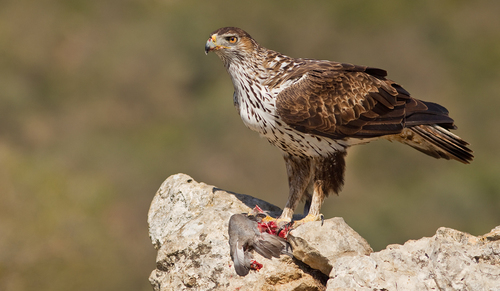
Adult Bonelli's eagles are dark brown above, with the color varying from a cold dark - chocolate hue to umber due to molt, individual, and regional differences. Most feathers have pale margins, which are especially broad on the median wing coverts. There is a variably sized, irregular white patch on the mantle. The tail is grey with obscure darker brown thin bars, a broad blackish sub - terminal band, and a creamy white tip. The head is dark brown, with a paler, often streaky neck and a white throat. The underside has a cream base color with variable sparse blackish - brown streaks or drop - shaped markings. Females are generally darker and more heavily patterned than males, showing color sexual dimorphism. The streaking is strongest on the breast and upper flanks, while the lower belly and crissum are usually plain or faintly marked.
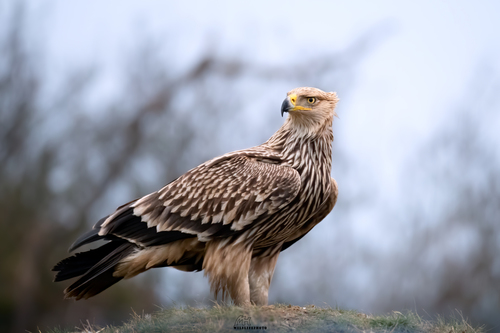
Juveniles are a lighter medium brown above with variable paler edges. They may have a creamy patch on the back (not the mantle as in adults) and uppertail coverts. The head is rusty - brown with darker brown around and behind the eyes. The crown is either darkly streaked or occasionally plain greyish. The tail is more clearly barred than in adults, with a sub - terminal band only slightly thicker than the other bars and a thin white tip. Juveniles are light rufous to warm buff below with minimal black streaks, usually confined to the chest - sides. By the 2nd summer, they become more patchy below with increased heavy streaking. As they molt, immature eagles develop a thicker sub - terminal band and a paler ground color below.
Adult eyes are yellow to yellow - orange, while juvenile eyes are hazel - brown. Adult plumage is obtained between the 4th and 5th years. At all ages, the cere and feet are pale yellow.
In flight, Bonelli's eagle is a large raptor with a well - projecting head and broad, long, somewhat square - ended wings that are slightly pinched at the body and taper at the tips. Feather molts can make the wing shape variable. The tail appears long and broad but can seem narrow when pinched. It flies with powerful but loose shallow beats. When gliding, it often uses flat wings with well - spread feathers and the carpals pressed slightly forward, more so in fast glides. It soars infrequently on flat or slightly raised wings. Bonelli's eagles often fly in pairs.
Adult flying eagles are dark above with variable white mantle markings. The tail has faded barring on grey, a big blotchy sub - terminal band, and a white tip. The tail markings look similar from below and above. Adults have white lesser coverts that contrast with the blackish central wing band. The flight feathers are faintly and thinly barred light grey - brown with paler bases, which can become whitish on the primaries inside the blackish tips and leading wing coverts.
Juveniles are brown above with slightly darker wing ends and tips to greater coverts and greyer primary windows. They may have a creamy patch on the back and an obscure narrow U above the barred tail. The wing linings are light rufous to warm buff like the body color. Juveniles usually have darker tips to greater coverts forming wing - diagonals and a small white area on the primaries against the blackish tips. Until the 3rd year, young eagles resemble 1st - year juveniles, but by the 4th year, subadults become more like adults, though they may still have a mix of juvenile and adult feathers on the flight feathers.
Bonelli's eagles can be confused with other raptors. In poor light, they may be mistaken for honey buzzards, but honey buzzards are slimmer, have a smaller head, notched tails, less emarginated primaries, and fly with wings at an angle. They can also be confused with Eurasian goshawks, long - legged buzzards, short - toed eagles, and booted eagles, but each of these species has distinct differences in size, wing shape, tail shape, flight style, and plumage. In the southern Red Sea, vagrants may be confused with African hawk - eagles, which are smaller, short - winged, and long - tailed.
Bonelli's eagle has a spotty and sparse worldwide distribution. It is found in northwestern Africa, with a semi - regular wintering range in coastal west Africa. It also occurs as a vagrant in east Africa. In southern Europe, it ranges through parts of Portugal, Spain, and southern France, and is present on the Italian islands of Sardinia and Sicily. In southeastern Europe, there are isolated populations in Croatia, Macedonia, Greece, and Crete. Outside Europe, it is found in western and southern Turkey, the Middle East, the Arabian Peninsula, and parts of Asia, including India, Myanmar, Thailand, Laos, southern China, and the Lesser Sunda Islands. Historically, it spread to Europe and the Mediterranean Basin around 50,000 years ago with human help.
Bonelli's eagles are mostly residential, but juveniles can disperse over several hundred kilometers. They have been recorded at migration sites and in areas where they do not breed in winter.
Bonelli's eagle usually lives at an elevation of 1,500 m (4,900 ft) or lower in Europe, 1,200–2,000 m (3,900–6,600 ft) in the Himalayas, up to 3,750 m (12,300 ft) in Bhutan, and 2,000 m (6,600 ft) in the Atlas Mountains. It prefers arid, sunny habitats near large bodies of water, such as the Mediterranean Sea and the northern Indian Ocean. It likes rocky areas, including lower mountains, foothills with cliffs and canyons, and areas with garrigue - type habitat or scattered trees. It avoids dense scrub and deep forests. In winter, it moves to lower elevations and more open habitats, such as semi - deserts and plains, and prefers wetter areas with concentrated prey.
Bonelli's eagles generally live solitarily or in pairs and mate for life. Territories are maintained through aerial displays, including sky - dancing. Aerial displays continue into the incubation and early nestling periods. Home ranges vary in size, with averages of 44.2 km² (17.1 sq mi) in Spain and up to 130 km² (50 sq mi) in Portugal. There is no significant relationship between prey density and the distance between neighboring pairs. A dead or missing mate can be quickly replaced, and mature adults may breed with subadults.
Bonelli's eagle is very aerial, often soaring and circling. It is a powerful predator, with hunting methods similar to a goshawk. It mainly hunts by still - hunting from a perch or a lofty spot, dashing out to catch prey. It also hunts in a quartering flying style or stoops from a soaring height. Tandem hunting by a pair is common, but it may not improve hunting success. It takes a wide variety of prey, mainly birds and mammals, with an average prey size of about 20–45% of its own weight. Hunting success averages around 28.5%.