About Aquila clanga Pallas, 1811
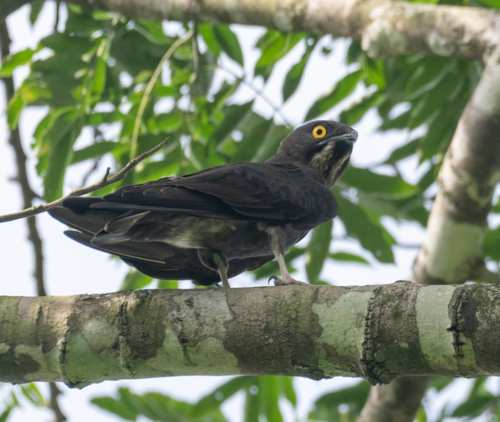
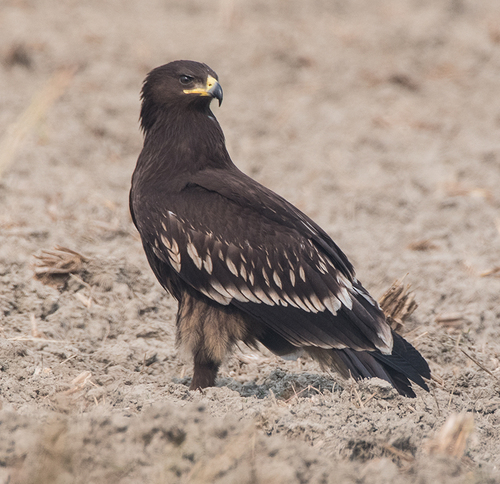
The greater spotted eagle (Aquila clanga Pallas, 1811) is a rather large, compact raptor. Most individuals are black-brown with a contrasting yellow beak. It has a short neck supporting a large, often shaggy-naped head, a strong beak, a short gape-line, and round nostrils. Its broad, long wings extend to the tip of its relatively short, rounded tail, and the combination of broad wings and a short tail creates an almost vulture-like silhouette. The species has large feet, with leg feathers that are less compactly arranged than those of the lesser spotted eagle. Greater spotted eagles typically perch in open areas, most often on treetops at forest edges, or on isolated vantage points such as bushes, utility poles, or steep riverbanks. They regularly forage and rest in a hunched posture on the ground.
Adult greater spotted eagles are generally uniformly dark to blackish brown, with coloration that may appear purplish and glossy, and looks more starkly contrasted when individuals are freshly moulted. Upperwing covert feathers are often slightly paler than the rest of the body, so the bird generally appears uniformly dark with just two contrasting features: a pale beak and a narrow white U-shaped marking above the tail, though the U is usually concealed when the bird is at rest. The species is sexually dimorphic and even polymorphic. Pale and intermediate phenotypes are rare, though slightly more common in eastern parts of the species' range. Pale adults, sometimes referred to as Clanga clanga fulvescens, have bicolored plumage: the tail, flight feathers, and greater wing coverts are all blackish, while the body and remaining wing coverts are light yellow or pale golden buff, fading to creamy with age. This buff colour usually has diffuse dark markings around the eyes, on the leading edges of the wings, and more rarely and sparsely on the chest. Intermediate and other variants are very rare. These include individuals with a slightly paler body and variable yellowish-brown streaking or mottling on the fore upperwing coverts (making them similar to juvenile lesser spotted eagles), and individuals mottled yellow-brown with a dark-streaked breast and pale-tipped wing coverts (similar to juvenile eastern imperial eagles (Aquila heliaca)). Intermediate types may have the typical dark brown to black upper body, but show pale mottled grey wing linings in flight, or have normal coloration except for a contrasting paler underbody.
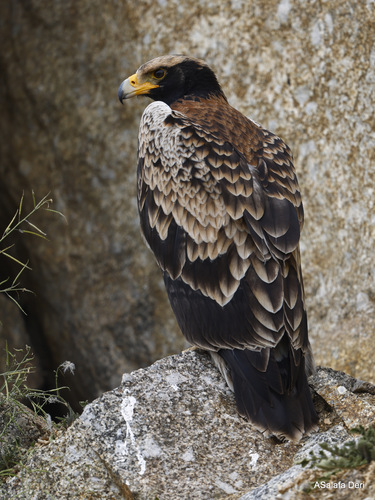
Juvenile greater spotted eagles are generally uniformly black-brown with whitish to yellowish drop-shaped spots. Some juveniles are heavily spotted across their whole body, while others have far fewer spots. They always have a clear row of spots along the upperwing coverts, which form clear wing bars across the tail and flight feathers, excluding the outer primaries. Juveniles' underfeathers often have broad cream tips, and may show some buffy streaks on the underside, especially on the flanks and feathered leg portions. Juveniles of the fulvescens morph resemble pale adults, but have the typical heavily spotted wings and tail of non-pale juvenile greater spotted eagles, and often have darker centers to the scapulars and median coverts. By the second to third year of life, plumage is often quite worn, but white tips still create prominent wing bars (unlike in lesser spotted eagles) until the second winter. After the second winter, most coverts have been newly moulted, with smaller pale tips. From the middle of the third year onwards, plumage is more adult-like, with few or no indistinct spots left, but flight feathers are of unequal ages and look untidy. Subadult greater spotted eagles are generally more uniform in color, but still often show some pale tips to the greater coverts. Full maturity is reached around the fifth year of life, though some individuals do not breed until the sixth year. Bare body parts change little in color with age: eyes are dark brown, while the beak and feet are yellow at all ages.
In flight, the greater spotted eagle is a large, dark raptor that often appears larger than its actual size. It has a well-protruding head, long wings that often look shorter due to their great breadth, slightly bulging secondaries, and rather squared seven-finger wing tips, though juvenile wings may look more rounded. In flight, greater spotted eagles appear heavy-bodied, with the body often held below the wings paired with a relatively short, broad tail. They have quick wing beats with little upstroke; their flight is comparatively lighter than that of the steppe eagle (Aquila nipalensis), but heavier, less graceful, and less Buteo-like than that of the lesser spotted eagle. Greater spotted eagles soar on almost flat wings, with the outer hand portion of the wings often slightly lowered and the primaries well spread. When gliding, the wings are bowed, with a clear angle between the inner arm portion and outer hand portion, which emphasizes the wings' short appearance. At all ages, greater spotted eagles variably show a pale primary patch on their upperwings, formed mainly by white-based feather shafts and partially pale outer webs; this patch is much smaller and less obvious on adults. The underwing almost always has a single white crescent formed by the white base of the outermost three primaries, the secondaries, and the innermost primaries. At close range, nine to eleven dense narrow dark bars that fade toward the wing tip are visible. A normal adult in flight is uniformly blackish with a faint pale U above the tail, barely paler wing coverts, and paler quills. Adults not uncommonly have slightly paler wing linings similar to lesser spotted eagles, but only have a single (not double) whitish crescent at the base of the primaries. Adult fulvescens pale morph individuals have most wing coverts (on both surfaces) and their body contrastingly buffy to tawny. Juveniles in flight normally appear very dark with extensive spotting above and below, though some juveniles only have spots restricted to the wings, scapulars, and feathered leg portions. All well-observed juveniles show characteristic white end spots on wing coverts that form two to three wing bars. Otherwise, juveniles have a creamy trailing edge to their wings and tail. On the underside, juvenile greater spotted eagles have largely black wing linings (except for the creamy crissum) that contrast with paler grayer-soot flight feathers. Other juvenile plumage variants are variably paler, but have quills matching those of a typical juvenile. Birds that breed in the Volga–Ural area are slightly larger and have more muted plumage characteristics. Slightly smaller individuals are more common farther west in Europe. Wintering greater spotted eagles in India are nearly 5% larger on average than those wintering in the Middle East.
Field identification of the greater spotted eagle can be quite difficult. This species is primarily differentiated from the lesser spotted eagle by its structure and proportions, though distant individuals may be practically indistinguishable. Compared to the lesser spotted eagle, adult greater spotted eagles have very broad wings, which makes the head look relatively small. However, juvenile greater spotted eagles can appear less bulky, with narrower, more rounded wing edges, and longer tails, bringing their proportions closer to the lesser spotted eagle. Greater spotted eagles are usually clearly larger overall, and females are effectively larger than most lesser spotted eagles, but there is a broad size overlap between the two species. In some cases, male greater spotted eagles can be barely any larger than male lesser spotted eagles. When seen side-by-side, greater spotted eagles are typically conspicuously darker than lesser spotted eagles. They are also notable for their dark uppertail coverts, lack of a nape patch, blackish-brown uniform inner wing portions, and uniform, dark upperwing coverts (not contrastingly rusty brownish). Though difficult, intermediate greater spotted eagles can be distinguished from young lesser spotted eagles by the former's morphology, usually darker wing linings, and differences in the appearance of the primary patch and carpal arc. Juvenile greater spotted eagles usually lack the pale nape patch of the juvenile lesser spotted eagle, but the patch is sometimes present, "albeit only slightly paler than rest of plumage and never ochre or orange". Typically, spotting and barring patterns are much stronger in juvenile greater spotted eagles, but this trait is not always reliable. Hybrids between the two spotted eagle species can be even more difficult to distinguish, and often have muddled, varied appearances, with some hybrids appearing much closer to one parent species than the other. Pure greater spotted eagles can be told apart from pure lesser spotted eagles via in-hand measurements including bill height, the width and extent of white spots on juveniles, and middle toe length.
On the Indian subcontinent, the greater spotted eagle may be confused with the Indian spotted eagle. The Indian spotted eagle is smaller (similar in size to the lesser spotted eagle), somewhat narrower-winged and longer-tailed, with primary fingers more deeply cut and square-ended. It has a more distinct pale window in the primaries, paler and less distinctly streaked underparts, and paler upperparts (more similar to a steppe eagle in color) with less distinct, more diffuse pale tips to the larger wing-coverts. Furthermore, the Indian spotted eagle has a notably deeper gape that extends behind the eye. Compared to non-spotted eagles of similar or larger sizes, the greater spotted eagle tends to have fairly compact features, with proportionately broad (and short-looking) wings, a shortish tail, and an overall darker, distinctly patterned plumage. The steppe eagle is similar but larger and bulkier than the greater spotted eagle; the greater spotted eagle has a shorter neck, smaller bill with a shorter gape line, no pale nape patch (which is present in adult steppe eagles), narrower and less baggy feathered leg portions, and generally much shorter, slightly broader wings. Though visually similar at a distance, the steppe eagle has bolder, more extensive barring on greyer flight feathers, completely lacks a carpal arc on the underside, has a paler throat and nape, and a larger but more diffuse primary patch.
Fulvescens and intermediate morph greater spotted eagles resemble many other eagle species, but can be distinguished by their underwing colour and pattern—such as their distinct carpal arc and dark, thinly barred quills—from pale or intermediate morphs of the similarly sized tawny eagle (Aquila rapax). Tawny eagles usually have a less dark back, lack a diffused dark face, and have more typical, narrower wing proportions. Juvenile eastern imperial eagles can resemble fulvescens greater spotted eagles, but are larger and structurally different. Eastern imperial eagles have much longer and narrower wings, a longer neck, a bigger, more prominent beak with an oblong (rather than oval) nail, a longer and narrower gape line, more conspicuous pale inner primaries, no carpal arc, a brown-streaked breast (though greater spotted eagles can have some diffuse marks), unmarked feathered tarsi, pale irises, and an obvious pale window on the inner primaries. Beyond structural differences, subadult steppe eagles can be distinguished from pale morph greater spotted eagles by the subadult steppe's thicker well-spotted quill bars and paler underwing diagonal. In the eastern portion of the greater spotted eagle's range, it can be told apart from the even darker black eagle, which is much slimmer and has paddle-shaped wings and a long, clearly barred tail.
The greater spotted eagle breeds primarily in the Palearctic and Indomalayan regions. It also breeds in central and southeastern Europe, but is highly restricted to small, non-contiguous breeding pockets in Poland, Belarus, Ukraine, Bulgaria, Romania, Serbia, and Hungary. A more continuous breeding range starts in Eastern Europe, and includes eastern Estonia, Latvia, Lithuania, and central Belarus. An uncertain number of breeding birds range onto the edge of eastern Finland. They are found broadly across favorable habitat in European Russia, extending through much of Arkhangelsk Oblast to the lower coasts of the White Sea. They are found across much of Central Russia, with their probable northern limits in Shuryshkarsky and Pitkyarantsky Districts. They also occupy a broad strip across southern Siberia that extends well into the Amur region. Their range outside Russia includes much of northern Kazakhstan, with isolated breeding areas recorded in the East Kazakhstan Region and southern Kazakhstan. Greater spotted eagles also breed in an isolated area stretching from Kyrgyzstan and adjacent parts of Russia down to Xinjiang, China. Historically, greater spotted eagles have been recorded breeding in the Indian subcontinent from Gujarat northwards to Punjab, with breeding recorded as far south as Saurashtra and as far north as Maharashtra, but this may only be historical, and almost certainly no stable breeding population exists there today. They also breed in northern Mongolia, and extend rather far into northeastern China and northern North Korea.
Greater spotted eagles disperse widely during migration, typically from September to November in autumn, and February to April in spring. They are found across a wider area during migration than during breeding or wintering. While migrating, greater spotted eagles may be seen across much of Eastern Europe, Anatolia, the entire Middle East, Central Asia (south from Kazakhstan), and western South Asia. This species is prone to vagrancy, and has been recorded in several European countries including the Netherlands, Great Britain, Gibraltar, and the Czech Republic. Its regular breeding range no longer extends as far west as Germany, but individuals are still occasionally seen there, with a few records per decade. Young birds disperse very widely; the Staatliches Museum für Tierkunde Dresden holds a specimen (C 21845) shot in November 1914 near Bernsdorf, Saxony. It is a juvenile, and though its exact age cannot be determined, it is heavily spotted and probably less than 20 months old. Vagrancy has also been recorded in Africa, including Morocco, Algeria, Tunisia, Libya, Cameroon, Chad, Kenya, Tanzania, Zambia, and Botswana. The species is sometimes documented in central and east Afghanistan. It may also be found in East Asia across the southern part of the Russian Far East and eastern China, and occasionally in Southeast Asia from Myanmar and Thailand down through the Malay Peninsula. Rarely, greater spotted eagles are even documented in Indonesia, specifically Sumatra.
Dedicated wintering areas are more limited and isolated than the species' range during migration. The main central wintering areas are principally the Mediterranean Basin, the Middle East, and the Indomalayan realm. Small wintering pockets may exist in southwestern Spain adjacent to Portugal, southern France, northeastern Italy, western Greece (where it is sometimes considered the most common wintering eagle), small areas of southern Bulgaria, eastern Romania, and southern Moldova. Other wintering areas include northeastern Egypt, southern Sudan and adjacent South Sudan, north-central Ethiopia, and scattered areas of the Middle East including northern Israel, Kuwait, and central Syria. They are found more continuously across much of the southern coastal Arabian Peninsula, including broadly along the Red Sea coast in Saudi Arabia, western and southern Yemen, southern Oman, coastal United Arab Emirates, and eastern Saudi Arabia. Additionally, they winter in southeastern Turkey, Azerbaijan, southeastern Georgia, eastern Iraq, broadly across western, northern, and eastern Iran, southern Turkmenistan, western Afghanistan, and far western Pakistan. They are also found discontinuously in eastern Pakistan, northern India, Bangladesh, southern Bhutan, and into northwestern Myanmar. In India, the winter range extends across the Indo-Gangetic Plain to Bihar, Jharkhand, West Bengal to Assam (including the North Cachar hills), and the northeastern hill states, extending south through central India. They were once reasonably common on the Malabar and Carnatic coasts, but likely only before one hundred years ago. After another distribution gap, they are found across much of southern and central Myanmar, central and southern Thailand, southern Laos, the northern tip of Vietnam, discontinuously in southeastern Vietnam and most of Cambodia, and southern coastal Malaysia. In China, wintering greater spotted eagles range from Jiangsu and Anhui continuously south to northern Guangdong across to Taiwan, and occur rarely in Korea.
Greater spotted eagles inhabit open wet forests and forest edges, often adjacent to marshes, swampy patches, bogs, or wet meadows, as well as river-valley woodlands and floodplain forests. They are generally found in wetlands more often than lesser spotted eagles, but can be found in drier hillside forests in Central Asia. The difference in habitat preferences between the two species was confirmed in northeastern Poland, where greater spotted eagles nested in wooded floodplain areas that experience considerably more annual flooding than areas nested in by lesser spotted eagles. Though typically scarce when breeding in areas heavily modified by human development, they have been observed hunting over cultivated land in Estonia and migrating over lowland farms in the Czech Republic. In Russia, they are found in transition zones between taiga forest and open steppe (often around river valleys), in pine forests, near dwarf forests, in wet, wooded areas of the steppe, and in forested swamps. In Kazakhstan, riparian forests in lowland steppes and forest-steppe mosaics are their primary habitat.
In winter, much like during breeding, they usually occur in wetter habitats than most other eagles, including forested river deltas, mangrove forests, marshes, lakeshores, and especially in India, jheels. However, greater spotted eagles have also been recorded in semi-arid Acacia savannas in northeastern Africa. Reportedly, in Eritrea they occur in open moorland, around villages, and lowland grasslands, while in Sudan they are usually found in shrubby areas. One individual wintering in Ankara, Turkey, was found in an upland forest area. In the Mediterranean Basin, a study found that the preferred habitats of wintering greater spotted eagles were salt marshes and coastal lagoons with freshwater areas. They are not uncommon in paddy fields and sometimes garbage dumps in Asia during winter, and are much more adaptable to human-modified areas in this season, though by and large they prefer assorted wetlands, mudflats, large rivers, estuaries, and mangroves. In Arabia, they are now largely found in manmade habitats such as sewage farms, reservoirs, and agricultural land, since the native mangrove and Phragmites reed-beds that once lined coastal bays have been almost entirely eliminated. In southern Iran, they are usually found in mangrove areas. A key habitat for the species in Iraq is the Mesopotamian Marshes. Wintering habitats in Israel are the wettest available valleys and damp open zones, chiefly cultivated fields and fishponds near patches of trees, and similar habitats are used in Oman. Greater spotted eagles are typically found from sea level to 300 m (980 ft), and are characteristically a lowland bird. However, they have been recorded at elevations up to 4,000 m (13,000 ft) in northern Iran. One migrating greater spotted eagle was recorded at 4,370 m (14,340 ft) in Ladakh in the Himalayas.