About Aquila chrysaetos (Linnaeus, 1758)
The golden eagle (Aquila chrysaetos) is a bird of prey native to the Northern Hemisphere, and is the most widely distributed eagle species. Like all eagles, it is a member of the Accipitridae family, and is one of the most well-known birds of prey in the Northern Hemisphere.
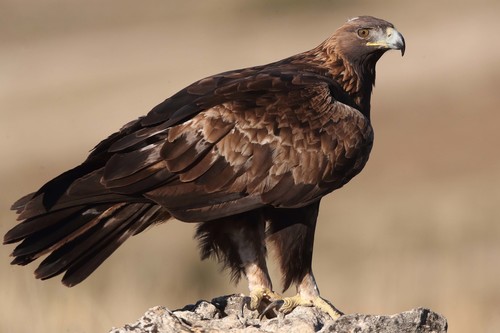
Adult golden eagles are dark brown, with lighter golden-brown plumage covering their napes. Immature golden eagles typically have white tail coloration and often have white markings on their wings. This species combines agility and speed with powerful feet and large, sharp talons to hunt a variety of prey, most commonly hares, rabbits, marmots, and other ground squirrels.
Golden eagles maintain home ranges or territories that can reach up to 200 km² (77 sq mi) in size. They build large nests on cliffs and other elevated sites, and may return to the same nesting site for multiple breeding years. Most breeding activity occurs in the spring. Golden eagles are monogamous, and breeding pairs may stay together for several years, or potentially for life. Females lay up to four eggs, which they incubate for six weeks. Typically, one or two young survive to fledge after around three months. Juvenile golden eagles usually gain full independence by the fall, after which they wander widely until they establish their own territory four to five years after hatching.
Once widespread across the Holarctic, golden eagles have been lost from many areas that are now heavily populated by humans. While the species has been extirpated or become uncommon in parts of its former range, it remains widespread across large areas of Eurasia, North America, and portions of North Africa. It is the largest and least numerous of the five true accipitrid species that breed in both the Palearctic and Nearctic regions.
For centuries, golden eagles have been one of the most highly valued birds used in falconry. Due to its hunting skill, the golden eagle is held with great mystic reverence in some ancient tribal cultures. It is also one of the most extensively studied raptor species in the world in parts of its range, including the Western United States and the Western Palearctic.
There are six currently recognized extant subspecies of golden eagle, which differ slightly in size and plumage. Individuals of any subspecies show some variation, and differences between subspecies are clinal, especially for body size. Aside from these small differences, there is very little variation across the species' entire range. Some recent genetic studies have proposed that only two subspecies should be recognized: Aquila chrysaetos chrysaetos (including A. c. homeyeri) and A. c. canadensis (including A. c. japonica, A. c. daphanea and A. c. kamtschatica).
Aquila chrysaetos chrysaetos (Linnaeus, 1758), sometimes called the European golden eagle, is the nominate subspecies. It is found across almost all of Europe, including the British Isles (mainly Scotland), most of Scandinavia, southern and northernmost France, Italy, and Austria. In Eastern Europe, it occurs from Estonia to Romania, Greece, Serbia, Bulgaria, and Kosovo in southeastern Europe. It also ranges through European Russia, with its eastern limit reported around the Yenisei River; it also ranges south at the same longitude into western Kazakhstan and northern Iran. For this subspecies, male wing length ranges from 56.5 to 67 cm (22.2 to 26.4 in), averaging 62 cm (24 in), while female wing length ranges from 61.5 to 71.2 cm (24.2 to 28.0 in), averaging 67 cm (26 in). Males weigh 2.8 to 4.6 kg (6.2 to 10.1 lb), averaging 3.69 kg (8.1 lb), and females weigh 3.8 to 6.7 kg (8.4 to 14.8 lb), averaging 5.17 kg (11.4 lb). Male wingspans range from 1.89 to 2.15 m (6 ft 2 in to 7 ft 1 in), averaging 2.02 m (6 ft 8 in), while female wingspans typically range from 2.12 to 2.2 m (6 ft 11 in to 7 ft 3 in), averaging 2.16 m (7 ft 1 in). This is a medium-sized subspecies, and the palest of the six extant subspecies. Compared to golden eagles further east in Eurasia, adult A. c. chrysaetos are tawny golden-brown on the upperside. Their nape patch is often a gleaming golden color, and the feathers in this area are exceptionally long.
Aquila chrysaetos homeyeri Severtzov, 1888 is commonly known as the Iberian golden eagle. This subspecies occurs across almost the entire Iberian Peninsula, as well as the island of Crete, and is absent from the rest of continental Europe. It also ranges through a narrow sub-coastal strip of North Africa from Morocco to Tunisia. A completely isolated population of golden eagles lives in Ethiopia's Bale Mountains, at the southern limit of the entire species' global range. Though this population has not been formally assigned to a subspecies, it is very likely part of A. c. homeyeri. This subspecies also ranges across most of Asia Minor, mainly Turkey, occurs sporadically through the Middle East and Arabian Peninsula into northern Yemen and Oman, and extends east to the Caucasus, most of Iran, and as far north as southwestern Kazakhstan. Male wing length ranges from 55 to 64.3 cm (21.7 to 25.3 in), averaging 59 cm (23 in), and female wing length ranges from 60 to 70.5 cm (23.6 to 27.8 in), averaging 64 cm (25 in). Body weight ranges from 2.9 to 6 kg (6.4 to 13.2 lb), with no published average weight. It is slightly smaller and darker-plumaged than the nominate subspecies, but not as dark as golden eagles found further east. Its forehead and crown are dark brownish, with a short-feathered, relatively light rusty-colored nape patch.
Aquila chrysaetos daphanea Severtzov, 1888 is variously called the Asian golden eagle, Himalayan golden eagle, or berkut. This subspecies is distributed in central Kazakhstan, eastern Iran, and the easternmost Caucasus, and extends east to Manchuria, central China, and along the Himalayas from northern Pakistan to Bhutan, stopping in northeastern Myanmar (it rarely ranges into northernmost India). This subspecies is the largest on average. Male wing length ranges from 60 to 68 cm (24 to 27 in), averaging 64 cm (25 in), and female wing length ranges from 66 to 72 cm (26 to 28 in), averaging 70 cm (28 in). No full range of body weights is known, but males weigh approximately 4.05 kg (8.9 lb) and females weigh approximately 6.35 kg (14.0 lb). While the average wingspan for this subspecies is reported as 2.21 m (7 ft 3 in), some individuals have much longer wingspans; one captive female berkut had an authenticated wingspan of 2.81 m (9 ft 3 in). It is generally the second-darkest subspecies, with blackish coloration on the back. Its forehead and crown are dark, with a blackish cap near the end of the crown. The feathers of the nape and upper neck are rich brown-red. Nape feathers are slightly shorter than those of the nominate subspecies, and similar in length to those of A. c. homeyeri.
Aquila chrysaetos japonica Severtzov, 1888 is commonly known as the Japanese golden eagle. This subspecies occurs in northern Japan (on the islands of Honshu, Hokkaido, and discontinuously on Kyushu) and in undetermined parts of Korea. Male wing length ranges from 58 to 59.5 cm (22.8 to 23.4 in), averaging 59 cm (23 in), and female wing length ranges from 62 to 64.5 cm (24.4 to 25.4 in), averaging 63 cm (25 in). No full range of body weights is known, but males weigh approximately 2.5 kg (5.5 lb) and females weigh approximately 3.25 kg (7.2 lb). This is by far the smallest-bodied subspecies, and also the darkest. Even adults are slaty-grayish black on the back and crown; juveniles are similar, but have darker black plumage that contrasts with brownish color and white scaling on the wings, flanks, and tail. This subspecies has bright rufous nape feathers that are quite loose and long. Adult Japanese golden eagles often have extensive white mottling on the inner-webs of the tail, a pattern more typical of juvenile eagles in other subspecies.
Aquila chrysaetos canadensis (Linnaeus, 1758) is commonly known as the North American golden eagle. It occupies the entire golden eagle range in North America, covering most of Alaska, western Canada, the Western United States, and Mexico. The species breeds occasionally in all Canadian provinces except Nova Scotia. It is currently absent as a breeding species in the Eastern United States east of a line running from North Dakota through western Nebraska and western Oklahoma to West Texas. Its southern range limit is in central Mexico, from the Guadalajara area in the west to the Tampico area in the east; this is the "Mexican eagle" featured on Mexico's coat of arms. It has the largest breeding range of any golden eagle subspecies, and is probably the most numerous, especially if A. c. kamtschatica is included within it. Male wing length ranges from 59.1 to 64 cm (23.3 to 25.2 in), averaging 61 cm (24 in), and female wing length ranges from 60.1 to 67.4 cm (23.7 to 26.5 in), averaging 65 cm (26 in). The average wingspan for both sexes is about 2.04 m (6 ft 8 in). Males weigh 2.5 to 4.47 kg (5.5 to 9.9 lb), averaging 3.48 kg (7.7 lb), and females typically weigh 3.6 to 6.4 kg (7.9 to 14.1 lb), averaging 4.91 kg (10.8 lb). This subspecies does not follow Bergmann's rule, which states that widely distributed organisms are larger-bodied further from the Equator; specimens of both sexes from Idaho had a mean weight of 4.22 kg (9.3 lb), and were slightly heavier than specimens from Alaska, which had a mean weight of 3.76 kg (8.3 lb). It is medium-sized, generally intermediate in size between the nominate subspecies and A. c. homeyeri, with extensive size overlap between groups. It is blackish to dark brown on the back. The long feathers of the nape and upper neck are rusty-reddish, and are slightly narrower and darker than those of the nominate subspecies.
Aquila chrysaetos kamtschatica Severtzov, 1888 is sometimes called the Siberian golden eagle or the Kamchatkan golden eagle. This subspecies ranges from Western Siberia, where overlap with A. c. chrysaetos is likely, across most of Russia (including the Altay, which spills over into northern Mongolia), to the Kamchatka Peninsula and the Anadyrsky District. This subspecies is often grouped into A. c. canadensis. Male wing length ranges from 61.8 to 70.5 cm (24.3 to 27.8 in), averaging 64 cm (25 in), and female wing length ranges from 65 to 72 cm (26 to 28 in), averaging 69 cm (27 in). No body weight records are known for this subspecies. Its coloration is almost exactly the same as that of A. c. canadensis. The main difference is that this subspecies is much larger in size, and is nearly equal in size to A. c. daphanea when compared by wing length.
Two prehistoric golden eagle taxa are recognized: the larger Middle Pleistocene golden eagles of France (and possibly elsewhere) are referred to the paleosubspecies Aquila chrysaetos bonifacti, and the large Late Pleistocene specimens from Liko Cave, Crete have been named Aquila chrysaetos simurgh. An ancestral golden eagle with a heavier, broader skull, larger wings, and shorter legs compared to modern birds has also been found in the La Brea Tar Pits of southern California.
Golden eagles are fairly adaptable to different habitats, but most populations share a few key ecological preferences. They are best suited to hunting in open or semi-open areas, and seek out these habitats year-round. They appear to be attracted to native vegetation, and typically avoid all types of developed areas, from urban zones to agricultural land, as well as heavily forested regions. In desolate areas such as southern Yukon, they can occur regularly at roadkills and garbage dumps. Today, the largest golden eagle populations are found in mountainous regions, with many eagles conducting most of their hunting and nesting on rock formations. However, they are not restricted only to high elevations, and can breed in lowlands if local habitats are suitable.
Golden eagles usually mate for life. Breeding pairs form through a courtship display, which includes undulating flight displays from both birds. During courtship, the male picks up a small rock or stick, drops it, then enters a steep dive to catch it mid-air, repeating the maneuver at least three times. The female performs the same behavior with a clump of earth. Golden eagles typically build multiple eyries within their territory, preferring cliff sites, and alternate use of these eyries for multiple years. Their nesting areas are characterized by highly consistent spacing between nests.
Mating and egg-laying timing varies by location. Copulation usually lasts 10–20 seconds, and mating occurs roughly 40–46 days before the first egg is laid. Golden eagle chicks can be heard from inside the egg 15 hours before hatching begins. After the first chip is broken through the eggshell, no hatching activity occurs for around 27 hours. Hatching activity then accelerates, and the shell is broken apart in 35 hours. The chick is completely free of the shell 37 hours after hatching activity began.
In their first 10 days, chicks mostly lie down on the nest material. They are able to preen by their second day, but parents continue brooding them to keep them warm until around 20 days of age. Chicks grow considerably, reaching around 500 g (1.1 lb) by this point, and start sitting up more often. By around 20 days of age, chicks generally begin standing, which becomes their main posture over the next 40 days. The initial whitish down remains until around 25 days of age, after which it is gradually replaced by dark contour feathers that cover the down, giving the birds a piebald appearance. After hatching, the adult male captures and brings 80% of food items and 90% of food biomass to the nest.
Fledging occurs at 66 to 75 days of age in Idaho, and at 70 to 81 days of age in Scotland. Young eagles' first departure from the nest after fledging can be abrupt: young birds may jump off and use a series of short, stiff wingbeats to glide downward, or may be blown out of the nest while flapping their wings. 18 to 20 days after their first fledging, young eagles complete their first circling flight, but cannot gain height as efficiently as adult eagles until approximately 60 days after fledging. In Cumbria, young golden eagles were first observed hunting large prey 59 days after fledging. 75 to 85 days after fledging, young eagles are largely independent of their parents. In general, breeding success is highest where prey is abundant.