About Aquila audax (Latham, 1802)
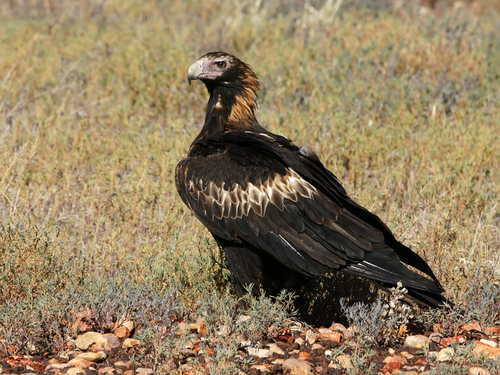
Wedge-tailed eagles (Aquila audax) are very large, lanky birds. Their plumage is characteristically black, but can range from tar to charcoal brown depending on lighting and individual variation. They have a massive bill, a relatively small and flat head, and a long, almost vulturine neck. They are also distinct for their prominent carpals and baggy feathered leg plumage, often called feathered trousers. This species typically perches conspicuously on dead trees, telegraph poles, rocks, and sometimes open ground. The combination of large bill size, elongated body shape, and prominent shoulders makes this eagle highly distinctive. When perched, their long wings extend down to a long, clearly wedge-tipped tail. They have a large area of bare facial skin, which researchers think is an adaptation to warm climates rather than carrion eating; this is because the non-carrion-eating Verreaux's eagle has similar facial feathering, while the carrion-eating golden eagle does not share this trait. Against their dark base plumage, tawny-rufous lanceolate-shaped neck hackles, a pale brown to rufous crissum, and a narrow mottled grey-brown band across the greater wing coverts all stand out clearly. The sexes cannot be distinguished by their plumage. Juvenile wedge-tailed eagles are mainly darkish brown, with extensive rufous feather edging and a paler, fairly streaky head. They also have a lighter-brown crissum and a light reddish-brown to golden nape; this lighter color sometimes extends to the back and wing band. The juvenile wing band is considerably more prominent than that of adults, extending to the median and sometimes the lesser coverts. Rarely, a juvenile may be entirely dull black, with no rufous feather edges and no wing band. From the second through fourth years, young eagles remain similar to juveniles, though they are almost always visibly moulting and their wing band gradually narrows. They become darker around the fifth year, retaining a red-brown nape and a still narrower wing band. Full mature plumage is not achieved until the seventh or eighth year, although sexual maturity can occur as early as five years of age. Adults have dark brown eyes, while juveniles usually have similar but slightly darker eyes. The cere and feet of wedge-tailed eagles are typically creamy white, though they may be dull yellow, and this duller coloring is more common in juveniles than adults. This species has a unique moult process: they moult almost continuously and very slowly, and it may take three or more years for an individual to complete a full moult. Moulting only stops during periods of famine, and occurs gradually so it does not interfere with the eagle's ability to fly or hunt. In flight, wedge-tailed eagles appear as very large, dark raptors, with a protruding head, long and relatively narrow wings that hold more or less parallel edges when soaring, and most distinctively a long diamond-shaped tail. Their shape is unlike that of any other raptor in the world. By comparison, juveniles have broader wings. Their wingspan is approximately 2.2 times the bird's total length. They usually fly with loose but deep, powerful wingbeats. Wedge-tailed eagles spend much time gliding, and remain stable and controlled even in strong winds. They glide and soar on upswept wings with long splayed primaries. Their broad tail may be upcurved, or "dished", at the edges. The eagle often spreads its deep wing emarginations to reduce drag in high winds. Contrary to their excellent controlled appearance once airborne, takeoff and flight for wedge-tailed eagles can be difficult even in normal conditions, unless they launch from a high point or there is moderate wind. Inside forests, they may clamber awkwardly to reach the canopy. Birds that have gorged on food while on the ground become practically grounded, leaving them vulnerable; this was historically an advantage for Aboriginal hunters. Human gliders have recorded encountering wedge-tailed eagles at altitudes over 3,000 m (9,800 ft). On adult eagles, the wings are almost entirely blackish except for the tawny-rufous nape and a greyish wing band that extends less than a quarter of the way down the wing width. Below the body, little breaks the dark coloration apart from the pale brown to rufous crissum and the pale greyish bases of the flight feathers. Juvenile wedge-tailed eagles appear much browner overall, and have largely the same underpart and wing pattern as adults. However, juveniles may have paler off-rufous mottling. Meanwhile, the juvenile's tail and most flight feathers are barred greyish, which contrasts with the pale-based, black-tipped primaries. On the upperparts, juveniles have much paler, more sandy rufous colour from the head to at least the upper mantle, along a broad wing band that covers more than half the wing width. This lighter dorsal colour sometimes extends to most of the back and scapulars. Rare individual juvenile eagles are dull black, with no wing band and no paler feather edges. With considerable individual variation, as young eagles age their characteristic wing band shrinks gradually, and after the fifth year their plumage darkens. The unique combination of large size, lanky build, long diamond-shaped tail (which can appear round-ended when both central tail feathers are moulted together), mainly dark or black plumage, and long wings when soaring or gliding makes wedge-tailed eagles of all ages fairly unmistakable across most of their range. The main species that may cause confusion is the black-breasted kite (Hamirostra melanosternon), which has surprisingly similar colouring but is much smaller, has a relatively short squared tail, and has extensive clear white patches across much of its wings. Juveniles of the white-bellied sea eagle (Haliaeetus leucogaster), sometimes noted as potentially confused with young wedge-tailed eagles, are much paler on the underparts, have a very different flight pattern: a short pale tail, bare legs, and shorter, broader wings held in a stiff dihedral. In New Guinea, Gurney's eagle is more similar to the wedge-tailed eagle in form and build than the species above, but it is somewhat smaller and more compact, has rich yellow feet, a rather shorter rounded or faintly wedge-tipped tail, and shorter, relatively broader wings, an adaptation to a more forest-dwelling lifestyle. Additionally, Gurney's eagle has much paler immature plumage. Although usually considered an island endemic, Gurney's eagle may be capable of marine dispersal, as the wedge-tailed eagle is, which could lead to individuals turning up in the forests of northern Australia; historical records confirm that rare vagrants of this species do appear there. The Papuan eagle (Harpyopsis novaeguineae), the only other New Guinean island raptor that approaches the wedge-tailed eagle in size, is a highly distinct, forest-restricted species. It is much paler, particularly on the underparts, has long bare legs, different body proportions that are more like a giant Accipiter, with short rounded wings, a long somewhat rounded-tipped tail, and a large rounded head. Wedge-tailed eagles are found throughout Australia, including Tasmania, as well as southern New Guinea, and occur in almost all habitats. They tend to be more common in favourable habitat in southern and eastern Australia. In Australia, they range from the Cape York Peninsula in the north down to Wilsons Promontory National Park and Great Otway National Parks at the southern tip of the continent, and from Shark Bay on the western coast to Great Sandy National Park and Byron Bay in the east. They are widespread across the desert interior of Australia, but occur at low, rare densities in the most arid parts of the continent, such as the Lake Eyre Basin. Off the mainland, wedge-tailed eagles live on several larger Australian islands and some smaller ones. These include most of the Torres Strait Islands, Albany Island, Pipon Island, the isles of Bathurst Bay, many small isles in Queensland from Night Island down to the South Cumberland Islands, Fraser Island, Moreton Island, North Stradbroke Island, Montague Island, Kangaroo Island, the Nuyts Archipelago, Groote Eylandt and the Tiwi Islands. In Tasmania, they are found almost throughout the main island, as well as some isles of the Kent Group, Bass Strait, Flinders Island and Cape Barren Island. In New Guinea, the wedge-tailed eagle has a highly restricted range, and occurs predominantly in the Trans-Fly savanna and grasslands in the general area around the Western Province, as well as in Indonesia's Merauke Regency, with some isolated reports from Western New Guinea near the Bensbach River and the Oriomo River. The wedge-tailed eagle lives in an extremely wide range of habitats. Although its range is smaller than that of the golden eagle, it likely occupies a wider range of habitat types than most other Aquila eagles, and uses more diverse habitats than any booted eagle species, making it more similar to habitat generalist raptors such as Buteo buzzards. Various habitats that support wedge-tailed eagles include open woodland, savanna, heathland, grasslands, desert edge and semi-desert, subalpine forests, montane grasslands and mountain peaks, not overly dense tropical rainforests, monsoon forests, dwarf conifer forests, some wetlands, and they regularly enter coastal areas, though they normally occur around plains some distance from the water. Favourite habitat is generally remote or rugged country, at least partially wooded, often with some rocky areas and shrubland. Wedge-tailed eagles appear to prefer areas where dead trees are present. They occur quite regularly around Eucalyptus woodland, as well as Acacia woodland, mixed woodlands of Casuarina cristata-Flindersia maculosa-Callitris cypresses, and stands of Casuarina cunninghamiana. A study in the Australian Capital Territory detected a strong preference for C. cunninghamiana alongside several Eucalyptus species, with sloping ground that allows good access and access to tall mature trees being key features for the eagles in that area. They are often seen soaring over hills, mountains or escarpments, as well as over flat plains, especially spinifex grassland. They typically avoid dense forest, and seek out glades and edges in forested areas. While they do occur in rich riparian woodlands, they are relatively scarce there, even though this is an area where many other Australian raptors congregate. In the deserts of the Lake Eyre basin, they are often seen on gibber plains along treed watercourses and drainage basins, where they are often concentrated around Eucalyptus in stony creek beds. In the sandy desert regions of Western Australia, wedge-tailed eagles were once reasonably common but have mostly left the region after the macropod prey they relied on there were almost hunted to extinction. Wedge-tailed eagles commonly occur from sea level up to about 2,000 m (6,600 ft), with no apparent preference for any particular altitude. A few studies have detected a clear preference for mountainous areas such as plateaus. One of the few habitat types that wedge-tailed eagles strongly avoid is intensively settled or cultivated land. Their tendency to avoid human areas has weakened slightly in recent times, likely because persecution rates have dropped greatly, and wedge-tailed eagles may now be seen near towns and villages in exurban and even suburban areas that are mostly surrounded by bushland. However, the species is seldom seen anything other than flying over more developed towns and cities. Additionally, it is not uncommon to see these eagles in man-made areas such as pastures, forestry clearings, and rolling farmland.