About Aquila adalberti C.L.Brehm, 1861
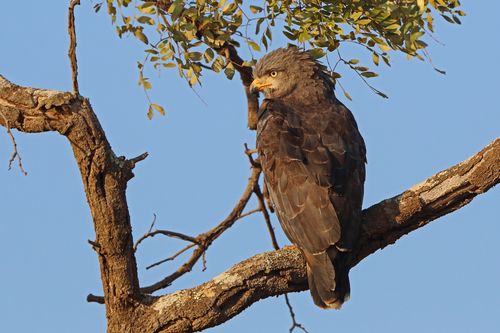
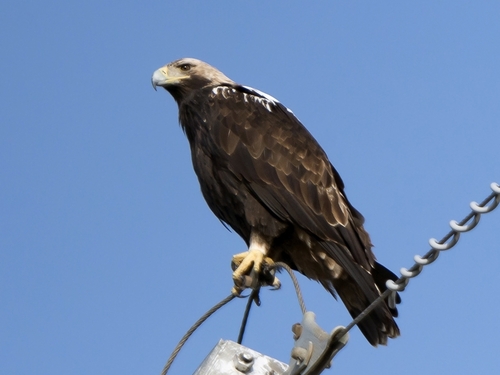
This is a large raptor, specifically a large eagle in the Aquila genus, broadly similar in size to its close relative the eastern imperial eagle, which occupies a very different distribution range. Compared to other medium-to-large booted eagles that share its range, it is somewhat smaller than the golden eagle and somewhat larger than Bonelli's eagle. Spanish imperial eagles weigh between 2.5 and 4.8 kg (5.5 to 10.6 lb). In one sample, the average weight of 10 males was 3.19 kg (7.0 lb), and the average weight of 17 females was 3.43 kg (7.6 lb). Another sample of 10 unsexed adult Spanish imperial eagles had an average weight of 3.93 kg (8.7 lb). On average, the Spanish imperial eagle weighs about 10% more than the eastern imperial eagle. It rivals the longer-winged and longer-tailed wedge-tailed eagle for the title of third heaviest member of the Aquila genus, ranking behind only the golden eagle and Verreaux's eagle. This species has a total body length of 72 to 85 cm (28 to 33 in) and a wingspan of 177 to 220 cm (5 ft 10 in to 7 ft 3 in). The typical reported wingspan is around 190 cm (6 ft 3 in) for males and around 210 cm (6 ft 11 in) for females. Adult Spanish imperial eagles resemble eastern imperial eagles, and can look superficially similar to golden eagles, especially when seen from a distance. However, adults are overall darker in color than both species, with a rich blackish-brown color that runs continuously from the throat down to the belly. Like the eastern imperial eagle, adult Spanish imperial eagles have a broad, distinctive white band on the shoulder and leading edge of the wing; this band is even more pronounced in the Iberian species than it is in the eastern imperial eagle. Adults also have a much paler tawny color on the nape and crown, which differs from the golden-yellow color of the matching area on a golden eagle. Juvenile Spanish imperial eagles look very different from both adults and other large raptors in their range: they are an overall uniform pale straw-sandy color, which contrasts with broad black bands on both the upper and lower sides of the wings. Juveniles have a relatively longer neck, and typically hold a much flatter wing profile when flying compared to the upturned dihedral wing shape that is typical of golden eagles. The Spanish imperial eagle occurs in central and south-west Spain and adjacent areas of Portugal, on the Iberian Peninsula. Its core population stronghold is in the dehesa woodlands of central and south-west Spain, including regions such as Extremadura, Ciudad Real, and areas in the north of Huelva and the Sierra Norte of Seville. Unlike the partially migratory eastern imperial eagle, the Spanish imperial eagle is a permanent resident species. A stable established population in Morocco is unconfirmed, but immature Spanish imperial eagles regularly visit Morocco during their dispersal period. An increasing number of vagrant Spanish-born eagles have been found electrocuted in Morocco. Some areas used by the eagles in Morocco act as a drain on the species' recovery, because Morocco's transmission tower insulation matches the conditions found in Spain in the early 1980s. Vagrant eagles have even reached as far as Mauritania and Senegal. North of the species' natural range, vagrants have been recorded reaching as far as the Netherlands in one rare instance. The Spanish imperial eagle feeds mainly on European rabbits, which made up around 58% of the species' diet before the outbreaks of myxomatosis and rabbit haemorrhagic disease that greatly reduced the native rabbit population in Iberia. After the rabbit population crashed, the eagles were recorded feeding on a wide range of vertebrates, with variable success depending on local prey populations. They may become semi-specialized hunters of water birds, especially Eurasian coots, ducks, and geese. They also take a number of partridges, pigeons, crows, and any other bird they encounter that is vulnerable to an ambush attack. More than 60 bird species are known to be included in the Spanish imperial eagle's prey spectrum. The eagles also hunt several types of mammals, including various rodents, hares, mustelids, and hedgehogs. They even prey on other large predators such as red foxes, and very rarely, domestic cats and small dogs, which are not typically found in the eagle's native habitat. Rarely, the eagles may also prey on reptiles or even fish. The largest prey taken by this species can easily exceed 3.3 kg (7.3 lb), examples including foxes, greylag geese, and white storks, but the average prey mass is relatively low, especially in areas with fewer remaining rabbits. One local study recorded a mean prey mass of 450 g (0.99 lb), though larger average prey sizes have also been reported. The Spanish imperial eagle is one of several rabbit-specialized birds of prey found in Spain, alongside the similarly rabbit-specialized Iberian lynx. To reduce direct competition, this species is largely separated by habitat from other rabbit-specialized eagles in the region: the Spanish imperial eagle favors woodland areas, while golden eagles and Bonelli's eagles tend to live in much rockier areas. Despite this, Spanish imperial eagles frequently compete for food with various other raptors, including much larger vultures, and raptors in the area may sometimes attempt to kill each other's young. In one recorded case, an adult Spanish imperial eagle protecting its own nest even killed a cinereous vulture, which is the largest accipitrid in the world. Healthy, free-flying adult Spanish imperial eagles are apex predators, and have almost no natural predators themselves. However, they sometimes kill each other during conflicts, and rarely, interspecific conflicts can also be fatal. When the eagles are protected from human persecution and located far from threats such as powerlines, annual adult mortality can be as low as 3–5.4%.