About Aquarius cordifolius (L.) Christenh. & Byng
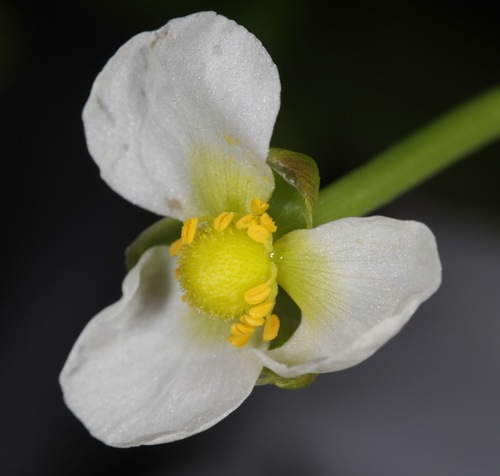
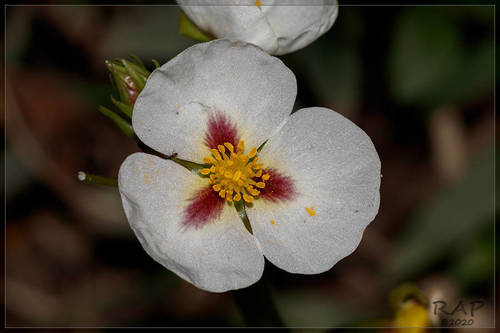
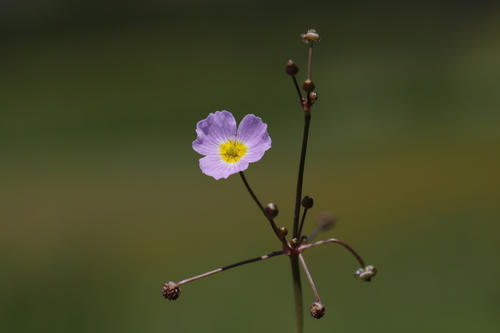
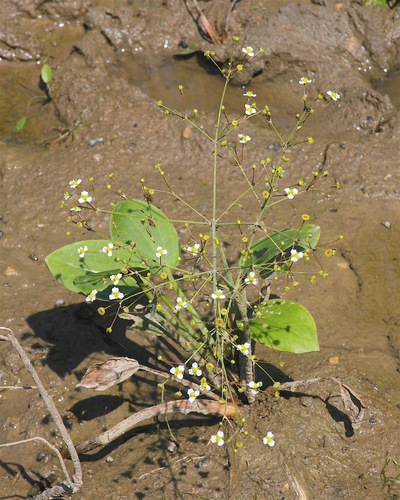
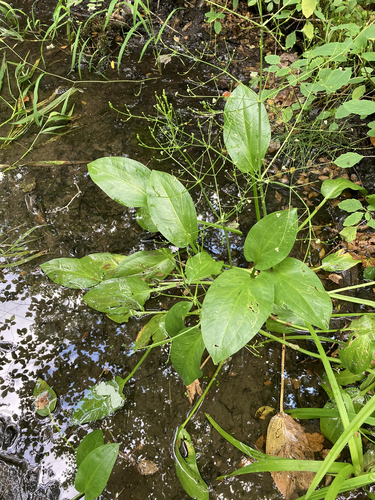
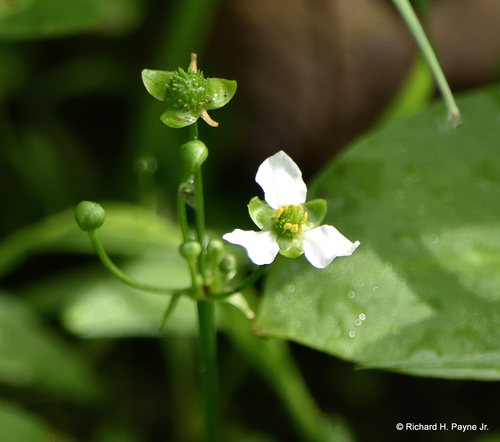
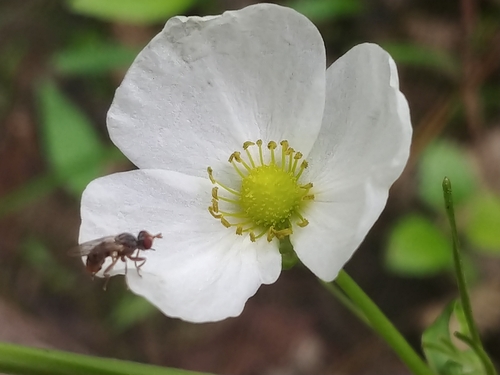
This is a description of the perennial stout herb Aquarius cordifolius (L.) Christenh. & Byng, previously known as Echinodorus cordifolius. Individuals can grow up to 100 cm tall and have rhizomes. Most leaves are emersed, with submersed leaves mostly absent. Leaf petioles have 5–6 ridges and measure 17.5–45 cm long. Leaf blades have distinct lines of translucent markings, are shaped ovate to elliptic, 6.5–32 cm by 2.5–19.1 cm, with bases ranging from truncate to cordate. Inflorescences are racemes made of 3–9 whorls, with each whorl holding 3–15 flowers. Inflorescences are decumbent to arching, growing up to 62 cm long and 8–18 cm wide, and often proliferate. Peduncles are terete and 35–56 cm long, while the rachis is triangular. Bracts are distinct, subulate, coarse, have coarse margins, and measure 10–21 mm long. Pedicels are erect to ascending, 2.1–7.5 cm long. Flowers can reach 25 mm wide; sepals are spreading, 10–12-veined, and their veins are papillate. Petals are not clawed. Each flower has 22 stamens with versatile anthers, and 200–250 pistils. Fruits are oblanceolate and plump, with 3–4 ribs, a single abaxial keel, and measure 2–3.5 mm by 0.9–1.5 mm. Each fruit has 3–4 glands, with a terminal beak 1–1.3 mm long. The chromosome count is 2n = 22. This species is very easily recognized: it is the only species with arching to decumbent inflorescences, and the only one with papillate veins on its sepals. Aquarius cordifolius is easily cultivated. It grows well in neutral to soft water at tropical to subtropical temperatures, and requires a rich substrate and good light. It is common in the cultivated aquarium trade. Emersed plants readily produce flowers and seeds, but the species can also be grown submersed. Most commercially sold plants are grown emersed on plant farms. When first submerged, older emersed leaves may die off before new underwater leaves develop. In aquariums, it is typically grown as a background specimen plant. It will quickly outgrow smaller aquariums, but removing floating leaves can help keep it smaller and maintain it under water. A large, deep aquarium is required to grow it properly. CO2 infusion supports stronger growth. It is a heavy feeder, and a rich substrate including clay is needed for optimum growth. When grown emersed, it is prone to aphid attacks. It is not particular about water conditions beyond requiring tropical aquarium temperatures. It can be grown outdoors in warmer countries and cannot tolerate frost. It prefers high levels of light. It can be grown in or beside ponds in warmer climates. Its seeds can be sown in shallow water.