About Apus pacificus (Latham, 1801)
Taxonomy and Length
The Pacific swift, Apus pacificus (Latham, 1801), measures 17–18 cm (6.7–7.1 in) in length, making it the largest species in the Apus swift genus.
Wingspan
It has a wingspan of 43 to 54 cm (17 to 21 in).
Weight
Females average 44.5 g (1.57 oz), which is slightly heavier than males that average 42.5 g (1.50 oz).
Body Shape
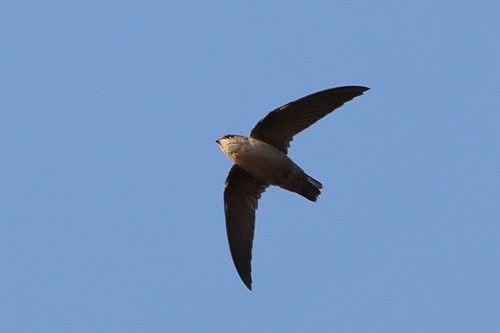
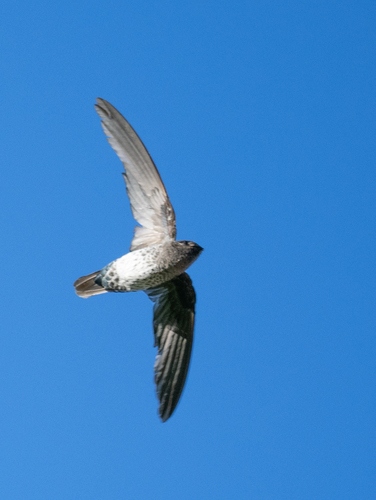
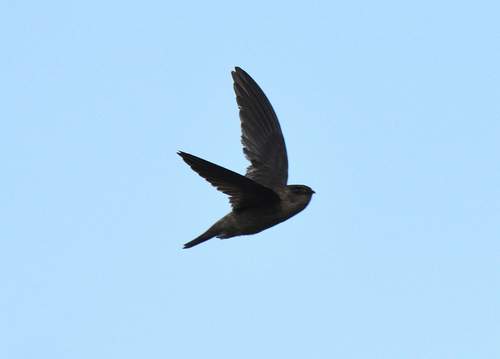
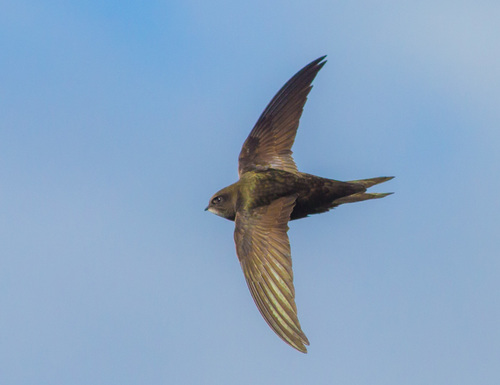
Its general shape is similar to the common swift, but it has slightly longer wings, a more protruding head, a deeper tail fork, and a broader rump.
Upperpart Coloration
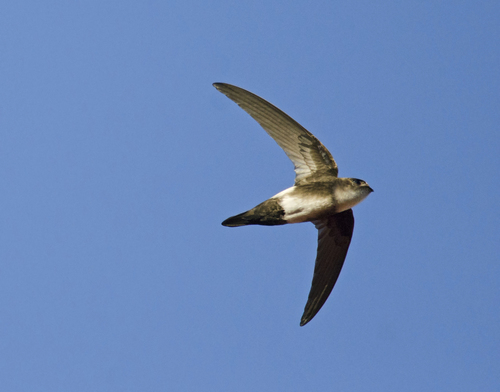
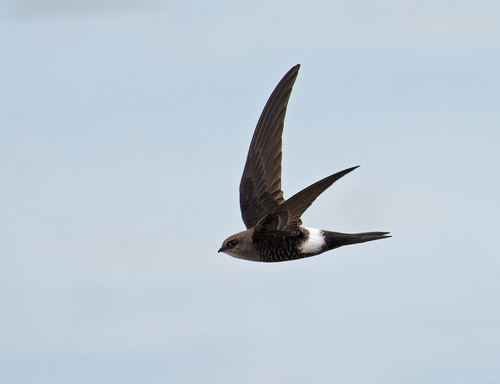
Its upperparts are black, except for a white rump band and a somewhat greyer head.
Underpart Coloration
The underparts are black, though white feather fringes give the belly a scaly appearance when viewed clearly from below.
Wing and Tail Coloration
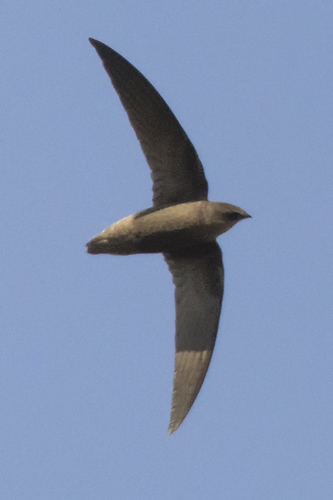
The tail and upper wings are black, while the underwings are brown.
Soft Part Coloration
The eyes are brown, and the small bill and very short legs are black.
Sexual Plumage
The sexes have identical plumage.
Juvenile Plumage
Juveniles differ from adults only by pale fringes on their feathers, most noticeably on the wings.
Subspecies Plumage
The southern subspecies, A. p. kurodae, has a narrower white rump patch than the nominate form: 15 mm (0.6 in) versus 20 mm (0.8 in), plus a grey throat and blacker underparts.
Pre-Migration Moult
Juveniles of migratory Apus swifts undergo a partial moult before migration, but keep their larger wing feathers.
Wintering Ground Moult
Moult is completed on the wintering grounds, where adults undergo a complete moult.
Identification Overview
This species is usually straightforward to identify.
Comparison with White-rumped Swift
The white-rumped swift is similar to the Pacific swift, but its slender body and long, deeply forked tail make it look quite different from the more powerfully built Pacific swift.
Common Identification Confusion
A common identification mistake can occur with a partially leucistic common swift that has a white rump.
Distinguishing Features
With careful observation, the Pacific swift can be distinguished by its deeper tail fork, longer wings, larger head, larger white throat patch, and patterned underparts.
Southeast Asia Identification Notes
In parts of Southeast Asia, migrating Pacific swifts pass through the resident ranges of former subspecies, so clear views are required to confirm correct identification.
Nominate Subspecies Breeding Range
The nominate subspecies, A. p. pacificus, breeds in eastern Asia from the Ob River northeast to Kamchatka, and east to the Kuril Islands, Sakhalin, and Japan.
Nominate Subspecies Wintering Range
It is strongly migratory, and winters in southern Indonesia, Melanesia, and Australia, including Tasmania.
Nominate Subspecies Migration Route
It is a common migrant through coastal Malaysia, Sumatra, and Java, with vast numbers crossing the Strait of Malacca.
A. p. kurodae Breeding Range
Subspecies A. p. kurodae breeds from southeastern Tibet through eastern China to southern Japan, Taiwan, and Orchid Island.
A. p. kurodae Wintering Range
It is a relatively short-distance migrant, wintering in the Philippines, Malaysia, and northern Indonesia.
Vagrant Status Overview
As a powerful long-distance migrant, the nominate subspecies of Pacific swift has occurred as a vagrant far outside its normal range.
Oceania and Asia Vagrant Records
Individual birds have been recorded in Brunei, the Maldives, New Zealand, and Macquarie Island, and there have been multiple records in the Seychelles.
US Vagrant Records
In the United States, this species is casual in the Pribilof and Aleutian Islands.
Canada Vagrant Claim
A claimed 2010 sighting from the Yukon will be the first record for Canada and the North American mainland if it is ratified.
South America Vagrant Record
In South America, there is a 1959 record from Colombia.
European Vagrant Records
As of 2013, there are 13 European records, from Denmark (two), Spain, Sweden (four), and the UK (seven).
European Record Uncertainty
It is possible this number overstates the true count of visiting birds.
2013 European Sighting Notes
All the listed countries had a sighting on different dates in the summer of 2013, which could all come from a single wandering bird.
UK Repeat Sighting Notes
The four most recent English records in 2005, 2008, 2011, and 2013 all include sightings at Spurn, East Yorkshire, and may refer to the same returning individual.
Habitat Generalist Status
A mainly aerial species, this swift is not restricted to specific land habitats or climatic zones.
Breeding Habitat
It breeds from the Arctic to subtropical China, and from sea level to at least 3,000 m (9,800 ft) in Japan.
Breeding Proximity to Humans
It is often found around human settlements.
Wintering Habitat
It generally winters in lowlands, and in Australia it occurs in arid areas, as well as in towns and along the coast.
Flocking Behavior
Flocks of thousands may appear when there are hot strong winds.
Mixed Flocking
Pacific swifts often travel and feed alongside white-throated needletails.
Roosting Behavior
The Pacific swift probably sleeps in flight when it is not nesting, a behaviour confirmed to occur in the common swift and suspected in other Apus species, but there is an Australian record of these swifts roosting in a tree, and they are occasionally seen landing briefly on the ground or on vertical surfaces.