About Aporocactus flagelliformis (L.) Lem.
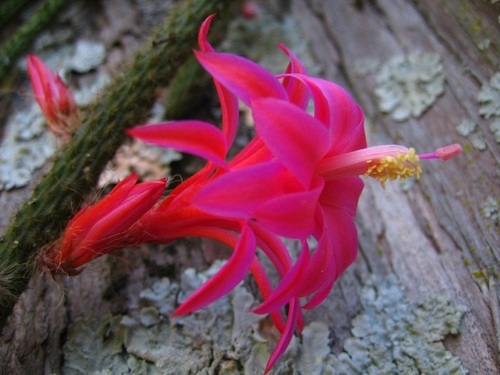
Aporocactus flagelliformis (L.) Lem. has stems that start ascending, then become prostrate or pendent, with extensive branching at the base. Stems reach 1–2 m or more in length, and are 8–24 mm thick. They have 7 to 14 obtuse ribs, with somewhat tuberculate margins. Areoles are small and whitish, with internodes measuring 4–8 mm. The species produces 8 to 20 bristle-like spines, 3 to 8 up to 10 mm long, ranging in color from yellowish to brownish. The epidermis is green when young, turning grayish with age. Flowers are zygomorphic, 7–10 cm long, 2 to 4 up to 7.5 cm wide, with a bilaterally symmetric, oblique flower limb. They are diurnal, open for 3–5 days, and have no scent. The pericarpel is greenish with acute bracteoles. The receptacle is 3 cm long, curves just above the pericarpel, and bears brownish, acute bracteoles. Outer tepals are linear-lanceolate, somewhat reflexed, 2–3 cm long and 6 mm wide, and crimson in color. Inner tepals are narrowly oblong, up to 10 mm wide, crimson, and sometimes fade to pink along the margins. Stamens are white to pale pink, erect, and extend beyond the flower mouth. The style has 5 to 7 white stigma lobes. Fruits are globose, 10–12 mm long, red, and covered in bristles, with yellowish pulp. Seeds are ovoid and brownish red. This species is native to Hidalgo, Mexico, where it grows as a lithophyte or epiphyte in dry forests. It appears to be rare and is seldom collected from wild populations. It is commonly known as rattail cactus, and is very easy to cultivate. It is suitable for growing in containers, greenhouses, and can be kept indoors or outdoors. It requires a minimum temperature of 6 °C (43 °F), and should be grown in bright indirect light in a fairly rich potting medium. The recommended growing mix is four parts sandy loam, combined with one part of a mixture of equal amounts sand and crushed brick. It should be repotted every two years, as its potting soil tends to sour; repotting does not require moving the plant to a larger pot. Once established, keep the growing mix moist from April to October. From November to March, much less water is needed, only enough to prevent stem dieback. In winter, old or discolored stems can be cut back to the base to encourage new growth. This plant has been awarded the Royal Horticultural Society's Award of Garden Merit.