About Aporandria specularia (Guenée, 1857)
The genus Aporandria is described as having obliquely porrect palpi that extend forward, are thickly covered in scales, and reach beyond the sharp frontal tuft. Antennae are bipectinated, meaning they are comb-like on both sides, with long branches extending to two-thirds of their length in both sexes. The hind tibia is not dilated. Forewings have a produced and acute apex, with an oblique outer margin. Veins 3 and 4 arise from the angle of the cell, or are shortly stalked. Veins 6, 7, 8, 9 and 10 are stalked, and vein 11 is free. Hindwings have an angled outer margin at vein 4, and veins 3, 4 and 6, 7 are stalked.
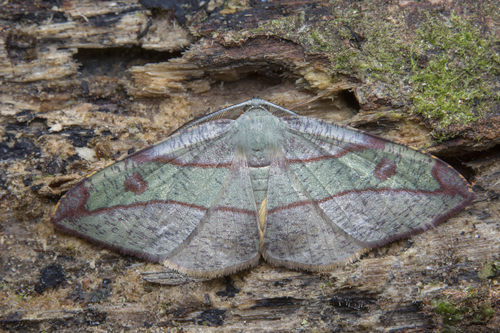
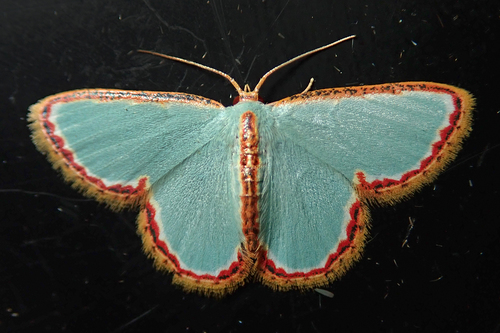
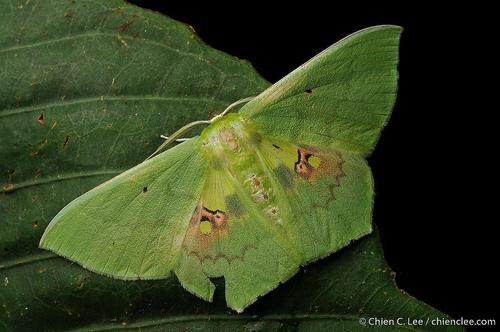
For the species Aporandria specularia, the wingspan of males is about 54 mm, while the wingspan of females is about 60 mm. The moth is pea green. Its palpi and frons are chocolate coloured, and the vertex of the head is white. Forewings have a dark speck at the end of the cell. Hindwings have a yellow-green base, and a large lunulate pinkish mark with brown edges and a black speck on it at the end of the cell; this mark extends towards the costa and inner margin as an indistinct band. Both wings have traces of a waved postmedial line. The ventral side of the palpi, thorax and base of the wings are silvery white.
The larvae are slender, with a green body, and a strongly bifid (cleft) head. True legs are pale purplish red with darker spots. Early instars are dark yellow. Larvae hold a twig-like posture when at rest. Eggs are thick, and are elongate-oval disc-shaped. Larvae have been recorded feeding on Mangifera, Terminalia, Eugenia, Areca, Rhizophora and Nephelium species. This is a lowland species that inhabits both forested areas, and disturbed or cultivated areas.