About Aplocera efformata (Guenée)
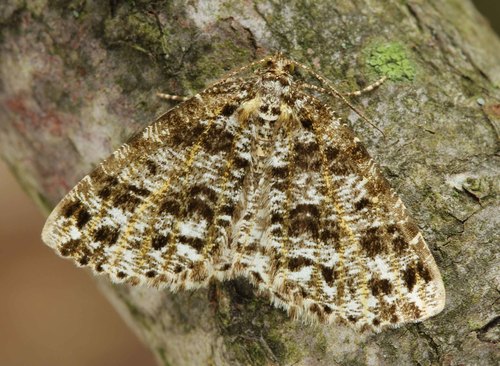
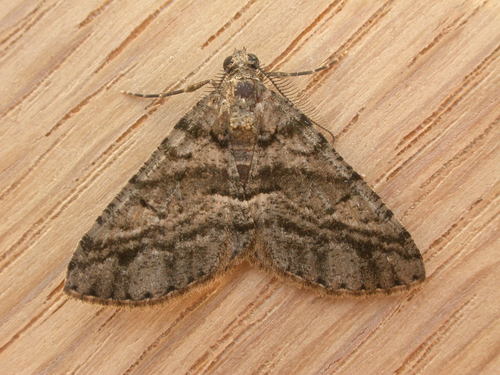
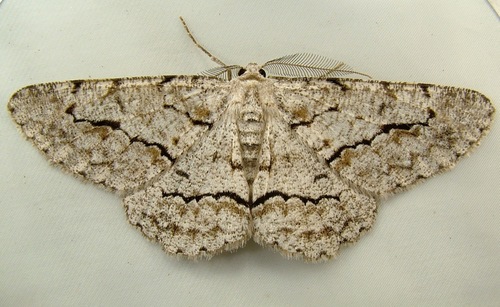
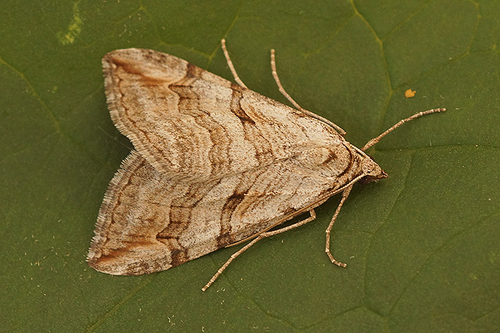
Aplocera efformata, commonly called the lesser treble-bar, is a moth in the Geometridae family. The species was first described by Achille Guenée in 1858, and it is found in Europe, Morocco, and Anatolia. This moth has a wingspan of 35 to 41 mm. It is difficult to reliably distinguish Aplocera efformata from its close relative Aplocera plagiata. The most reliable distinguishing feature concerns the innermost of the three dark cross-bands on the wing: the band is fairly straight with a marked bend near the front edge, rather than evenly curved. In addition, Aplocera efformata is mostly slightly smaller overall. Its forewing base colour is slightly lighter, while its cross-bands are slightly darker, making the cross-bands appear more pronounced. The slash at the wing tip is lighter brownish colour, rather than black. The forewings of this species are pointed, light grey with three dark grey cross-bands. The innermost cross-band is double, quite straight with a marked kink near the front edge. The two outermost cross-bands are triple and evenly curved. The outermost cross-band has two, more or less distinct, triangular projections on its outer side. There is a short, slightly diffuse brownish slash at the wing tip. The hindwings are greyish-white. For further information, see Townsend et al. This species produces two to three generations per year, with adults active on wing from the end of April to mid-November. The larvae feed on Hypericum perforatum. Larvae can be found from June to August, and from September to May. The species overwinters in its larval stage, and pupation occurs beneath the soil.