About Aplastodiscus leucopygius (Cruz & Peixoto, 1985)
Size
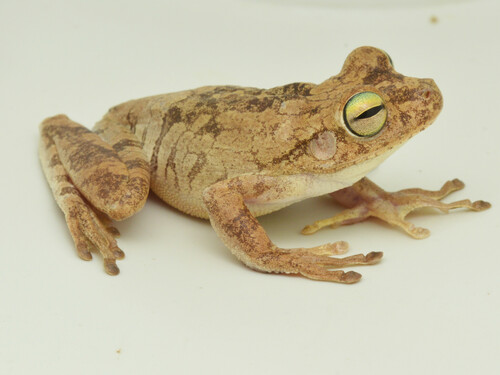
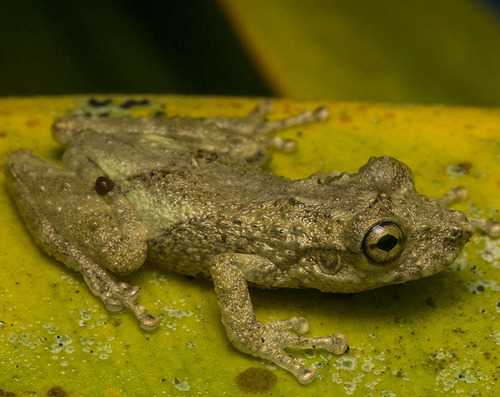
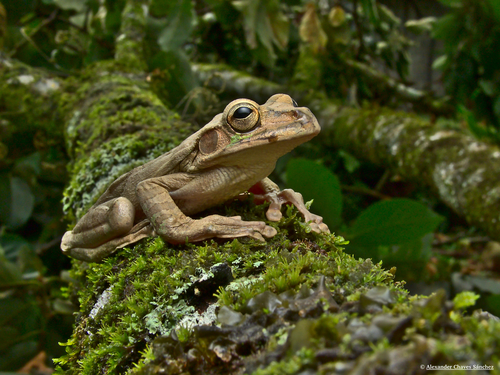
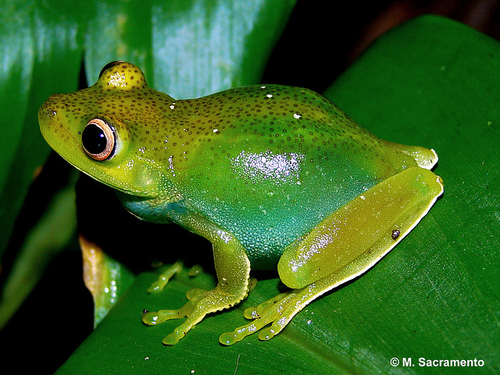
Aplastodiscus leucopygius is a medium-sized frog that reaches a length of approximately 4 cm (1.6 in).
Head and Throat Features
It has a rounded snout and a single vocal sac on its throat.
Sensory Organ Features
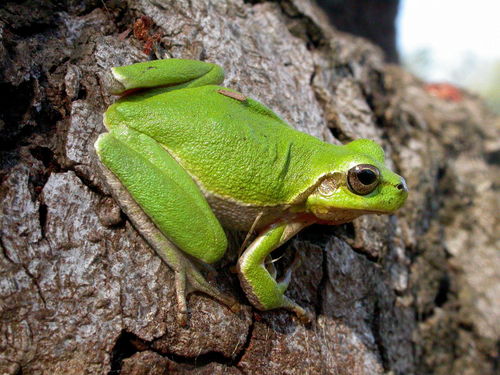
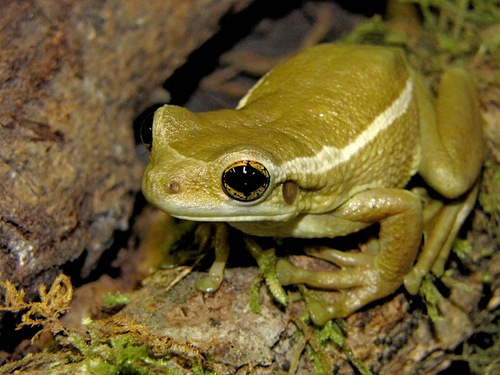
The iris is golden, with an orange tinge along the edge, and the tympanum is clearly visible.
Limb Structure
The tips of its fingers and toes have large discs that help it maintain grip while climbing.
Dorsal Coloration and Texture
The dorsal (upper) surface of this frog is smooth and green, scattered with white spots.
Ventral Coloration and Texture
Its ventral (lower) surface is granular, cream-coloured, and marked with white flecks.
Vent Skin Marking
A short, white ridge decorates the skin above the vent.
Distribution and Altitude Range
Aplastodiscus leucopygius is an arboreal species endemic to mountains near the south-eastern coast of Brazil, where it occurs at altitudes between 800 and 1,600 metres (2,600 to 5,200 ft) above sea level.
Habitat
It is primarily found in forested areas near streams or temporary pools.
Breeding Period
Breeding for this species occurs during the rainy season, between December and February.
Mating Call Behavior
Males call from trees near a body of water to attract females, and multiple nearby males often form a chorus.
Courtship Ritual
When a female arrives, she selects a male through an elaborate courtship ritual.
Nest Inspection Step
The ritual concludes with the female inspecting an underground nesting chamber that the male has already prepared in a wet, muddy location.
Mating and Egg Laying
If the chamber is acceptable to the female, mating occurs, and a raft of eggs is laid inside the chamber.
Tadpole Development
Developing tadpoles stay in the nest until they are washed out by flooding, after which they continue their development in shallow streams.