About Apis mellifera Linnaeus, 1758
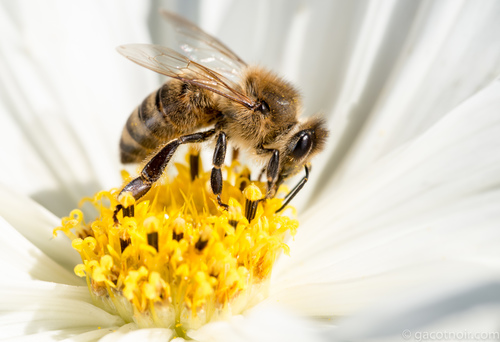
The western honey bee, also called the European honey bee (scientific name Apis mellifera Linnaeus, 1758), is the most common of the 7–12 recognized honey bee species worldwide. The genus name Apis is Latin for "bee", while mellifera means "honey-bearing" or "honey-carrying" in Latin, a reference to the species' honey production. Like all honey bee species, the western honey bee is eusocial. It forms colonies made up of one fertile female called the queen, large numbers of normally non-reproductive female workers, and a small proportion of fertile males called drones. Individual colonies can hold tens of thousands of bees. Colony activity is organized through complex communication between individuals, which uses both pheromones and the waggle dance. The western honey bee was one of the first domesticated insects, and remains the main species kept by beekeepers today for honey production and crop pollination. With human assistance, the species now lives on every continent except Antarctica. Western honey bees face threats from pests and diseases, most notably the Varroa mite and colony collapse disorder. As of 2025, the western honey bee is listed as "Data Deficient" on the IUCN Red List. It is an important model organism for scientific research, particularly in studies of social evolution, learning, and memory. It is also used in pesticide toxicity research, especially through pollen exposure, to measure non-target impacts of commercial pesticides. The western honey bee can be found on every continent except Antarctica. The species is thought to have originated in either Africa or Asia, and naturally spread across Africa, the Middle East, and Europe. Human activity is responsible for its greatly expanded current range; humans introduced European subspecies to North America in the early 1600s, as well as to South America, Australia, New Zealand, and eastern Asia. Unlike most other bee species, western honey bees have perennial colonies that persist year after year. Due to this high degree of sociality and permanent colony structure, western honey bee colonies can be classified as superorganisms, meaning the biologically relevant reproductive unit is the entire colony rather than individual bees. Western honey bee colonies reproduce through a process called swarming. In most climates, swarming occurs in spring and early summer, when abundant blooming flowers provide plenty of nectar and pollen for collection. In response to these favorable conditions, the hive produces one to two dozen new queens. When the pupal stage of these daughter queens is nearly complete, the old queen leaves the colony along with approximately two-thirds of the adult worker bees in a swarm. They travel some distance to find a new suitable location to build a hive, such as a hollow tree trunk. In the original colony, the daughter queens often start "piping" just before they emerge as adults. When the daughter queens eventually emerge, they fight one another until only one remains, and this survivor becomes the new queen of the old colony. If one sister emerges earlier than the others, she may kill her remaining siblings while they are still in the pupal stage, before they can emerge as adults. After eliminating all rivals, the new fertile queen lays all the eggs for the colony her mother left behind. Unmated virgin females can lay eggs that develop into males, a trait shared by bees, wasps, and ants due to haplodiploidy. However, the queen must mate to produce female offspring, which make up 90% or more of the bees in a colony at any time. For this reason, the new queen takes one or more nuptial flights, mating with 1 to 17 drones each time. Once she finishes mating, usually within two weeks of emerging, she stays in the hive for the rest of her life and her primary role is laying eggs. Through the remainder of the growing season, the colony produces many workers, which collect pollen and nectar to store as food for the cold season. The average population of a healthy hive in midsummer can reach 40,000 to 80,000 bees. Worker bees process nectar collected from flowers by evaporating moisture until the content is low enough to prevent mold growth, turning the nectar into honey. The finished honey is capped with wax and can be stored indefinitely. In the temperate climates that western honey bees are adapted to, bees gather inside the hive to overwinter, and the queen may stop laying eggs during this period. Colony activity slows during the cold season, and the colony consumes stored honey to produce metabolic heat to stay warm. In mid to late winter, the queen starts laying eggs again, a change likely triggered by increasing day length. Depending on the subspecies, local environmental conditions, and internal hive characteristics, new queens and swarms may be produced every year or less frequently. Like other insects that undergo complete metamorphosis, the western honey bee has four distinct life stages: egg, larva, pupa, and adult. The complex social structure of western honey bee hives means all four life stages are present at the same time for most of the year. The queen lays one single egg into each honeycomb cell that has been prepared by worker bees. The egg hatches into a legless, eyeless larva that is fed by nurse bees, a group of worker bees that maintain the interior of the colony. After approximately one week, the nurse bees seal the larva inside its cell and the larva enters the pupal stage. After another week, it emerges as an adult bee. It is typical for the honeycomb to have distinct regions: one area holds young developing bees (called brood), while other areas store pollen and honey. Worker bees secrete the wax used to build the hive, clean and maintain the hive, guard it against threats, raise the young, and forage for nectar and pollen. A worker's specific role changes as it ages. For the first 10 days of their adult lives, worker bees clean the hive and feed larvae. After this period, they begin building comb cells. From days 16 through 20, workers receive nectar and pollen from older forager workers and store the resources. After the 20th day of adulthood, a worker leaves the hive and spends the rest of its life as a forager. Although worker bees are typically infertile females, some subspecies may produce fertile worker eggs when under stress. Since workers are not fully sexually developed, they do not mate with drones, so they can only produce haploid male offspring. Both queens and workers have a modified ovipositor called a stinger, which they use to defend the hive. Unlike the stinger of bees from other genera, and unlike the stinger of western honey bee queens, the stinger of worker western honey bees is barbed. Contrary to common belief, a bee does not always die soon after stinging; this misunderstanding comes from the fact that a bee usually dies after stinging a human or other mammal. When the barbed stinger lodges in elastic mammalian tissue, the entire stinger, venom sac, associated musculature, and a ganglion that continues to deliver venom after detachment pull free of the bee's body. This structure, including the barbs on the stinger, is thought to have evolved in response to vertebrate predation, because barbs do not function and the stinger apparatus does not detach unless embedded in elastic material. The barbs do not always catch, so a bee can sometimes pull its stinger free, fly away unharmed, and even sting again. For most subspecies, the average lifespan of a queen is three to five years, though records from the previously beekeeping-used German honey bee subspecies (A. m. mellifera) note that queens can live up to eight years. Near the end of a queen's life, her stored sperm is depleted, so she begins laying more unfertilized eggs. For this reason, beekeepers usually replace queens every one to two years. Worker lifespan varies significantly through the year in regions with long winters. Workers born in spring and summer work intensively and only live a few weeks, while workers born in autumn remain inside the hive for several months while the colony clusters for warmth. On average over the year, around 1% of a colony's worker bees die naturally each day. Except for the queen, all workers in a colony are replaced about every four months. The western honey bee is an important pollinator of agricultural crops, and this pollination service makes up most of the species' commercial value. In 2005, the global estimated commercial value of western honey bees was just under 200 billion US dollars. A large number of crop species farmed around the world depend on western honey bee pollination. As orchard and farm sizes have increased, wild pollinator populations have declined. Many regions address this pollination shortage with migratory beekeepers, who bring hives to a site during crop bloom and move them away after the flowering period ends. Commercial beekeepers plan their movement routes and overwintering locations based on anticipated pollination contracts. At higher latitudes, it is difficult or impossible to overwinter enough bees, or have colonies ready to pollinate early-blooming plants. Most migration is seasonal: hives overwinter in warmer climates and move to higher latitudes to follow the sequence of blooming crops. In California, almond pollination takes place in February, early in the growing season before local hives have built up their populations. Almond orchards require two hives per acre (or 2000 m² per hive) to reach maximum yield, so pollination depends on importing hives from warmer climates. Almond pollination, which occurs in February and March in the United States, is the largest managed pollination event in the world, requiring more than one-third of all managed honey bees in the country. Hives are also moved in large numbers to pollinate apple crops in New York, Michigan, and Washington. Even though western honey bees are not efficient pollinators for blueberries, large numbers of hives are still brought to Maine for blueberry pollination because they are the only pollinator that can be easily moved and concentrated for blueberries and other monoculture crops. Bees and other insects exhibit flower constancy, meaning they transfer pollen to other plants of the same biological species; this prevents flower stigmas from becoming clogged with pollen from unrelated species. In 2000, Drs. Roger Morse and Nicholas Calderone of Cornell University attempted to measure the total contribution of the western honey bee to American food crops. Their calculation put the contribution at 14.6 billion US dollars in crop value.