About Apis cerana Fabricius, 1793
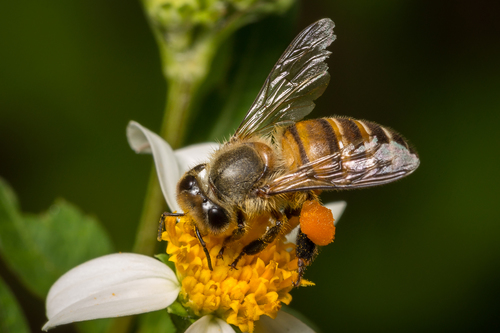
Apis cerana, formally described by Fabricius in 1793, has physical traits very similar to other species in the genus Apis. All members of the genus Apis are defined by long, erect hairs that cover their compound eyes (these hairs assist in pollen collection), a strongly convex scutellum, and a jugal lobe on the hindwing. Adult Apis cerana are black with four yellow abdominal stripes. There are clear physical distinctions between the species' worker bees, queens, and drones. Worker bees have a pollen press on the hind leg for transporting pollen, and a stinger located where an egg-laying organ would be in reproductive females. Queens, the species' reproductive females, are typically larger than worker bees because they have enlarged reproductive organs. Drones, the males of the species, have larger eyes, no stinger, and a blunter abdominal shape. Apis cerana lives across a wide range of climatic zones, including moist tropical rainforests, wet-dry tropical savannas, mid-latitude steppes, dry mid-latitude grasslands, moist continental deciduous forests, and taigas. The species' natural range stretches from Primorsky Krai, Russia in the north, to eastern Indonesia in the south; from Japan in the east, to the highlands of Afghanistan in the west. Countries where Apis cerana is native include Afghanistan, Bangladesh, Bhutan, Brunei, Cambodia, China, India, Indonesia, Japan, Laos, Malaysia, Myanmar, Nepal, North Korea, Pakistan, the Philippines, Russia, South Korea, Sri Lanka, Taiwan, Thailand, Timor-Leste, and Vietnam. Apis cerana was deliberately introduced to New Guinea in the 1970s, and has since spread through the Torres Strait Islands into Australia and the Solomon Islands. While the species was originally restricted to East Asia, human activity has allowed it to expand to various regions across the world. There is particular concern over its invasive potential in Australia, as its nests can be found in a wide variety of both natural and man-made environments. A 2020 study conducted in Vietnam found that Apis cerana uses animal feces, and even human urine, to defend their hives against raids by the hornet species Vespa soror. This defensive strategy is not used by Apis cerana's European and North American counterparts, though stingless bees are already well known to collect and use feces in nest construction.