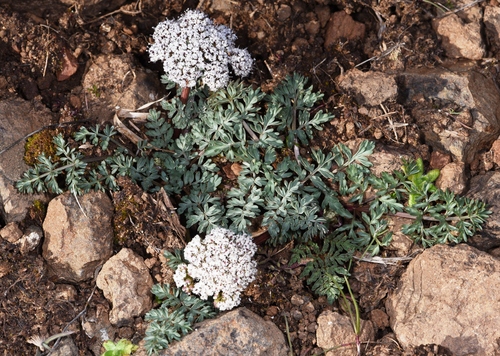
About Apiaceae
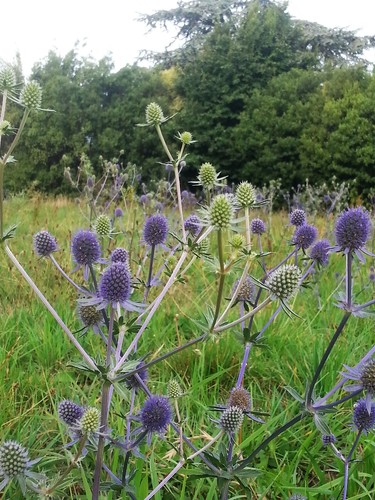
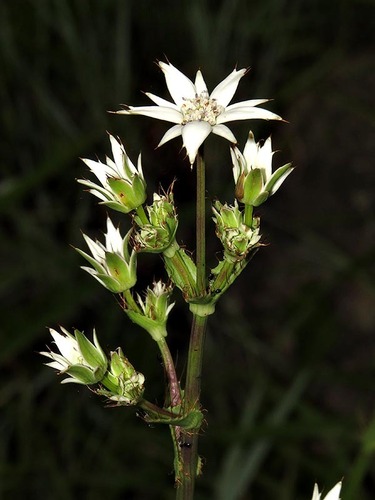
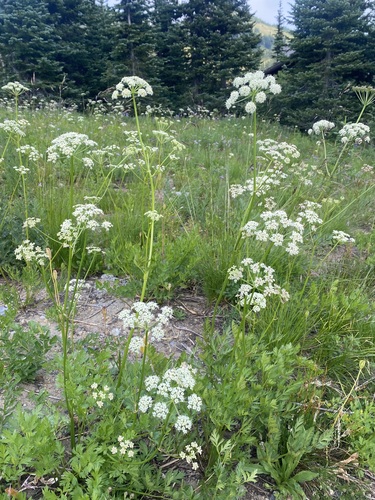
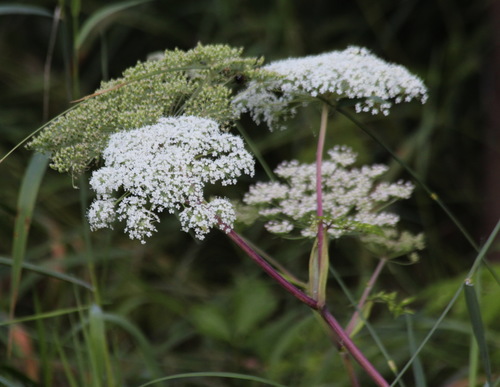
Most species in the Apiaceae family are annual, biennial, or perennial herbs, often with leaves clustered near the base. A small number of species are woody shrubs or small trees, such as Bupleurum fruticosum. Apiaceae leaves vary in size, are generally alternately arranged, though upper leaves are often nearly opposite. Leaves may be petiolate (stalked) or sessile (stalkless). Stipules are absent, but leaf stalks (petioles) are frequently sheathing, and leaves may be perfoliate. Leaf blades are most often dissected, ternate, or pinnatifid, but are simple and entire in some genera, for example Bupleurum. When crushed, most species' leaves give off a distinct scent that can range from aromatic to fetid, though some species have no noticeable scent. The defining feature of Apiaceae is their inflorescence: flowers are almost always grouped into terminal umbels, which may be simple, but are more commonly compound, and often take the form of umbelliform cymes. Flowers are usually perfect (hermaphroditic) and radially symmetrical (actinomorphic), but flowers at the edge of the umbel may be bilaterally symmetrical (zygomorphic) in species like carrot (Daucus carota) and coriander, with unequal-sized petals where those pointing outward from the umbel are larger than those pointing inward. Some species are andromonoecious, polygamomonoecious, or even dioecious, such as Acronema. Apiaceae flowers have a distinct calyx and corolla, but the calyx is often highly reduced, to the point of being undetectable in many species. The corolla can be white, yellow, pink, or purple. Flowers are nearly consistently pentamerous, with five petals and five stamens. There is often variation in stamen functionality even within a single inflorescence: some flowers are functionally staminate (a pistil may be present but it has no ovules capable of fertilization), while others are functionally pistillate (stamens are present but their anthers do not produce viable pollen). Geitonogamy (pollination of one flower by pollen from a different flower on the same plant) is common. The gynoecium is made of two carpels fused into a single, bicarpellate pistil with an inferior ovary. Stylopodia support two styles and secrete nectar, which attracts pollinators including flies, mosquitoes, gnats, beetles, moths, and bees. The fruit of Apiaceae is a schizocarp made of two fused carpels that separate at maturity into two mericarps, each holding one seed. Many species' fruits are dispersed by wind, while others such as Daucus species are covered in bristles; for Sanicula europaea (sanicle), these bristles may be hooked that catch on the fur of animals for dispersal. Seeds have an oily endosperm and often contain essential oils with aromatic compounds, which create the characteristic flavour of commercially important umbelliferous seeds like anise, cumin, and coriander. The shape and surface ornamentation details of ripe fruits are important for identifying species within Apiaceae. Ecologically, the black swallowtail butterfly, Papilio polyxenes, uses Apiaceae species as food and as host plants for oviposition. The 22-spot ladybird is commonly found eating mildew growing on Apiaceae plants. Many Apiaceae species produce phototoxic compounds called furanocoumarins that make human skin more sensitive to sunlight. Contact with plant parts that contain furanocoumarins, followed by exposure to sunlight, may cause phytophotodermatitis, a serious inflammatory skin condition. Known phototoxic species include Ammi majus, Notobubon galbanum, parsnip (Pastinaca sativa), and many species in the genus Heracleum, especially giant hogweed (Heracleum mantegazzianum). Approximately half of all plant species reported to cause phytophotodermatitis belong to the Apiaceae family. The family also includes a smaller number of poisonous species: poison hemlock, water hemlock, spotted cowbane, fool's parsley, and various species of water dropwort. Some edible members of Apiaceae, including carrot, celery, fennel, parsley, and parsnip, contain polyynes, an unusual group of organic compounds that have cytotoxic effects. Many Apiaceae members are cultivated for different uses. Parsnip (Pastinaca sativa), carrot (Daucus carota), and Hamburg parsley (Petroselinum crispum) produce large taproots that are used as food. Many species produce essential oils in their leaves or fruits, making them flavourful aromatic culinary herbs; examples include parsley (Petroselinum crispum), coriander (Coriandrum sativum), culantro, and dill (Anethum graveolens). The seeds of many species are used in cuisine, such as coriander (Coriandrum sativum), fennel (Foeniculum vulgare), cumin (Cuminum cyminum), and caraway (Carum carvi). Other notable cultivated Apiaceae are chervil (Anthriscus cerefolium), angelica (Angelica spp.), celery (Apium graveolens), arracacha (Arracacia xanthorrhiza), sea holly (Eryngium spp.), asafoetida (Ferula asafoetida), galbanum (Ferula gummosa), cicely (Myrrhis odorata), anise (Pimpinella anisum), lovage (Levisticum officinale), and hacquetia (Sanicula epipactis). For cultivation, all Apiaceae members generally grow best in cool-season gardens, and may not grow at all in soils that are too warm. Almost all widely cultivated Apiaceae are useful as companion plants. One reason for this is that their small flowers clustered in umbels provide nectar for ladybugs, parasitic wasps, and predatory flies when these insects are not reproducing; these beneficial insects then prey on insect pests affecting nearby garden plants. Some herbaceous Apiaceae are also thought to produce scents that mask the odours of nearby plants, making them harder for insect pests to locate. Poisonous Apiaceae species have been used for a range of purposes around the world. The poisonous Oenanthe crocata has been used to aid suicides, and various other Apiaceae species have been used to make arrow poisons. Daucus carota has been used as a colouring for butter. Dorema ammoniacum, Ferula galbaniflua, and Ferula moschata (sumbul) are sources of incense. The woody Azorella compacta Phil. has been used for fuel in South America.