About Aphyllon uniflorum var. occidentale Greene
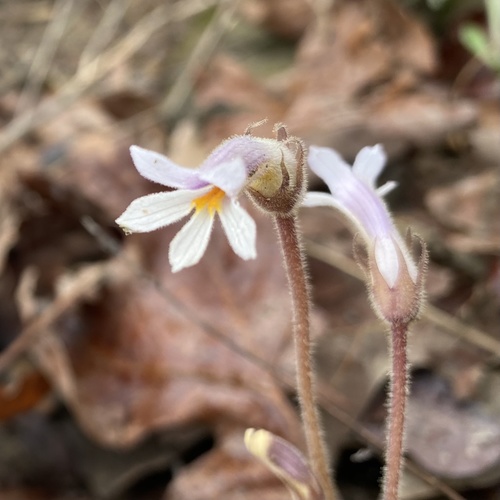
Aphyllon uniflorum var. occidentale Greene, also referenced as Orobanche uniflora, grows 3–10 centimetres (1+1⁄8–3+7⁄8 in) tall. Each stem bears a single purple-to-white five-petaled flower; the corolla is two-lipped, finely fringed, and has five similar lobes. Most of the main stem grows underground, with only flower stalks (pedicels) visible above ground, each holding just one flower. Visible stems are grayish tan, and the plant has no leaves on any part of itself or its offshoots. This plant reproduces via seeds, which develop from a two-section fruit that produces many seeds. It is a non-chlorophyll-producing parasitic plant that obtains nutrients including carbohydrates from the root systems of other plants, most commonly species in the stonecrop genus Sedum. Because it does not produce chlorophyll, it has no green tissues. Botanists have not reached an agreement on whether this plant’s flowers are pollinated by insects or self-pollinate, and the species’ life expectancy is unknown. It closely resembles Orobanche fasciculata, but the two can be distinguished by characteristics of their bracts and flower counts. Bracts are small leaf-like structures found at the junction where each flower stalk attaches to the underground stem: O. uniflora has hairless bracts, while O. fasciculata has hairy bracts. O. uniflora produces one to three flowers per stem branch, versus three to ten flowers per stem branch for O. fasciculata. O. fasciculata also has pinkish to creamy-white flowers, while O. uniflora flowers have a violet tinge. This plant grows in woods, thickets, mountains, and alongside stream banks, and is widespread across much of North America. Unlike other species in the genus Orobanche, O. uniflora is most commonly found in forests. It can survive in both full sun and shaded locations, and grows in a wide range of soil types. Its habitat is limited to areas with abundant host plants, and it is unlikely to survive in areas where its host plants are sparse. One specimen of this species is held in the botany department of the Smithsonian National Museum of Natural History, and another has been photographed in Hells Canyon National Recreation Area. It is classified as rare or vulnerable in 17 U.S. states and five Canadian provinces. In Minnesota, it was listed as Special Concern in 1984, when only seven populations were known to exist, and was reclassified as endangered in 2013.