About Aphyllon franciscanum (Achey) A.C.Schneid.
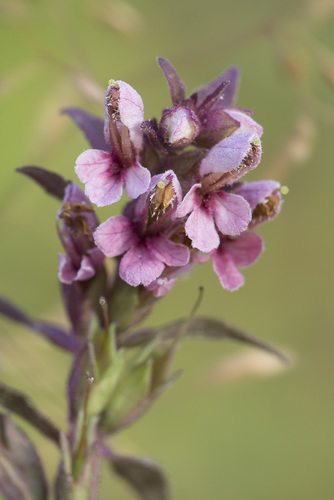
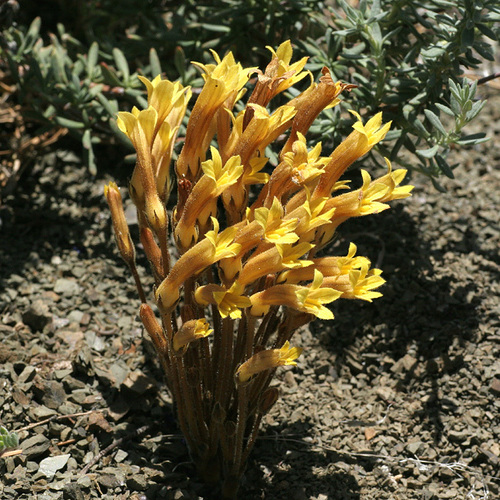
Orobanche fasciculata, commonly known as clustered broomrape, is a broomrape species native to much of western and central North America, ranging from Alaska and the Great Lakes region down to northern Mexico. It grows in many types of habitat. This plant is a parasitic species that grows attached to the roots of other plants, most commonly members of the Asteraceae family such as Artemisia, as well as members of other genera including Eriodictyon and Eriogonum. This species produces one or more stems from a bulbous root, growing erect to a maximum height of about 20 centimeters. Stems, leaves, and five-lobed flowers are all covered in sticky hairs. As a parasite that obtains nutrients from a host plant, it lacks both chlorophyll and a water-storage system. It is variable in color, most often yellowish or purple. Its inflorescence is a raceme holding up to 20 flowers, each borne on a pedicel up to 15 centimeters long. Each flower has a calyx of hairy triangular sepals, and a tubular corolla between 1.5 and 3 centimeters long, which is yellowish or purplish in color. Among the Zuni people, this plant is used as a traditional remedy for hemorrhoids: the whole plant is ground between two stones, and the resulting powder is inserted into the rectum.